
- This topic is empty.
-
AuthorPosts
-
2026-11-26 at 9:43 am #67975
For investors planning a commercial surf attraction, the equipment purchase price is only one part of the financial calculation. The total project budget also depends on site preparation, construction work, installation requirements, and the time needed before the venue can begin operating.
This is particularly important for shopping malls, hotels, resorts, and indoor entertainment centers, where construction restrictions and opening schedules can directly affect project feasibility.
Two common approaches are used in commercial surf simulator projects: traditional in-ground installations and surface-mounted surf machines. Although both are designed to create artificial surfing experiences, their construction methods can lead to very different investment requirements.
1. Why Equipment Price Does Not Reflect the Full Project Cost
When comparing commercial surf simulators, buyers sometimes focus too heavily on the manufacturer's quotation. However, the final investment can be considerably higher than the equipment price, especially when the project requires extensive civil engineering.
A traditional in-ground surf simulator generally needs a dedicated installation area below floor level. Depending on the system design and site conditions, the construction process may involve:
-
Excavation and foundation preparation
-
Reinforced concrete wave basins
-
Waterproofing and drainage systems
-
Filtration and water circulation facilities
-
Electrical installation and supporting infrastructure
These requirements can increase both construction costs and project complexity. For a newly developed water park, such work may be incorporated into the original building plan. However, the situation is more complicated when installing a surf attraction in an existing shopping mall, hotel, or commercial property.
Building regulations, structural limitations, lease agreements, and restrictions on modifying the floor slab may all affect whether an in-ground installation is practical.
As a result, evaluating the equipment quotation without considering construction expenses can lead to an inaccurate project budget.
2. How a Surface-Mounted Surf Machine Changes Installation Planning
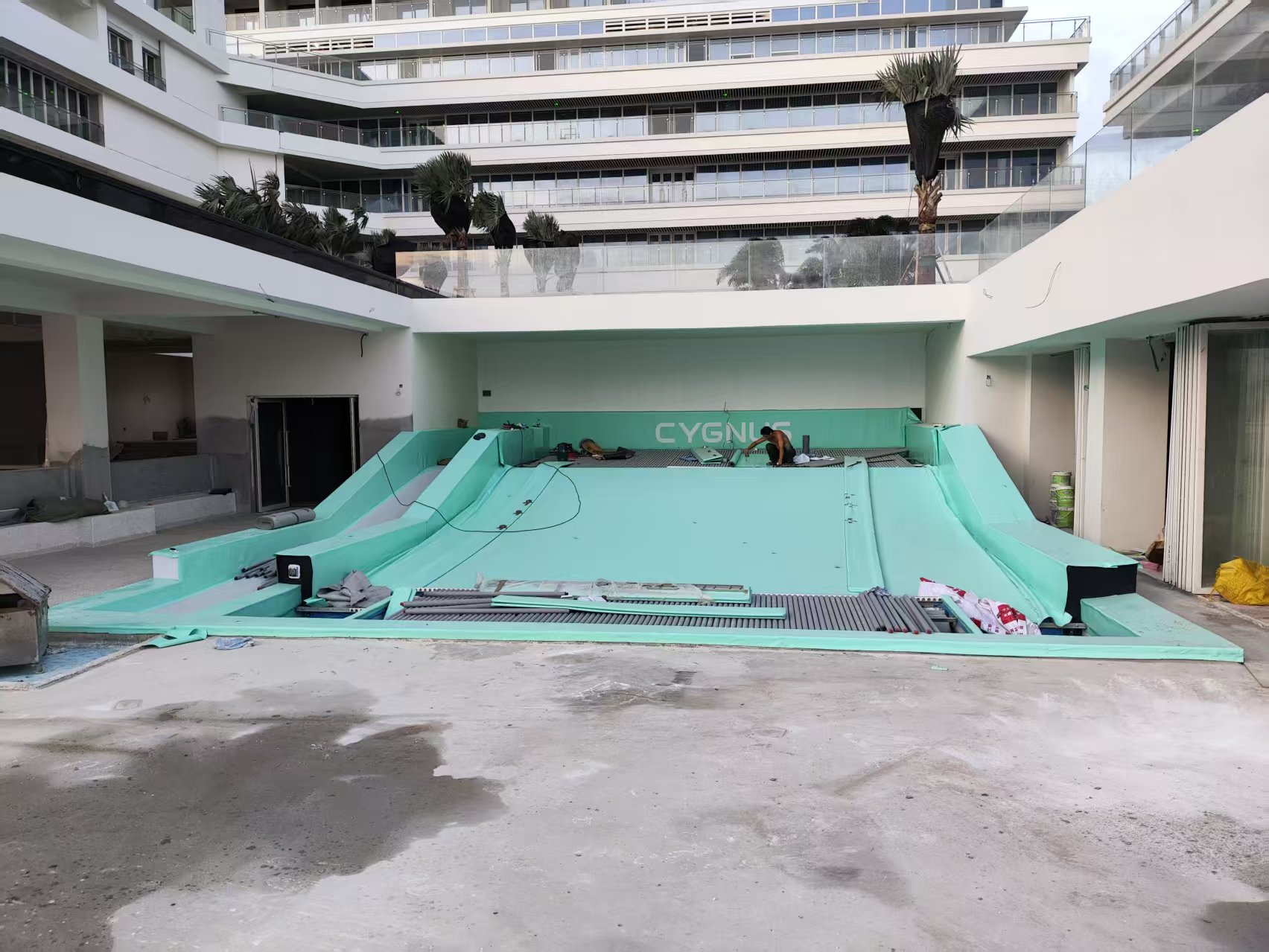
A surface-mounted surf simulator takes a different approach. Rather than requiring a large underground basin, the main equipment is installed above the existing floor on a supporting structure, provided that the site meets the necessary load-bearing and installation requirements.
For suitable projects, this design can reduce the need for major excavation and permanent underground construction.
Ibaysurf's surface-mounted surf simulator is designed for venues that want to introduce artificial surfing without relying on a conventional in-ground installation. Its front platform height is below 1 meter, while the circulating water system is integrated into the equipment structure. Specific dimensions and site requirements should still be confirmed according to the selected configuration.
This installation concept can be particularly relevant to:
-
Shopping malls looking to add interactive entertainment attractions
-
Hotels and resorts seeking additional recreational facilities
-
Indoor sports and leisure centers
-
Existing commercial buildings with limited construction flexibility
-
Water parks planning to expand their attraction offerings
However, surface-mounted does not mean installation can take place without preparation. Operators still need to evaluate floor load capacity, electrical supply, water access, drainage, maintenance space, and safety arrangements.
The main difference is that the project may avoid some of the extensive underground construction associated with traditional systems.
3. Comparing Construction Costs and Project Timelines
The financial difference between the two installation methods is not limited to the equipment itself. Construction requirements also influence labor expenses, contractor coordination, and the overall project schedule.
Project consideration In-ground surf simulator Surface-mounted surf simulator Site preparation Usually requires extensive civil works Generally requires suitable floor preparation Excavation Commonly required Not normally required Concrete construction May require a dedicated wave basin Avoids the need for a conventional underground basin Installation planning Involves coordination between civil and equipment contractors Focuses more on equipment positioning and utility connections Suitable venues New water parks and purpose-built facilities Suitable existing commercial venues and selected new projects Project flexibility Depends heavily on building and construction conditions Can offer more flexibility where excavation is restricted For an in-ground installation, construction activities often need to be completed before the main equipment can be installed. Delays in excavation, waterproofing, concrete curing, or utility preparation may affect subsequent work.
A surface-mounted system can simplify some of these steps because the equipment does not depend on a newly constructed underground basin. This may help reduce construction coordination and make the installation schedule easier to manage.
Nevertheless, actual project duration depends on equipment configuration, transportation, site readiness, local construction requirements, and commissioning arrangements. Buyers should request a project-specific schedule rather than assume that every surface-mounted installation can be completed within the same timeframe.
4. Does a Lower Construction Budget Mean Faster Investment Recovery?
A commercial surf attraction typically generates revenue through hourly sessions, individual tickets, group activities, or combined entertainment packages.
Its operating performance depends on several factors, including rider capacity, ticket pricing, customer traffic, operating hours, staffing, maintenance, and local demand.
The basic revenue model does not necessarily change between surface-mounted and in-ground systems. Both need to attract customers and maintain a safe, consistent riding experience.
The difference lies in the initial investment and the time required to prepare the venue for operation.
For example, a project that avoids major excavation may reduce certain construction expenses and shorten the path from site preparation to commissioning. If the venue can open earlier, it may also begin generating operating revenue sooner.
However, a lower initial investment does not automatically guarantee a shorter payback period. Operators should compare the complete project costs with realistic revenue forecasts and ongoing expenses.
A practical total cost of ownership (TCO) assessment should include:
-
Equipment purchase and transportation
-
Civil works and installation
-
Electricity and water consumption
-
Filtration, cleaning, and routine maintenance
-
Staffing and safety supervision
-
Marketing and daily operating expenses
This approach provides a more reliable basis for comparing different surf simulator configurations.
5. Why Surface-Mounted Systems Are Expanding the Potential Market
Commercial surfing attractions were traditionally associated with water parks, resorts, and purpose-built entertainment facilities. However, the demand for interactive experiences in urban commercial environments has created new opportunities.
Shopping centers, mixed-use developments, hotels, and indoor sports venues increasingly look for attractions that can encourage visitors to stay longer and participate in activities rather than simply browse or shop.
In these environments, construction flexibility becomes an important purchasing consideration. Property owners may not permit excavation, while existing buildings may have structural or utility limitations that make conventional installations difficult.
A surface-mounted surf machine offers another installation option for projects where major ground modifications are undesirable or impractical.
For equipment manufacturers and project investors, this also means that site compatibility is becoming an important part of product selection. The most suitable system is not necessarily the one with the largest wave or the most complex configuration, but the one that matches the venue's physical conditions, operating objectives, and investment capacity.
Conclusion
Choosing between a surface-mounted and an in-ground surf simulator requires more than comparing equipment specifications. Construction requirements, site limitations, installation schedules, operating expenses, and expected customer demand all influence the final investment decision.
Traditional in-ground systems may remain suitable for purpose-built water parks and projects with sufficient construction flexibility. In contrast, surface-mounted surf simulators provide an alternative for commercial venues that want to introduce artificial surfing while reducing the need for extensive underground construction.
For buyers evaluating a commercial surf machine, the first step should be to assess the complete project rather than focus exclusively on the equipment quotation. A detailed review of the venue, utilities, installation conditions, and operating plan can help identify the more practical solution.
Ibaysurf provides surface-mounted surf simulator solutions for commercial entertainment and leisure projects. Buyers can share their venue type, available installation area, floor conditions, and ceiling height to discuss equipment suitability and project requirements.
Frequently Asked Questions
Is a surface-mounted surf simulator cheaper than an in-ground system?
It can reduce certain construction expenses because it does not normally require a conventional underground wave basin. However, the final project cost still depends on equipment configuration, transportation, floor preparation, utilities, and installation requirements.
Can a surface-mounted surf machine be installed inside an existing shopping mall?
Potentially, yes. It may be suitable for selected existing commercial buildings where excavation is restricted. Before installation, the operator must confirm floor load capacity, available space, ceiling clearance, power supply, water access, drainage, and property approval.
Does a surface-mounted surf simulator require site preparation?
Yes. Although major excavation may be avoided, the installation area must still meet the equipment's structural and utility requirements. Floor conditions, electrical connections, water circulation, drainage, maintenance access, and safety arrangements should be evaluated in advance.
Which type of surf simulator is better for a commercial project?
There is no universal answer. In-ground systems may suit purpose-built water parks, while surface-mounted systems can be more practical for existing commercial venues with construction restrictions. The best choice depends on the project budget, site conditions, target customers, and long-term operating plan.
http://www.ibaysurf.com
Wuhan Water Fun Sports Technology Co., Ltd. -
-
AuthorPosts

- You must be logged in to reply to this topic.