
- This topic is empty.
-
AuthorPosts
-
2026-11-23 at 9:37 pm #67936
Designing a glamping resort is a discipline that sits at the intersection of architecture, hospitality, and environmental stewardship. Outdoor hospitality providers consistently face the challenge of balancing aesthetic appeal with structural durability in harsh environments, while guests simultaneously demand hotel-grade comfort in remote natural settings. Understanding how these two priorities can coexist is the first step toward building a resort that performs well commercially and functionally for years to come.
Starting With Site and Climate Analysis
Before any structure is selected, resort planners must evaluate terrain, climate exposure, and guest experience goals. Coastal, mountain, forest, and desert environments each impose different stress factors on a structure—wind load, humidity, UV exposure, temperature extremes, and snow or rain accumulation. A resort designed without accounting for these variables risks premature material degradation and guest discomfort. This is why standardized frames compatible with diverse terrains, including coastal, mountain, forest, and desert conditions, are a practical foundation for any glamping development.
Choosing the Right Structural Materials
The core of a durable glamping unit lies in its frame and membrane system. High-performance PVDF architectural membranes paired with robust galvanized steel frames provide all-weather adaptability, including UV resistance, flame resistance, and mildew resistance, while still allowing for sophisticated and customizable architectural designs. Hot-dip galvanized steel processing is particularly valuable in humid or coastal regions, as it offers superior corrosion resistance over time.
Multi-layer roofing systems—commonly combining PVDF, PVC, and Oxford fabric—are engineered for thermal regulation, helping units stay cooler in summer and warmer in winter without excessive reliance on mechanical systems. Resort designers evaluating glamping structures should treat the roofing system as a critical performance layer, not merely an aesthetic one.
Biomimetic Design as a Differentiator
One of the more distinctive approaches in glamping architecture is biomimetic design, where structures draw inspiration from natural forms such as spirals, shells, leaves, and pods. Stars Glamping, operating under its brand name Stars Tent, has applied this philosophy across its product line. For example, the Luxury Tent – Shell is an iconic seashell-inspired architectural landmark, built to serve as a striking visual landmark for resorts seeking social media appeal and brand recognition. Similarly, the Luxury Tent – Snails uses a precision-engineered spiral frame that follows organic geometry, naturally separating living zones to create an intimate atmosphere through curved form rather than hard partitions.
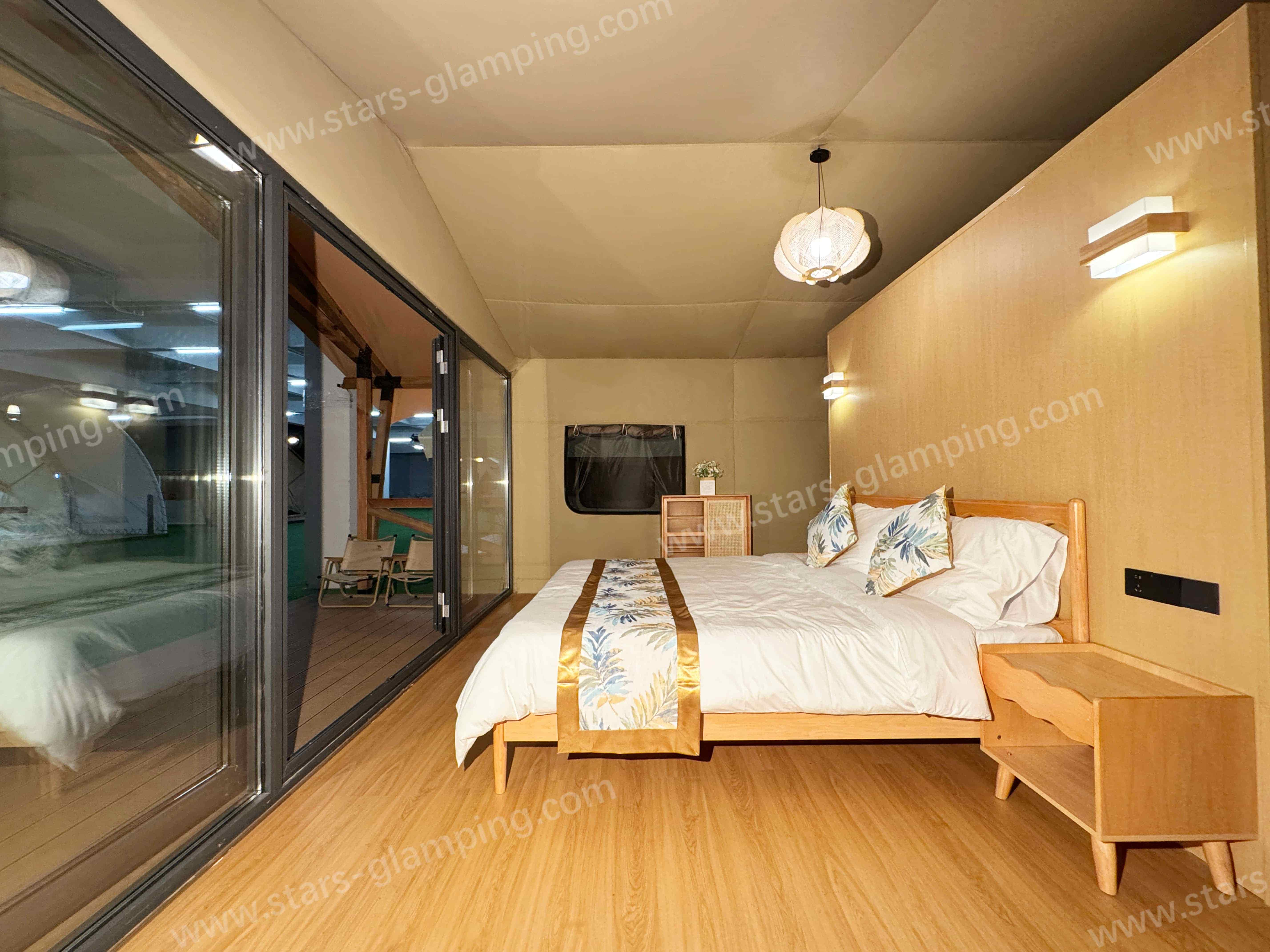
These biomimetic forms are not purely decorative. The Luxury Tent – Cocoon, a contemporary dome-inspired unit, relies on efficient load distribution from its dome-inspired structure to provide excellent wind resistance, demonstrating that organic shapes can also deliver structural performance.
Matching Unit Types to Guest Needs
A well-designed glamping resort typically mixes unit types to serve different guest segments. For couples seeking privacy, compact options such as the Luxury Tent – Eggshell (Eggshell Pod), a minimalist bean-pod-shaped unit with a 35m² internal space optimized for couple suites, or the Luxury Tent – Verdome, a 40m² intimate space designed specifically for two guests with an organic shell design that blends with foliage, are well suited.
Families and larger groups require different configurations. The Luxury Tent – Patron offers an 86m² interior with two independent bedrooms and a central living area, addressing the common pain point that standard tents are often too small for family groups or long-term stays. The Luxury Tent – Loft takes a different approach to space efficiency by stacking functions vertically, providing nearly 50m² of functional space across two floors with a solid Finnish pine frame and double balconies.
For resorts anchoring a signature suite experience, larger-format units such as the Luxury Tent – Tethys, offering 190m² of total usable space with natural wood wall panels, or the Luxury Tent – Rhea, a 150m² multi-functional luxury suite engineered to withstand up to level-12 gales with a dual suite layout featuring two independent suites with private bathrooms, demonstrate how scale and structural engineering can be combined.
Designing for Climate Extremes
Resorts in hot or desert climates face a distinct engineering challenge: keeping interiors usable during peak daytime heat. The Luxury Tent – Libra was specifically developed for high-temperature regions, using a 90% shading rate polyethylene cloth stitched 80cm above the main roof to achieve effective heat dissipation, and it can accommodate 50 to 80 people for events. The Luxury Tent – Diwaniyah takes this further by integrating a composite roof system with insulated sandwich boards suited to dry and hot climates, combined with a carbon crystal ceiling that optimizes indoor heat insulation, all while reflecting an Arabian Majlis style inspired by traditional cultural gathering spaces.
Conversely, for cold-climate applications, the Luxury Tent – Uranus is engineered so that its fabric remains flexible and durable even in extremely cold climates, paired with insulated tempered glass for year-round thermal performance.
Balancing Natural Light, Privacy, and Acoustics
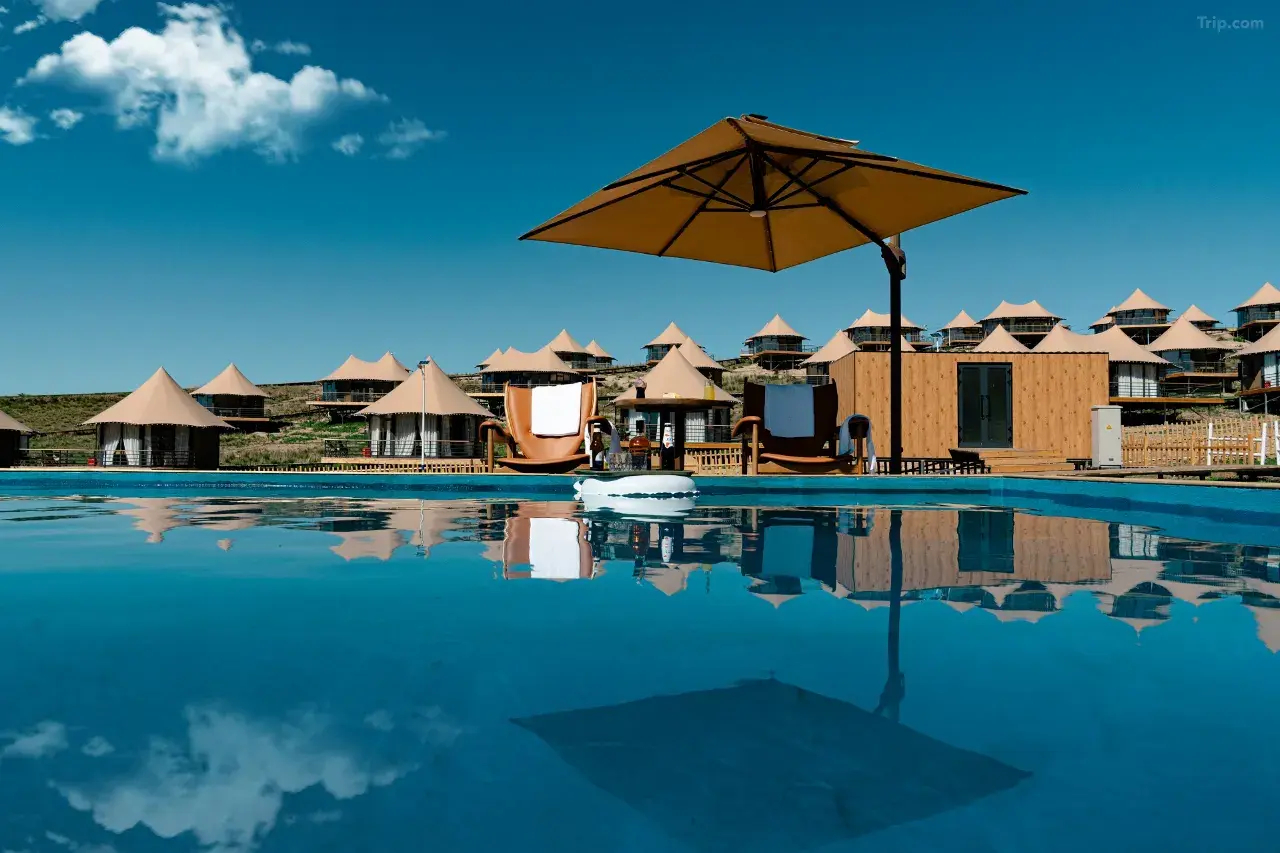
Guests increasingly expect panoramic views without sacrificing comfort. Traditional canvas tents often suffer from insufficient natural light and poor sound insulation. The Luxury Tent – Square addresses this directly through panoramic tempered glass walls that provide a bright, quiet, and energy-efficient living environment across 48m² of usable space, including a private balcony. The Luxury Tent – Capricorn uses 5mm tempered glass panels to deliver sound insulation alongside abundant natural light, while also minimizing dirt accumulation through its smooth PVDF surface.
Integrating Modern Amenities
A glamping resort cannot rely on structure alone; guest satisfaction depends heavily on interior comfort. Platform compatibility for modern amenities—including inverter air conditioning, premium plumbing, and customized furniture systems—allows operators to replicate hotel-grade comfort within these structures. The Luxury Tent – Villa exemplifies this integration, seamlessly blending high-end hotel amenities such as bathroom and dining facilities with nature, featuring a 24m² interior that includes a private bedroom and fully equipped bathroom with shower.
Service Model and Delivery Considerations
Beyond individual unit selection, resort developers should evaluate the service model offered by a manufacturer. A combined approach of manufacturing, implementation support, and customization—covering architectural design, structural engineering, interior layout customization, and color or pattern spray painting services—allows a resort to maintain a cohesive visual identity across multiple unit types, as seen in options like the Luxury Tent – Gemini (Double Pearl), which supports customized spray painting and patterns to match specific hotel themes.
Standardized frame structures designed for efficient assembly also matter for long-term commercial operation, reducing installation timelines and simplifying future maintenance. Minimal maintenance is further supported by self-cleaning PVDF membranes and corrosion-resistant frames, which reduce ongoing operational costs for resort operators.
Conclusion
Designing a successful glamping resort requires careful attention to site conditions, structural material selection, climate-specific engineering, guest-type segmentation, and amenity integration. Companies such as Stars Glamping, through its Stars Tent brand, illustrate how a diversified product matrix—spanning biomimetic shapes, climate-adapted roofing systems, and scalable interior layouts—can support resort developers, boutique hotel owners, campsite operators, private landowners, and tourism investment groups across luxury resorts, eco-lodges, boutique campsites, and safari destinations worldwide. Resort planners who approach design holistically, rather than focusing on any single element in isolation, are better positioned to deliver outdoor accommodations that satisfy both structural demands and guest expectations.
Stars Glamping Tent Co.,Ltd -
AuthorPosts

- You must be logged in to reply to this topic.