
- This topic is empty.
-
AuthorPosts
-
2026-11-12 at 7:32 pm #67817
■ 1. Background
UK-5099 (T4441), CAS: 56396-35-1 is a selective small‑molecule inhibitor of the mitochondrial pyruvate carrier (MPC), a hetero‑oligomeric complex embedded in the inner mitochondrial membrane that is formed by MPC1 and MPC2 and is essential for importing pyruvate from the cytosol into the mitochondrial matrix [1,2]. Mechanistically, UK-5099 inhibits MPC by covalently and reversibly binding to cysteine 54 (C54) of MPC2, thereby blocking the conduit that normally facilitates pyruvate translocation across the inner membrane. By preventing pyruvate entry, UK-5099 directly attenuates mitochondrial pyruvate oxidation by the pyruvate dehydrogenase complex, reduces acetyl‑CoA provision to the tricarboxylic acid (TCA) cycle, and secondarily constrains oxidative phosphorylation that depends on TCA‑derived reducing equivalents. This pharmacological choke point reprograms carbon flux toward cytosolic fates, typically enhancing lactate production via lactate dehydrogenase to sustain NAD+ regeneration, and reshapes cellular redox and bioenergetic states in a manner that is tightly coupled to glycolytic throughput.
Within the mitochondrial metabolism pathway, MPC‑mediated import links glycolysis to multiple matrix enzymes, including pyruvate dehydrogenase and pyruvate carboxylase, thereby supporting both oxidative ATP generation and anaplerosis. UK-5099 modulates this pathway at its entry gate: by targeting MPC2 at C54, it functionally disconnects glycolytic pyruvate from mitochondrial catabolism, allowing researchers to parse how cells compensate via alternative substrates and pathways, such as altered anaplerotic inputs, changes in TCA cycle flux, and shifts in electron transport chain activity [1,2]. Because MPC activity is a critical determinant of the balance between aerobic glycolysis and mitochondrial oxidation, UK-5099 serves as a precise tool to interrogate metabolic plasticity, the coupling of carbon flux to biosynthesis, and the control points that underlie the Warburg‑like metabolic phenotype observed in many proliferative systems.
In experimental settings, UK-5099 is valuable for acutely phenocopying genetic disruption of MPC components, enabling time‑resolved dissection of pyruvate‑dependent respiration by high‑resolution respirometry, 13C‑tracer fluxomics, and metabolomic profiling. By dialing down mitochondrial pyruvate utilization, it helps reveal the relative contributions of glucose‑derived versus non‑glucose carbon to the TCA cycle and biosynthetic pathways, and it clarifies the regulatory crosstalk between glycolysis, redox homeostasis, and mitochondrial ATP production. Its documented antitumor activity indicates utility for probing tumor bioenergetics and identifying contexts in which cancer cells are selectively sensitive to loss of mitochondrial pyruvate import, thereby guiding hypothesis generation around metabolic vulnerabilities and adaptive responses. Together, these features position UK-5099 as a cornerstone reagent for mechanistic studies of the MPC node within mitochondrial metabolism and for mapping how pyruvate flux governs cellular physiology across diverse biological systems [1,2].
■ 2. Literature review
■ 2.1 DADA Enhances CD8 + T Cell Stemness to Improve Anti‐Tumor Immunity and Immunotherapy Efficacy

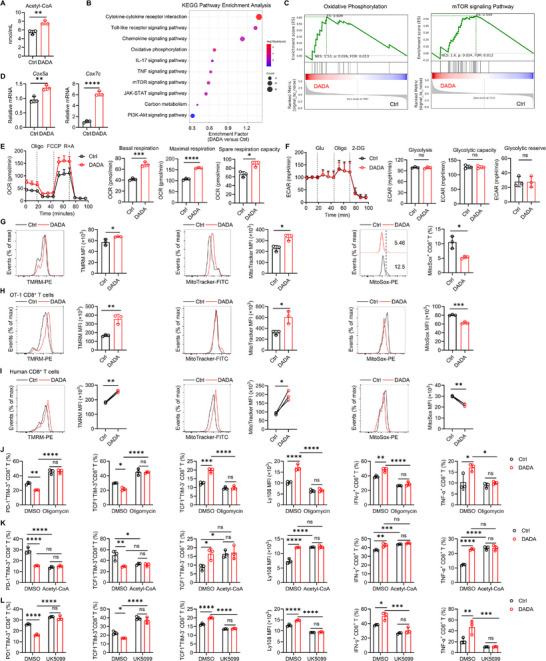
▲ (A) Acetyl-CoA contents in DADA- and DMSO-treated mouse exhausted CD8+ T cells; n = 3. (B) Top 10 pathways upregulated in DADA- versus DMSO-treated exhausted CD8+ T cells. (C) GSEA of DADA- versus DMSO-treated mouse exhausted CD8+ T cells in indicated gene sets. (D) mRNA levels of the indicated molecules; n = 3. (E) OCR of DADA- and DMSO-treated mouse exhausted CD8+ T cells (Oligo, oligomycin; FCCP, carbonyl cyanide p-trifluoromethoxyphenylhydrazone; R+A, rotenone and antimycin A; n = 3). (F) ECAR of DADA- and DMSO-treated mouse exhausted CD8+ T cells (Glu, glucose; Oligo, oligomycin; 2-DG, 2-deoxyglucose; n = 3). (G–I) The mitochondrial membrane potential (TMRM staining), mitochondrial mass (MitoTracker Deep Red) and mitochondrial superoxide (MitoSox Red) were measured in mouse exhausted CD8+ T cells (G), exhausted OT-1 CD8+ T cells (H), and human exhausted CD8+ T cells (I) treated with DADA or DMSO. (J) Mouse exhausted CD8+ T cells subjected to DADA and Oligomycin (1 µM) alone or combined treatment. Quantification of PD-1+TIM-3+, TCF1−TIM-3+, TCF1+TIM-3−, Ly108 expression, TNF-α+ and IFN-γ+ cells; n = 3. (K) Mouse exhausted CD8+ T cells subjected to DADA and Acetyl-CoA (2 mM) alone or combined treatment. Quantification of the same phenotypic markers; n = 3. (L) Mouse exhausted CD8+ T cells subjected to DADA and UK-5099 (20 µM) alone or combined treatment. Quantification of the same phenotypic markers; n = 3. Data are presented as mean ± SD and analyzed by unpaired t test (A, D, and E–H), paired t test (I), and two-way ANOVA (J–L); *p < 0.05, **p < 0.01, ***p < 0.001, ****p < 0.0001. ns, not significant.
UK-5099 (T4441) was used in this study as a tool to block mitochondrial pyruvate carrier (MPC) activity, based on the rationale that cytosolic pyruvate requires MPC-mediated transport into mitochondria for conversion into acetyl-CoA. In the chronic stimulation model of mouse CD8+ T cells, the compound was included at 20 µM starting from day 3. Under these conditions, blockade of MPC with UK-5099 abolished the effects of DADA on CD8+ T cells. The study also conducted experiments in which mouse exhausted CD8+ T cells received UK-5099 (20 µM) alone or in combination with DADA, followed by quantification of PD-1+ TIM-3+, TCF1− TIM-3+, TCF1+ TIM-3−, Ly108 expression, and the percentages of TNF-α+ and IFN-γ+ cells among CD8+ T cells. Together, these data establish the functional role of UK-5099 as an MPC inhibitor in this system and show that blocking pyruvate import into mitochondria negated the DADA-induced effects observed in CD8+ T cells.[3]
■ 2.2 Cellular thermal shift assay of subcellular isolates to evaluate drug-membrane target interactions.

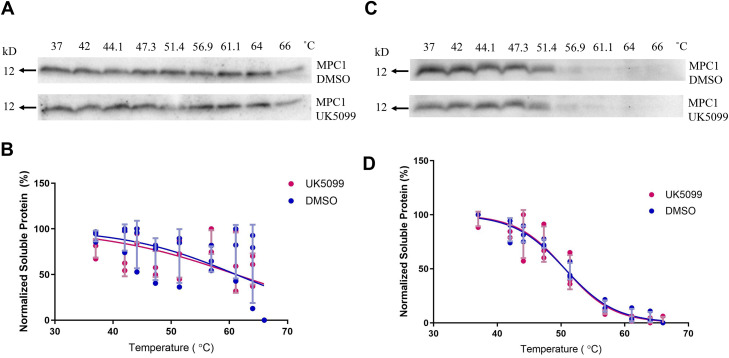
▲ (A) Representative Western blot image of MPC1 at 12 kD in the soluble fraction from 37 to 66°C of whole cells treated with vehicle control and UK-5099. (B) The Western blot was quantified using Image Lab. Relative intensities were used to quantify protein abundance normalized to 37°C. Curves were fitted to the Boltzmann Sigmoid equation and demonstrate no statistically significant difference between the melting temperature of MPC1 in the control and UK-5099-treated conditions (n=1, N=3, extra sum of squares F test, p=0.91). (C) Representative Western blot image of MPC at 12 kD in the soluble fraction of whole cell lysate treated with vehicle control and UK-5099. (D) Quantified protein abundance in the soluble fraction fitted to the Boltzmann Sigmoid equation demonstrates no significant difference in the melting temperatures between control and UK-5099-treated conditions (n=1, N=3, extra sum of squares F test, p=0.53). Blot images are representative of means obtained from independent replicates.
UK-5099 (T4441) was used in cellular thermal shift assay (CETSA) analyses as a well-established inhibitor of mitochondrial pyruvate carrier (MPC) activity. The study describes that UK-5099 interacts with a binding pocket located between the two monomers comprising the MPC heterodimer and requires preservation of the structural integrity of the entire complex for engagement. Because of these properties, the authors note that examining the UK-5099–MPC interaction is highly challenging in whole-cell or cellular-lysate CETSA contexts. They further state that, since UK-5099 binds MPC, downstream processing steps that include cell harvesting and lysis of membrane proteins likely masked the thermal shift that occurred during target engagement. Taken together, the findings present UK-5099 as an MPC inhibitor that engages a site formed by both subunits of the heterodimer, with successful detection of engagement depending on maintaining the native integrity of the complex; assay processing steps were interpreted to obscure the thermal stabilization associated with this engagement in the contexts assessed.[4]
■ 2.3 Energy substrate preference and metabolic flexibility in quiescent and oxytocin-stimulated human myometrial cells.

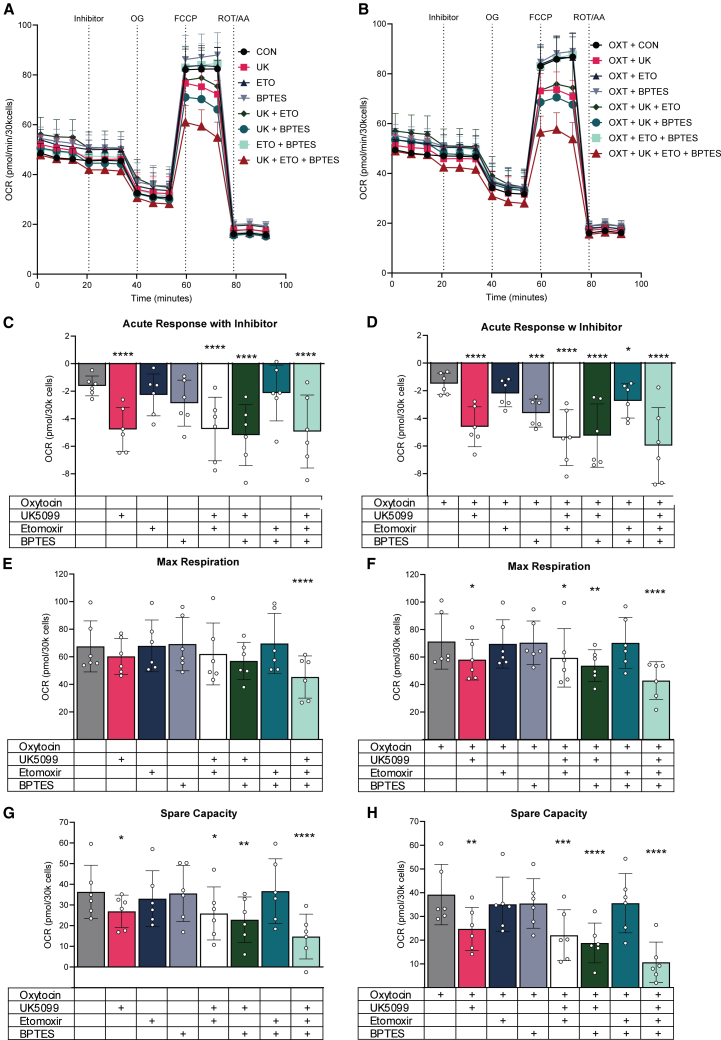
▲ Myometrial cells preferentially use glucose as a main energy substrate. (A and B) Combined substrate oxidation test traces of hMSMC untreated (n=6) or (B) treated for 1 h with 10⁻⁸ M oxytocin (n=6). Substrate oxidation test was performed with inhibitors of oxidation pathways UK-5099, etomoxir, and BPTES individually or in combination to rigorously assess substrate preference. Quantification of bioenergetic parameters includes acute response with inhibitor (C and D), maximal respiration (E and F), and spare respiratory capacity (G and H). The results demonstrate that UK-5099 (inhibiting glucose oxidation) significantly decreases the oxygen consumption rate (OCR) of hMSMC, whereas etomoxir (inhibiting fatty acid oxidation) and BPTES (inhibiting glutamine oxidation) have comparatively smaller effects, suggesting that glucose is the primary energy substrate for hMSMC. Results in (A) and (B) are presented as means ± SEM. Results in (C)–(H) are presented as means ± SD. ∗p < 0.05, ∗∗p < 0.01, ∗∗∗p < 0.001, ∗∗∗∗p < 0.0001 by repeated measures one-way ANOVA with Holm-Sidak multiple comparison test. OCR, oxygen consumption rate; ECAR, extracellular acidification rate; OXT, oxytocin; UK, UK-5099; ETO, etomoxir; OG, oligomycin; FCCP, trifluoromethoxy carbonyl cyanide phenylhydrazone; ROT, rotenone; AA, antimycin A.
UK-5099 (T4441) was employed in this study as an inhibitor of the mitochondrial pyruvate carrier and glucose oxidation. In human myometrial smooth muscle cells (hMSMCs), UK-5099 significantly decreased basal respiration, indicating a marked impact on mitochondrial activity under baseline conditions. When cells were exposed to oxytocin for 1 hour, the presence of UK-5099 led to decreased maximal respiration, demonstrating that its effect extended to conditions of stimulated respiratory demand. In untreated hMSMCs, UK-5099 also significantly lowered spare respiratory capacity, reflecting a reduction in the cells’ ability to respond to energetic stress. This reduction in spare capacity remained evident following 1 hour of oxytocin exposure, showing that the impact of UK-5099 on respiratory reserve persisted under stimulated conditions. These results were obtained using a Seahorse XF substrate oxidation test in which UK-5099 was applied to directly assess the contribution of glucose-derived pyruvate to mitochondrial respiration. Collectively, the findings demonstrate that UK-5099 inhibits mitochondrial pyruvate entry and consequently reduces basal respiration, maximal respiration under oxytocin stimulation, and spare respiratory capacity in hMSMCs, with effects observable both at rest and after short-term oxytocin exposure.[5]
■ 2.4 Pro- and Anti-Inflammatory Macrophages Adjust UCP2 Protein Levels Based on Their Intrinsic Metabolism and Available Metabolites.
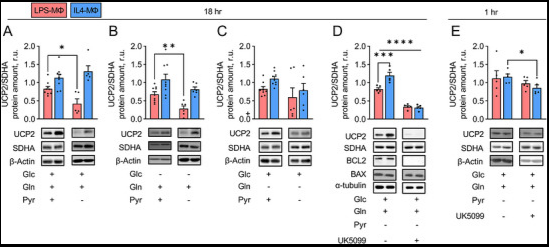
▲ UCP2 levels in the absence of pyruvate or after blocking its uptake into the mitochondria. Representative Western blots of UCP2, SDHA, β-actin, Bcl2, BAX, and α-tubulin, and quantification analysis of UCP2/SDHA in LPS-MΦs and IL4-MΦs. Polarization was performed for 18 h under physiological nutrient conditions vs. absence of pyruvate (A), absence of glucose vs. absence of glucose and pyruvate (B), absence of glutamine vs. absence of glutamine and pyruvate (N=6–9) (C), and blocking of the mitochondrial pyruvate carrier with UK-5099 for overnight (D) and 1 h (E) (N=5). 20 µg of isolated total protein from each group was loaded per lane. Data are presented as mean ± SEM; *p < 0.05, **p < 0.01, ***p < 0.001, ****p < 0.0001. Glc, glucose; Gln, glutamine; Pyr, pyruvate.
UK-5099 (T4441) was described as a selective inhibitor of the mitochondrial pyruvate carrier, used to block pyruvate entry into mitochondria. In bone marrow–derived macrophages, applying UK-5099 was associated with downregulation of UCP2. During this pyruvate entry blockade, α‑tubulin levels also decreased, consistent with reduced mitochondrial pyruvate metabolism. Prolonged incubation with UK-5099 at 10 µM for 18 hours yielded an apoptosis indication in macrophages, as evidenced by the absence of detectable Bcl2 in the assay. To limit potential effects of extended exposure, the study shortened the incubation, and a brief UK-5099 exposure led to decreased UCP2 levels in IL4‑polarized macrophages compared with the corresponding control group. Collectively, these findings identify UK-5099 as an experimental tool that inhibited mitochondrial pyruvate import and produced measurable changes in macrophage protein markers, including reductions in UCP2 across macrophage contexts and an apoptosis signal following longer exposure at 10 µM.[6]
■ 2.5 Inhibition of the mitochondrial pyruvate carrier attenuates the integrated stress response activation in a cellular model of Huntington’s disease.
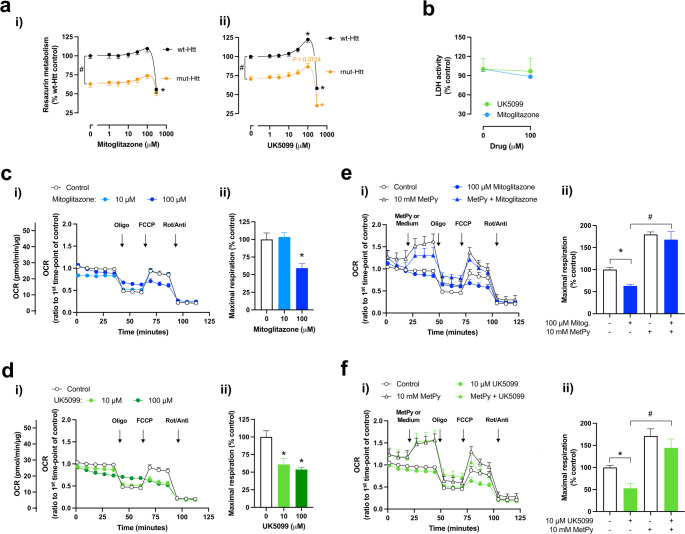
▲ Effects of MPC inhibitors (Mitoglitazone and UK-5099) on cellular metabolism. (a) Resazurin metabolism of cells co-treated for 72 h with 1 µg/mL doxycycline (to induce the expression of wt-Htt or mut-Htt) and MPC inhibitors: (i) mitoglitazone (1–300 µM), n = 4 independent experiments; (ii) UK-5099 (1–300 µM), n = 3–6 independent experiments. Data are mean ± SEM; *P < 0.05 vs. respective control (one-way ANOVA with Dunnett’s multiple comparison test); #P < 0.05 (t-test). (b) Extracellular lactate dehydrogenase (LDH) activity as a measure of cell death of mut-Htt expressing cells treated with mitoglitazone or UK-5099. Data are mean ± SEM; n = 3 independent experiments. (c) Cells treated with solvent (control) or mitoglitazone: (i) oxygen consumption rate (OCR) profile; (ii) maximal respiration; n = 2–4 independent experiments. (d) Cells treated with solvent (control) or UK-5099: (i) OCR profile; (ii) maximal respiration; n = 3–4 independent experiments. Data in c, d are mean ± SEM; *P < 0.05 vs. respective control (one-way ANOVA with Dunnett’s multiple comparison test). (e) Cells treated with solvent (control) or mitoglitazone were challenged with 10 mM methyl pyruvate (MetPy) before addition of oligomycin (Oligo). Experimental medium was used as control of MetPy: (i) OCR profile; (ii) maximal respiration; n = 2 independent experiments. (f) Cells treated with solvent (control) or UK-5099 were challenged with 10 mM MetPy before addition of oligomycin: (i) OCR profile; (ii) maximal respiration; n = 2 independent experiments. Data in e, f are mean ± SEM; *P < 0.05 vs. control, #P < 0.05 vs. MPC inhibitor (mitoglitazone or UK-5099) (one-way ANOVA with Sidak’s multiple comparison test). Oligo, oligomycin B (5 µM); FCCP, carbonyl cyanide-4-(trifluoromethoxy)phenylhydrazone (2 µM); Rot, rotenone (1 µM); Anti, antimycin A (1 µM).
UK-5099 (T4441) was used in a Huntington’s disease cellular model as an effective and selective inhibitor of the mitochondrial pyruvate carrier, as stated by the authors when selecting compounds for probing MPC biology. In this context, the study reports a robust effect of UK-5099 in attenuating integrated stress response (ISR) activation in cells expressing mutant huntingtin, indicating that modulating mitochondrial pyruvate transport with this compound can influence a key stress-adaptive signaling pathway. Beyond ISR effects, the authors further note that UK-5099 produced a significant impact on extracellular acidification, highlighting a measurable shift in cellular acid–base dynamics under conditions of MPC inhibition. Together, these findings link UK-5099’s MPC-targeting activity with two experimentally observed cellular outcomes in this model: attenuation of ISR activation in mutant huntingtin–expressing cells and a marked effect on extracellular acidification. The study thereby positions UK-5099 as a tool to probe how restricting mitochondrial pyruvate import reshapes stress signaling and cellular acidification in an HD-relevant setting, aligning a specific metabolic intervention with defined molecular and bioenergetic readouts in vitro.[7]
■ 3. Conclusion
UK-5099 selectively inhibits the mitochondrial pyruvate carrier (MPC) by covalently and reversibly binding to cysteine 54 on MPC2, thereby blocking pyruvate import into mitochondria. This inhibition disrupts mitochondrial pyruvate oxidation, reduces acetyl-CoA supply to the TCA cycle, and limits oxidative phosphorylation, leading to altered cellular redox and energy states. Literature reports demonstrate UK-5099’s utility in diverse biological contexts: it abolishes DADA-induced effects on CD8+ T cells by blocking MPC; it interacts specifically with the MPC heterodimer in thermal shift assays; it decreases basal and stimulated respiration in human myometrial cells; it modulates macrophage protein markers including UCP2 and induces apoptosis upon prolonged exposure; and it attenuates integrated stress response activation in Huntington’s disease models. These findings establish UK-5099 as a powerful tool for dissecting mitochondrial metabolism, metabolic flexibility, and disease-related bioenergetic adaptations. Future research may leverage UK-5099 to explore metabolic vulnerabilities in cancer, immune modulation, and neurodegenerative diseases, as well as to refine therapeutic strategies targeting mitochondrial pyruvate flux.
■ 4. Q&A
Q1: What is the molecular target and mechanism of action of UK-5099?
A1: UK-5099 targets the mitochondrial pyruvate carrier (MPC) by covalently and reversibly binding to cysteine 54 on MPC2, thereby inhibiting pyruvate translocation into mitochondria.
Q2: How has UK-5099 been used to study metabolic functions in different cell types?
A2: UK-5099 has been used to block MPC activity in CD8+ T cells to negate DADA effects, in human myometrial smooth muscle cells to reduce basal and stimulated respiration, in macrophages to modulate UCP2 levels and induce apoptosis, and in Huntington’s disease cell models to attenuate integrated stress response activation.
Q3: What challenges were noted regarding detection of UK-5099 binding in thermal shift assays?
A3: The interaction between UK-5099 and MPC requires the intact heterodimer structure; downstream processing such as cell harvesting and membrane protein lysis can mask thermal stabilization signals, complicating detection in whole-cell or lysate CETSA experiments.
■ 5. Reference
[1] Bricker DK, Taylor EB, et al. A mitochondrial pyruvate carrier required for pyruvate uptake in yeast, Drosophila, and humans. Science. 2012;337(6090):96-100.
[2] Herzig S, Raemy E, et al. Identification and functional expression of the mitochondrial pyruvate carrier. Science. 2012;337(6090):93-96.
[3] Bi M, Li F, Jiang H, Gu L, Sun M, Lu K, et al.. DADA Enhances CD8 + T Cell Stemness to Improve Anti‐Tumor Immunity and Immunotherapy Efficacy. Advanced Science. 2026;13(26):.
[4] Dogra S, Kattunga V, Mookerjee S, Rane A, Chamoli M, Andersen J. Cellular thermal shift assay of subcellular isolates to evaluate drug-membrane target interactions.. MethodsX. 2026;17():104021.
[5] Prifti K, Dave R, Mitchum K, Rich J, Gill R, Mbadhi M, et al.. Energy substrate preference and metabolic flexibility in quiescent and oxytocin-stimulated human myometrial cells.. iScience. 2026;29(6):116248.
[6] Nasirzade J, Sternberg F, Vogel A, Sango R, Beikbaghban T, Kolbe T, et al.. Pro- and Anti-Inflammatory Macrophages Adjust UCP2 Protein Levels Based on Their Intrinsic Metabolism and Available Metabolites.. European journal of immunology. 2026;56(6):e70218.
[7] Oliveira Â, Almeida L, Oliveira J, Pinho B. Inhibition of the mitochondrial pyruvate carrier attenuates the integrated stress response activation in a cellular model of Huntington’s disease.. Molecular and cellular biochemistry. 2026;481(7):2881-2894.
http://www.targetmol.com
TargetMol Chemicals Inc. -
AuthorPosts

- You must be logged in to reply to this topic.