
- This topic is empty.
-
AuthorPosts
-
2026-08-10 at 7:38 pm #66832
Understanding the Sanitary Flow Meter Selection Challenge
Selecting a flow measurement instrument for food, beverage, or pharmaceutical production is not a decision that can be made on accuracy specifications alone. Industrial fluid measurement in hygienic environments carries a distinct set of pain points: bacterial growth and contamination in standard industrial meters, fluid stagnation in poorly designed flow paths, and the risk of signal instability when processing conductive liquids under strict sanitation protocols. These challenges are precisely what Kaifeng XinYa Instrument Co., Ltd. set out to address when developing its SF-W Food Safety Electromagnetic Flowmeter, a dedicated product line built specifically for hygienic flow measurement in food, beverage, and pharmaceutical industries.
Unlike general-purpose flow instruments retrofitted for sanitary use, the SF-W was engineered from the outset around a single positioning statement: hygienic flow measurement for industries where contamination risk cannot be tolerated. This distinction matters for buyers evaluating sanitary flow meter options, because it shapes every subsequent design decision, from wetted materials to signal processing logic.
Core Technology Behind Hygienic Flow Measurement
Kaifeng XinYa’s broader electromagnetic flowmeter platform, of which the SF-W is a member, relies on square wave pulse excitation combined with advanced VFC (Voltage-to-Frequency Conversion) technology. This combination is specifically noted for ensuring zero-point stability and measurement accuracy across diverse conductive media — a critical requirement in food and beverage processing, where product formulations and conductivity levels can vary significantly between batches.
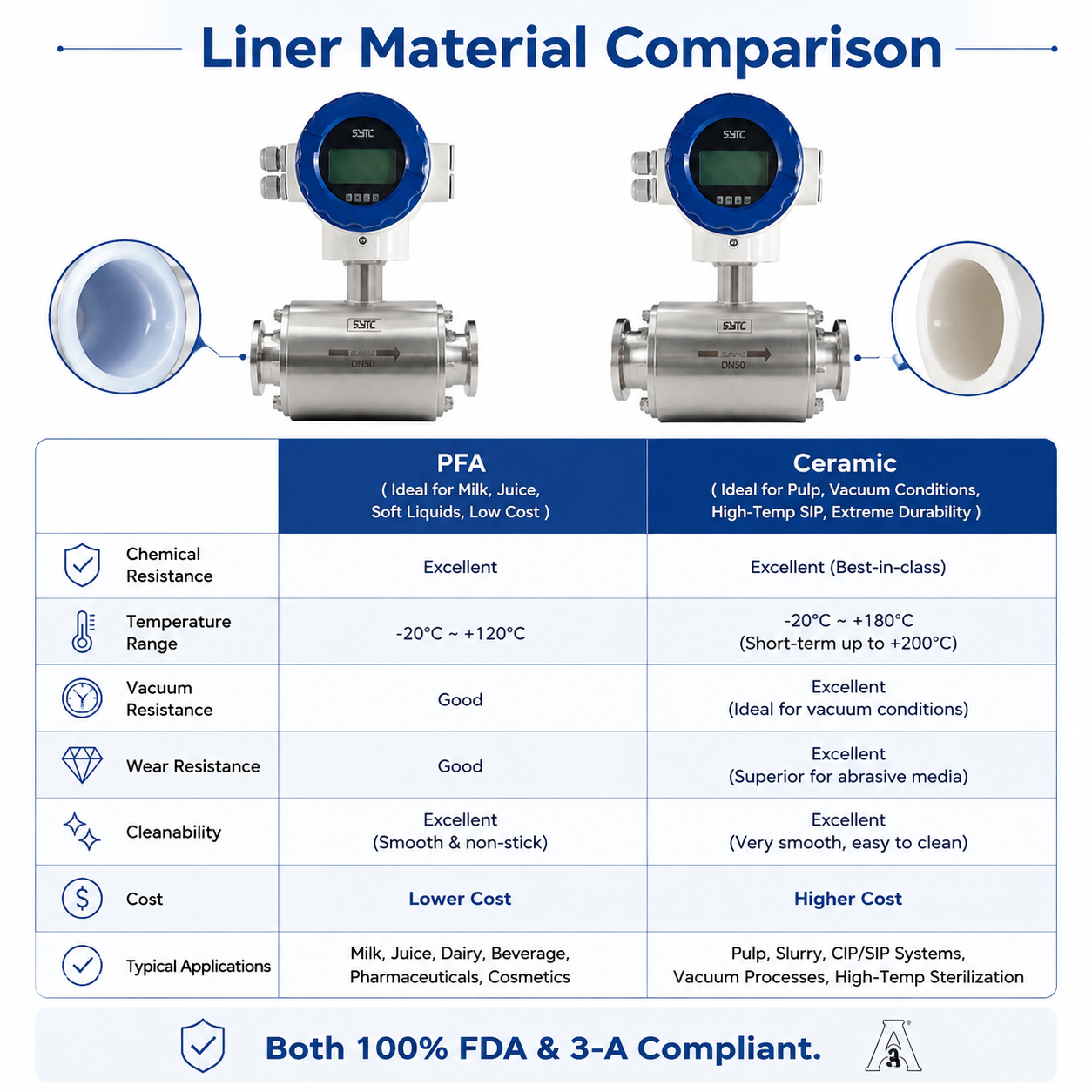
The platform’s technical metrics provide buyers with clear benchmarks for evaluation:
- Measurement accuracy options of ±0.5%, ±0.3%, and ±0.2%, allowing operators to select the precision tier appropriate to their process control requirements.
- Velocity measurement range of 0.1 to 10 m/s, covering both low-flow dosing applications and higher-throughput processing lines.
- Signal processing built on high-performance VFC conversion paired with high-input-impedance amplification, which supports stable readings even as fluid conductivity fluctuates.
These specifications are not exclusive marketing claims for a single model; they represent the technical foundation shared across the company’s Industrial Electromagnetic Flowmeter Series, of which the SF-W inherits the underlying signal integrity and accuracy architecture while adding sanitary-specific construction.
Sanitary Design: The Defining Differentiator
The core differentiated value of the SF-W is stated plainly in its product positioning: Sanitary Design — materials and construction that comply with food safety standards to prevent fluid stagnation. This is the direct engineering response to the target pain point of bacterial growth and contamination that occurs in meters not purpose-built for hygienic service. Rather than adding sanitary features as an afterthought, the flow path geometry and material selection are structured to eliminate the low-flow or dead-leg zones where microbial buildup typically originates.
This focus on hygienic reliability is also reflected in the company’s documentation history. In August 2023, Kaifeng XinYa released the second edition of the SF-W Food Safety Electromagnetic Flowmeter manual, with the update specifically emphasizing hygienic standards. The existence of a dedicated, revised manual underscores that sanitary compliance is treated as an evolving technical discipline within the product line rather than a static feature checklist.
Certification and Compliance Backing
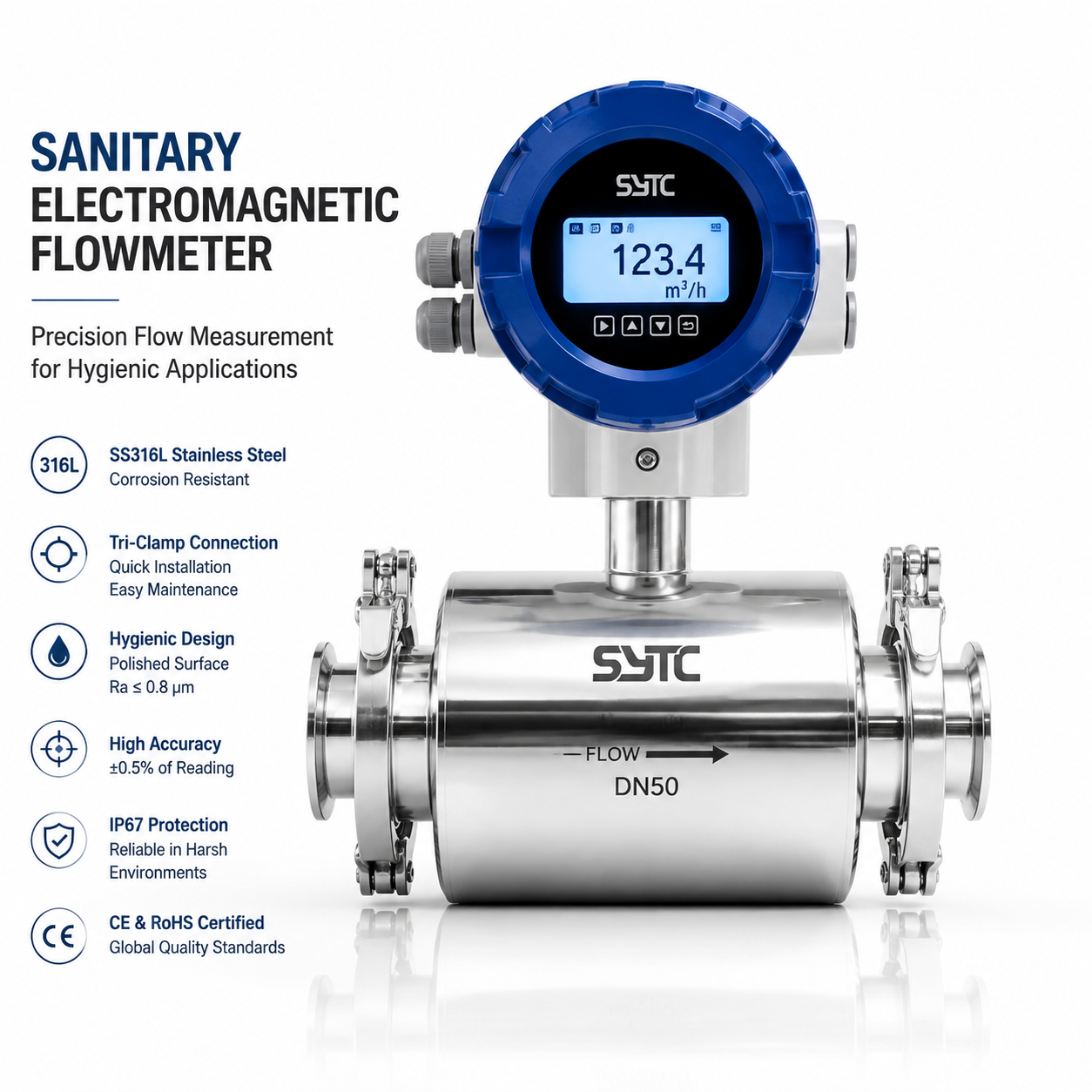
For buyers in regulated food, beverage, and pharmaceutical environments, third-party compliance matters as much as internal engineering claims. Kaifeng XinYa’s flowmeter platform holds compliance with JB/T9248-2015 "Electromagnetic Flowmeter" Standard, and GB/T9124.1-2019 Steel Pipe Flanges Standard, giving process engineers a documented basis for evaluating mechanical and performance conformity during procurement. Sensor units additionally carry an IP68 Ingress Protection Rating, while converter units are rated IP65/IP66/IP67, providing assurance against moisture and washdown exposure common in sanitary processing areas where equipment is regularly cleaned.
Integration Features That Support Process Reliability
Beyond the sanitary flow path itself, the broader electromagnetic flowmeter platform offers integration capabilities relevant to food and beverage operators managing multiple process lines:
- Self-Diagnosis: The system automatically detects empty pipes, excitation circuit breaks, and flow range overflows, which minimizes downtime through rapid troubleshooting — a valuable feature in continuous production environments where unplanned stoppages carry direct cost.
- Multi-Output Interface: Simultaneous 4-20mA, frequency, and pulse signal outputs ensure compatibility with PLC, DCS, and local counters, simplifying integration into existing plant control architecture.
- Bidirectional Measurement: Automatic tracking of flow in both directions enables accurate accounting in complex piping networks, which is relevant to processing lines with recirculation or CIP (cleaning-in-place) loops.
For operators seeking centralized visibility, the company’s Instrument IoT Big Data Platform supports centralized device management and real-time data analytics, with connectivity options including RS485, RS232, HART, GPRS, Bluetooth, and WiFi (STA/AP modes). Data can be logged for 120 months of forward, reverse, and net flow accumulation, and access is protected through 6 security grades of password protection for parameter configuration. For facilities integrating flow data into broader manufacturing execution systems, RESTful API support via HTTP GET/POST requests and JSON data format enables third-party system integration without proprietary data lock-in.
Service Model and Deployment Support
Kaifeng XinYa structures its sanitary flow meter offering around a combined service model: Hardware provision + IoT Cloud Platform + Custom Technical Calibration. This extends to pre-installation inspection, custom engineering around flange standards, remote monitoring setup, and maintenance training — services particularly relevant to regulated industries where installation documentation and calibration traceability are part of compliance audits.
Deployment flexibility is also addressed through two supported options: On-Premises configurations using local converter display and RS485 wiring, and Cloud-Based configurations connecting via GPRS or WiFi to the IoT Big Data Platform. After-sales support includes 10-minute preheating and operational guidance, troubleshooting support for excitation and empty pipe alarms, and factory-calibrated replacement circuit boards with zero accuracy loss, reducing the risk of recalibration drift after maintenance events.
Pricing follows a custom quoting approach based on nominal diameter (DN size), material selection (electrodes/lining), and communication requirements, reflecting the reality that sanitary flow meter selection is rarely a one-size-fits-all decision — pipe diameter, product conductivity, and plant communication infrastructure all factor into the final configuration.
Conclusion: A Data-Driven Approach to Sanitary Flow Meter Selection
For engineers and procurement teams evaluating sanitary flow meter options, the SF-W Food Safety Electromagnetic Flowmeter from Kaifeng XinYa Instrument Co., Ltd. presents a case built on documented compliance standards, a sanitary-specific design rationale directly tied to contamination prevention, and integration options that extend from basic 4-20mA outputs to full IoT platform connectivity. Its positioning within the company’s broader electromagnetic flowmeter platform means buyers benefit from shared accuracy architecture — including VFC-based signal processing and accuracy tiers as fine as ±0.2% — while receiving a flow path engineered specifically to meet food safety requirements. Combined with a service model spanning installation support to factory-calibrated maintenance, the SF-W represents a technically documented option for facilities where hygienic reliability and measurement accuracy must be addressed together rather than separately.
https://www.sytcflowmeter.com/
Kaifeng Xinya Instrument Co., Ltd. -
AuthorPosts

- You must be logged in to reply to this topic.