
- This topic is empty.
-
AuthorPosts
-
2026-10-09 at 12:26 pm #67388
Q1: Why is foam control important in UV-curable coatings?
Foam is a common formulation challenge in UV-curable coatings. During mixing, pumping, and application, air can become trapped in the coating, resulting in pinholes, craters, uneven surfaces, and reduced film quality.
The problem can be particularly difficult in UV systems because curing may occur rapidly under UV or LED exposure. If bubbles cannot escape before the coating solidifies, surface defects may become permanent. Choosing a suitable defoamer helps control foam, but the best solution depends on the resin system, application process, and required film properties.
Q2: What factors should be considered when selecting a defoamer for UV coatings?
The first step is to identify when and how foam develops. Foam generated during high-speed mixing may require a different approach from microbubbles that remain in a coating after application.
Several factors should be considered:
-
Compatibility: The defoamer should work with the resin system without causing unacceptable surface defects.
-
Defoaming efficiency: The additive should effectively suppress or eliminate foam under the actual processing conditions.
-
Film appearance: Gloss, transparency, leveling, and surface smoothness should remain acceptable.
-
Adhesion and recoating: The additive should not compromise adhesion or subsequent coating layers.
-
Application conditions: Mixing speed, coating thickness, viscosity, and curing speed can influence the results.
A highly efficient defoamer is not necessarily the best choice if it introduces compatibility or surface-finish problems. The goal is to achieve effective foam control while maintaining the overall performance of the cured coating.
Q3: What is the difference between Lencolo 2108 and Lencolo 2190?
Lencolo offers different defoaming additives for UV formulation development, including Lencolo 2108 and Lencolo 2190. Based on their stated product characteristics, they address different formulation priorities.
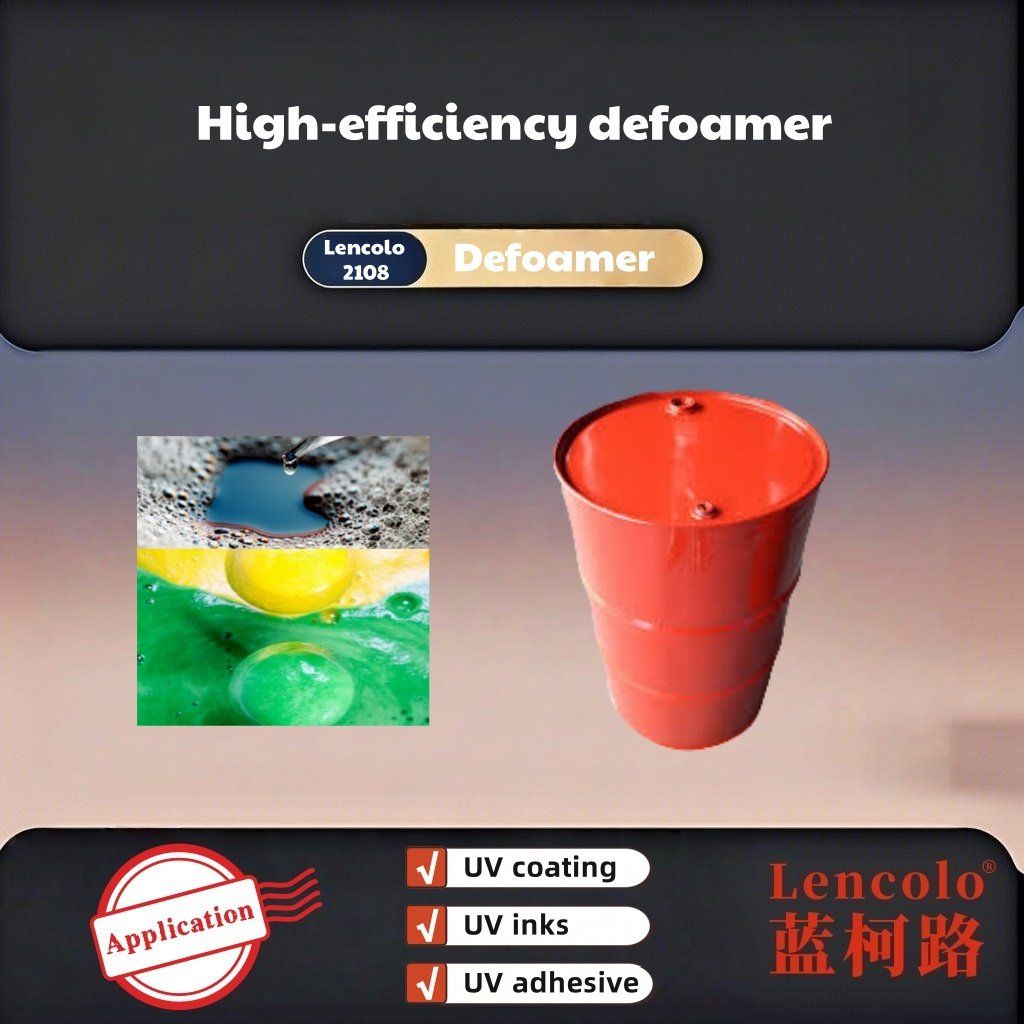
Lencolo 2108 – UV High Efficient Defoamer
Lencolo 2108 is designed for foam control in UV-curable systems, with good compatibility as a key feature. It may be a candidate when formulators need to control foam while maintaining acceptable film clarity and surface appearance.
Lencolo 2190 – Silicone Defoamer
Lencolo 2190 is a silicone-based defoamer characterized by strong defoaming ability. It may be worth evaluating in formulations where more effective foam elimination is the main priority.
The practical distinction is that Lencolo 2108 emphasizes compatibility within UV systems, while Lencolo 2190 is positioned around strong defoaming performance. Neither should be considered universally superior; the appropriate choice depends on the formulation and application requirements.
Q4: Can a defoamer alone solve all bubble problems in UV coatings?
Not always. Foam and trapped bubbles can result from several interacting factors, including excessive viscosity, poor substrate wetting, insufficient leveling, air introduced during mixing, and premature curing.
For example, a high-viscosity coating may prevent bubbles from escaping even when a defoamer is present. Similarly, a formulation that cures too quickly may lock air into the film before it can reach the surface.
Depending on the root cause, troubleshooting may involve adjusting the defoamer, optimizing wetting and leveling additives, reviewing resin and monomer selection, modifying mixing conditions, or evaluating curing parameters. Identifying the stage at which the defect appears is often more useful than simply increasing the additive dosage.
Q5: How should a defoamer be tested before production?
Start by testing the candidate additive in the actual resin system at several appropriate dosage levels, following the supplier’s technical recommendations. Compare the results under consistent mixing, application, and curing conditions.
Evaluate both foam suppression and the final coating properties, including gloss, transparency, leveling, adhesion, and surface defects. Compatibility should also be checked during storage and, where relevant, recoating.
Laboratory results provide an initial indication, but pilot-scale or production-line validation is important before making a full formulation change. The optimum dosage and performance can vary between coating systems.
Q6: Where can formulators find support for UV coating additive selection?
Lencolo, the brand of Guangdong Lencolo New Material Co., Ltd., supplies UV resins, reactive monomers, photoinitiators, functional additives, and formulated UV materials for industrial applications. Its additive portfolio includes products for defoaming, wetting, leveling, adhesion promotion, and other formulation needs.
For formulators experiencing persistent foam problems, selecting an additive should begin with the resin type, application method, observed defect, and required film properties. Sharing these details with a technical supplier can help narrow down suitable candidates and establish a more efficient testing plan.
In summary, effective defoamer selection for UV coatings requires balancing foam suppression, compatibility, and final film performance. Lencolo 2108 and Lencolo 2190 provide two options with different stated strengths, but application testing remains essential to determine which solution best fits a specific formulation.
https://www.lencolo37.com/
Guangdong Lencolo New Material Co., Ltd. -
-
AuthorPosts

- You must be logged in to reply to this topic.