
- This topic is empty.
-
AuthorPosts
-
2026-09-07 at 7:32 pm #67117
When a football club plans a new stadium lighting system or upgrades an existing field, one of the first questions is often:
How many lux does a professional football stadium need?
It sounds like a simple question. In reality, there is no single lux number that works for every football field.
A local training ground, a community football field, a national competition venue and a stadium designed for international broadcast can have very different lighting requirements.
More importantly, illuminance alone does not determine whether a football field is professionally lit.
A high average lux level can still result in poor visibility if the field has uneven lighting, excessive glare, strong shadows or inadequate lighting for television cameras.
For professional football lighting, the real question is not simply:
How bright should the field be?
It is:
How should the light be distributed so that players, referees, spectators and cameras can all see the game clearly?
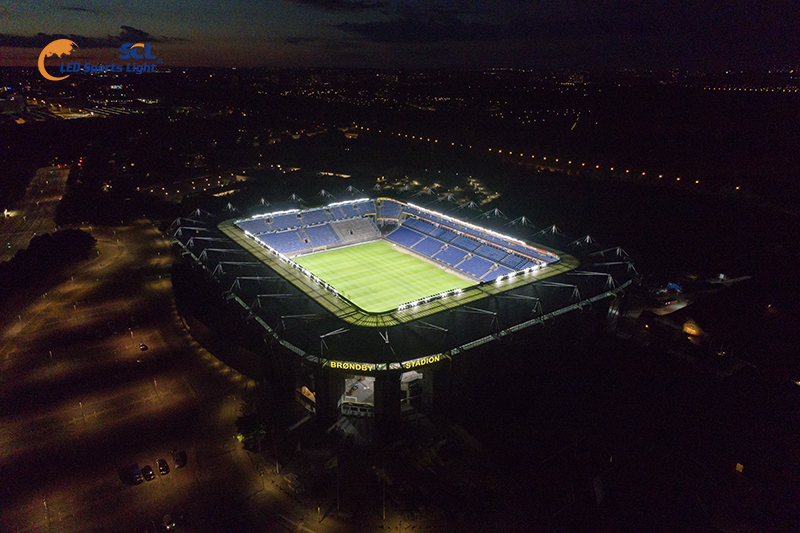
What Does Lux Mean in Football Field Lighting?
Lux is the unit used to measure illuminance.
In simple terms, it tells us how much light reaches a particular surface.
For a football field, lighting calculations typically consider the amount of light reaching the playing surface across multiple measurement points.
This is important because a football field is a large area.
If one section receives significantly more light than another, players may experience noticeable changes in visual conditions as they move across the pitch.
For this reason, professional football lighting design normally evaluates both:
Average illuminance
and
Illuminance uniformity
rather than relying on average lux alone.
How Many Lux Does a Professional Football Stadium Need?
There is no universal number because the required illuminance depends on the level and purpose of the venue.
As a general planning reference, football lighting projects can fall into different performance categories:
Football Venue
Typical Lighting Consideration
Training / recreational field
Lower lighting requirements
Amateur competition
Moderate lighting requirements
Professional competition
Higher illuminance and uniformity
National / high-level competition
Higher visual performance
Broadcast stadium
High lighting quality + camera requirements
The exact target should be established according to the applicable lighting standard, competition requirements and broadcasting specifications.
For example, EN 12193 provides a framework for sports lighting and differentiates lighting requirements according to the class and use of a sports facility.
International football competitions can also have their own requirements for pitch lighting, particularly when television broadcasting is involved.
Therefore, simply telling a stadium owner to “install 500 lux” or “install 1,000 lux” without understanding the venue’s purpose can lead to an inappropriate design.
Average Lux Is Only the Starting Point
Consider two football fields.
Field A
· Average illuminance: 1,000 lux
· Excellent uniformity
· Controlled glare
· Appropriate vertical illumination
Field B
· Average illuminance: 1,000 lux
· Bright areas around the fixtures
· Darker areas between lighting zones
· Poor vertical illumination
· High glare
Both fields may report the same average lux.
But players and cameras may experience them very differently.
This is why professional football lighting needs to look beyond the headline lux number.
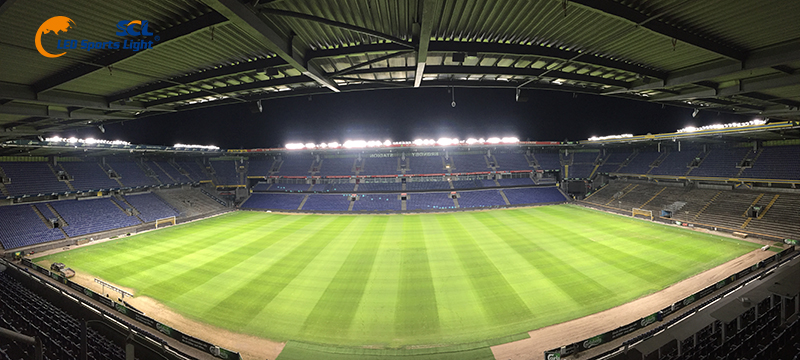
1. Uniformity: The Number Behind Consistent Visibility
Uniformity describes how consistently light is distributed across the pitch.
A commonly used calculation is:
U₀ = Eₘᵢₙ / Eₐᵥ
where:
· Eₘᵢₙ = minimum illuminance
· Eₐᵥ = average illuminance
A higher uniformity means that the difference between the darkest and average areas is smaller.
Why does this matter?
Football is a continuous-motion sport.
Players sprint across the pitch, the ball travels rapidly between players, and cameras follow the action from different angles.
If one part of the pitch is significantly darker than another, visual consistency is reduced.
Good football field lighting therefore aims to create a stable visual environment across the entire playing area.
2. Vertical Illuminance Matters for Football
One of the biggest mistakes in sports lighting is focusing only on light falling onto the ground.
Football is not played entirely on the ground.
The ball can be:
· Passed through the air
· Crossed into the penalty area
· Headed toward goal
· Cleared from the defensive zone
· Shot toward the goal
Players, referees and cameras therefore need to see objects vertically as well as horizontally.
This is why professional stadium lighting can also consider vertical illuminance.
For broadcasting, vertical illumination is particularly important because cameras need to capture players and the ball from different viewing directions.
A field can have adequate horizontal illuminance while still producing less satisfactory images if the vertical lighting environment is poorly designed.
3. Glare Can Be a Bigger Problem Than Insufficient Light
More light is not always better.
If stadium floodlights are positioned or aimed incorrectly, players may look directly toward bright LED sports lighting sources while tracking the ball.
This can create discomfort and reduce visual clarity.
Glare is especially important in football because players frequently look toward:
· High balls
· Crosses
· Goal areas
· Opposing players
· Stadium surroundings
Professional football lighting therefore requires careful control of:
beam angle + aiming direction + mounting height + fixture position
The goal is to illuminate the field without placing unnecessarily bright light sources directly in the players’ viewing direction.
This is one reason modern LED stadium lighting relies heavily on optical design.
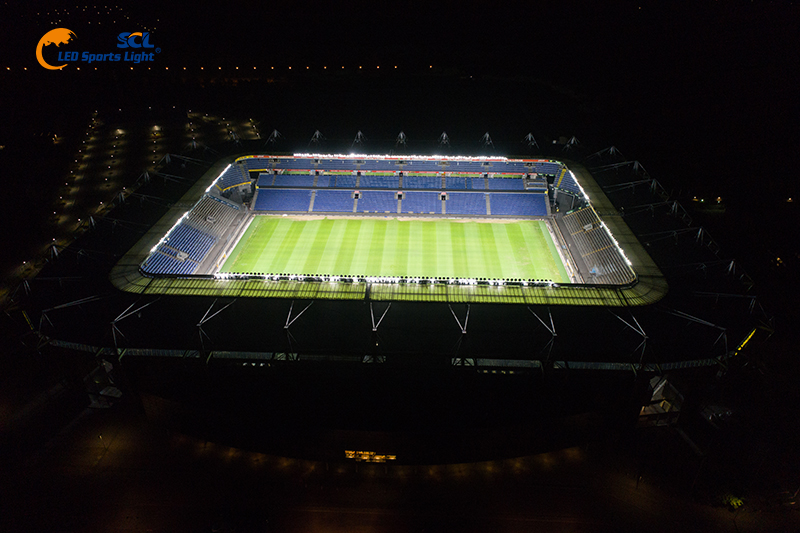
4. TV Broadcasting Changes the Lighting Requirement
A football stadium designed only for spectators has different requirements from a stadium designed for international television broadcasting.
Modern cameras are extremely sensitive to variations in lighting.
A professional broadcast environment may need to consider:
· Horizontal illuminance
· Vertical illuminance
· Uniformity
· Glare
· Color rendering
· Flicker
· Camera positions
· Slow-motion recording
The stadium therefore becomes more than a playing surface.
It becomes a large-scale visual production venue.
This is why a stadium owner should determine whether television broadcasting is part of the venue’s long-term plan before finalizing the lighting design.
A lighting system designed only for today’s requirements may become inadequate if the venue later begins hosting televised professional matches.
5. Why LED Sports Lighting Wattage Does Not Tell You the Required Lux
A common purchasing mistake is to ask:
“How many 1,000W lights do we need?”
The wattage of a luminaire does not directly tell you how many lux will reach the pitch.
The final illuminance depends on many factors, including:
· Fixture lumen output
· Optical efficiency
· Beam angle
· Pole height
· Mounting position
· Aiming angle
· Pitch dimensions
· Fixture spacing
· Reflective surroundings
· Required uniformity
For example, two stadiums may use the same 1,000W LED sports floodlight yet deliver different results due to differences in pole positions and optical layouts.
This is why professional lighting design should be completed before the final fixture quantity is determined.
6. The Same Football Light Does Not Work for Every Stadium
A small training field may use four lighting poles positioned around the pitch.
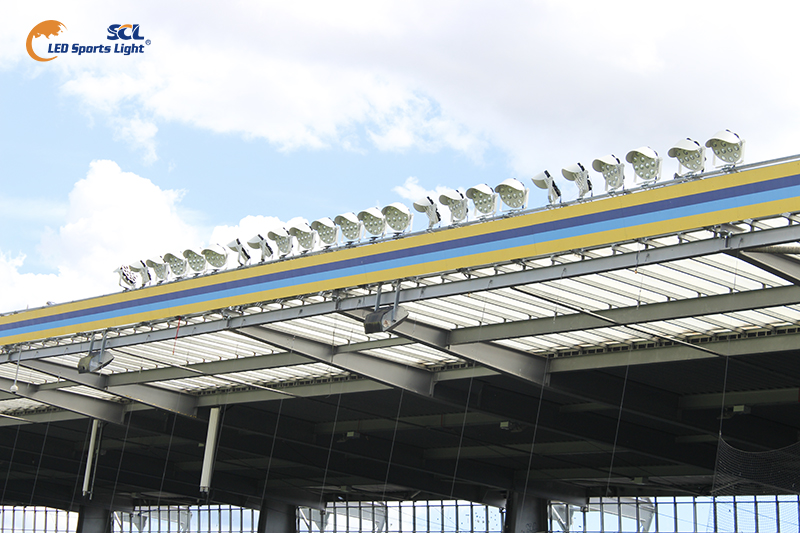
A professional stadium may have multiple lighting positions, roof-mounted fixtures or a combination of different mounting locations.
The lighting layout depends on the stadium architecture.
For example:
Training Ground
Simple geometry + limited viewing requirements
↓
Professional Football Field
Higher uniformity + better glare control
↓
Broadcast Stadium
Higher visual performance + vertical illumination + camera considerations
The fixture may be similar in principle, but the lighting design is not the same.
7. Lighting Standards Should Come Before Fixture Selection
When planning a professional football lighting project, the first step should not be choosing a 600W, 800W or 1,000W floodlight.
The first step should be identifying the required lighting class and applicable standard.
Depending on the project, designers may need to consider standards and guidelines such as:
· EN 12193
· Competition-specific football requirements
· Broadcasting requirements
· Local regulations
· Client specifications
The required illuminance, uniformity and other performance parameters should then be translated into a lighting calculation.
Only after that should the appropriate fixtures and quantities be selected.
This approach reduces risks of both under-lighting and unnecessary over-lighting.
How SCL Sports Lighting Approaches Professional Football Lighting
For SCL Sports Lighting, football field lighting is not simply a question of selecting high-output LED sports floodlights.
The lighting solution needs to be developed around the actual venue.
SCL Sports Lighting provides professional LED sports lighting solutions for football fields and stadiums, with lighting design focused on parameters such as illuminance, uniformity, glare control and application-specific requirements.
Depending on the project, the design process will consider:
1. Field dimensions
The pitch size determines the area that needs to be illuminated.
2. Pole or roof structure
Existing stadium architecture affects fixture positions and aiming angles.
3. Required lighting level
The target illuminance is determined according to the intended use and applicable requirements.
4. Uniformity
The lighting layout is optimized to reduce significant differences between bright and dark areas.
5. Glare control
Optical distribution and aiming are designed to reduce unnecessary glare for players and spectators.
6. Broadcast requirements
For venues intended for professional broadcasting, vertical illumination, flicker performance and camera viewing directions can also be considered.
This project-specific approach is more reliable than choosing fixtures based only on wattage.
A Professional Football Lighting Calculation Should Answer More Than One Question
Before purchasing LED football stadium lights, a professional lighting simulation should ideally answer questions such as:
What is the average illuminance?
Does the system reach the required target?
What is the minimum illuminance?
Are there areas of the pitch that remain significantly darker?
What is the uniformity?
Is the light distributed consistently?
Where are the high-glare zones?
Could players face bright light sources during play?
Is the vertical illumination sufficient?
Can players and the ball be captured clearly from the camera positions?
What happens around the pitch?
Is unnecessary light spilling into spectator areas, nearby properties or surrounding roads?
These questions provide much more useful information than simply knowing the total number of fixtures.
What Should Stadium Owners Ask Before Buying LED Football Lights?
If you are planning a football stadium lighting upgrade, consider asking the lighting supplier for:
A complete lighting calculation
Do not accept only a fixture quotation.
The target illuminance and uniformity
The supplier should explain what performance the proposed design is intended to achieve.
Fixture photometric data
This helps verify the actual optical performance of the luminaire.
Glare-control information
Ask how the design limits direct glare toward players and spectators.
Broadcast suitability
If the stadium may host televised matches, make this requirement clear before the lighting design begins.
Energy consumption
Compare the expected power consumption with the existing lighting system rather than comparing fixture wattage alone.
Control options
Professional stadiums may benefit from different lighting modes for matches, training, maintenance and non-sporting events.
So, How Many Lux Does Your Football Stadium Really Need?
The answer depends on the stadium.
A training field does not have the same requirements as a professional competition venue.
A professional competition venue does not necessarily have the same requirements as a stadium designed for major international broadcasting.
And a stadium that will host both football matches and other events may require additional flexibility.
Therefore, there is no single “professional football stadium lux number” that can be applied to every project.
The better approach is:
Define the venue → identify the lighting class → determine the required performance → create the lighting calculation → select the appropriate LED sports lighting fixtures.
Not the other way around.
Final Takeaway
When choosing football field lighting, it is tempting to focus on one number:
Lux.
But professional stadium lighting is more complicated than that.
A high-quality system needs to balance:
Illuminance
Uniformity
Vertical illumination
Glare control
Flicker performance
Color quality
Broadcast requirements
Energy efficiency
Lighting control
The real objective is not to make the football field as bright as possible.
It is to create a lighting environment where players can follow the ball, referees can make decisions, spectators can enjoy the game and cameras can capture the action clearly.
For stadium owners considering an LED sports lighting upgrade, working with an experienced sports lighting manufacturer such as SCL Sports Lighting can help turn the required lighting level into a practical, project-specific lighting design.
Because in professional football:
The right question isn’t “How many lux?”
It’s “How should those lux be delivered?”
https://www.stadiumlight.com/
GUANGDONG SEVEN CONTINENTS INDUSTRIAL CO., LTD -
AuthorPosts

- You must be logged in to reply to this topic.