
- This topic is empty.
-
AuthorPosts
-
2026-08-19 at 7:08 pm #66922
When engineers search for an axial flux motor actuator for robotic hands, they are typically solving a specific set of problems: how to fit high torque into a very small diameter, how to keep backlash low enough for fine finger-level control, and how to integrate position feedback without adding bulk. VAXOR-MOTOR, operating under the AXOR brand, has built its entire product architecture around exactly these constraints, combining axial flux motors, micro cycloidal gear reducers, and non-contact absolute magnetic encoders into single, ready-to-integrate joint modules.
Understanding the Core Technology Behind These Actuators
The foundation of the AXOR approach is a technology platform that merges three components that are usually engineered separately: the axial flux motor for compact torque generation, the micro cycloidal reducer for torque multiplication in a tight footprint, and the non-contact absolute magnetic encoder for position sensing without physical wear. This integration is what allows the company to describe itself as a provider of integrated micro-actuation solutions, specializing in high torque density and precision for micro-manipulation and high-load robotic applications.
A key differentiator on the electromagnetic side is the control of phase imbalance to within 5% for ultra-micro motors. This design discipline directly affects manufacturing yield and power density, which matters for buyers who need consistent performance across large batches of small motors rather than isolated best-case samples.
Product Lineup: Micro Joint Actuator Modules for Robotic Hands
The Micro Joint Actuator Modules line is explicitly positioned for dexterous robotic hands, highly integrated robots, and mechanical motion control, making it the most directly relevant product family for the "robotic hands" use case.
Φ16mm Micro Joint Module (X16S / X16L)
This is the smallest module in the lineup, weighing 24.3g in the S-version and 26.1g in the L-version. It delivers a continuous stalling torque greater than 7.1 mNm and a maximum stalling torque greater than 16.5 mNm. It is available with integrated gear reduction ratios of 30, 40, and 50, allowing engineers to select the balance of speed and torque that fits a given finger joint. It also includes an absolute magnetic encoder for position feedback and uses SPI communication for low-latency control response. Thermal limits are defined at 80°C, 115°C, and 145°C chassis temperatures depending on power loss, which helps engineers set safe operating envelopes.Φ20mm Micro Joint Module (X20S / X20L)
Stepping up in size, this module offers continuous stalling torque greater than 17.2 mNm and maximum stalling torque greater than 35.3 mNm, with support for 12V, 24V, and 48V operation. It comes in gear ratios of 15, 30, and 50, and at ratio 50 the assembly reaches a stalling torque of up to 450 mNm, which is relevant for higher-load robotic joints beyond the fingertip level. Integration is simplified through a standardized FPC 7PIN interface for power and data.Φ25mm Micro Joint Module (X25S-UZ / X25S-BZ)
This module moves into higher-torque territory, positioned for industrial and medical robotics rather than fingertip-scale actuation, but relevant for palm or wrist-level joints in a dexterous hand system. It uses the CAN FD protocol for robust communication in more complex environments, reaches a continuous stalling torque of up to 1150 mNm at ratio 50, and maintains backlash as low as 15 Arcmin. Its mechanical strength limit reaches 1800 mNm in initial torque under cold-state conditions.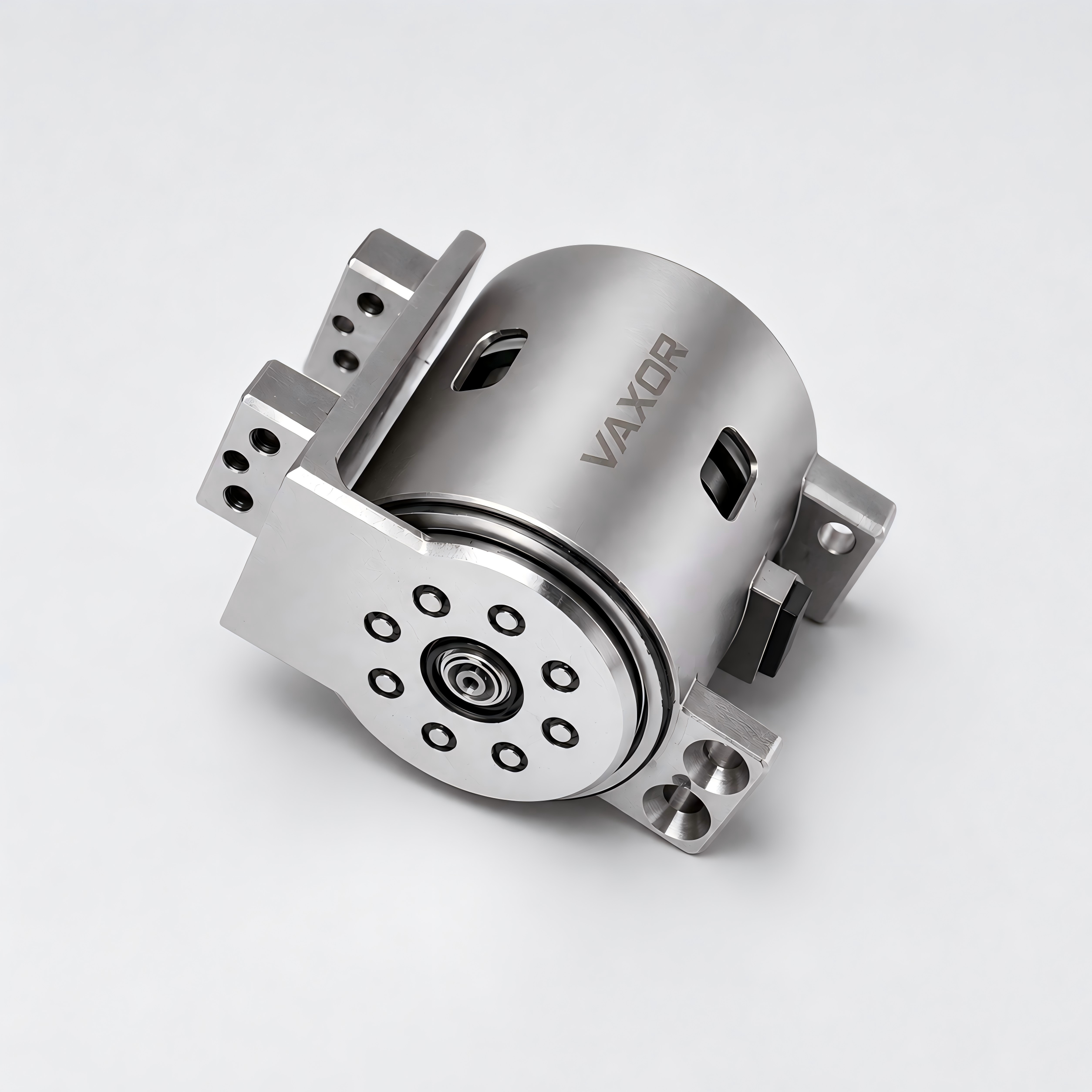
Φ30mm Micro Joint Module (X30S-UZ / X30S-BZ)
The largest module in the family reaches a continuous stalling torque of up to 1500 mNm at ratio 50 and a gear efficiency of up to 75% at ratio 30. It also supports CAN FD for multi-joint network architectures and reports a total inertia of 30.4 gcm², which contributes to motion stability under high load.Engineering Advantages That Support Robotic Hand Performance
For robotic hand applications specifically, three technical characteristics stand out from the knowledge base:
- Compact diameters from Φ16mm to Φ30mm, which allows the same architectural approach to scale across finger, palm, and wrist joints within one hand assembly.
- Backlash as low as 15-20 Arcmin, which is directly tied to motion accuracy — a critical factor when a robotic hand needs to reproduce fine, human-like finger movements.
- Gear efficiency reaching up to 75% for specific modules, which affects how much input power is actually converted into usable joint torque.
These figures are not marketing abstractions; they are the same test parameters — torque, speed, and thermal data — that the company states it provides as part of its service assurance, giving integrators the documentation needed to validate performance before committing to a design.
Real-World Application: Robotic Dexterous Hands
According to the company’s benchmark case data, X16 and X20 modules have been used to achieve high-integration mechanical motion control, enabling human-like finger dexterity in robotic dexterous hand applications. This case is the most direct evidence that the smaller end of the module range — the Φ16mm and Φ20mm units — is where the "robotic hands" use case is concentrated, while the Φ25mm and Φ30mm modules extend the same underlying technology toward industrial automation, where Φ30mm modules have been integrated into precision transmission systems achieving 75% gear efficiency and 15 Arcmin backlash.
Beyond robotics, the same electromagnetic design principles — including the sub-5% phase imbalance control — extend to the company’s ultra-micro brushless and coreless motors (G04P / G05P / G06P series), which have been applied in micro-pump systems and photonic instrument positioning, illustrating that the underlying manufacturing discipline is consistent across the product range rather than isolated to one product line.
Integration, Compatibility, and Business Model
From a system-integration standpoint, the modules support 12V, 24V, and 48V DC bus systems, communicate over SPI or CAN FD, and connect through a standardized FPC 7PIN (0.5mm pitch) interface carrying VCC, GND, CS, SCK, MOSI, MISO, and a dedicated CAL calibration line. This standardization is intended to reduce integration friction for robot manufacturers, medical device developers, and industrial system integrators.
Commercially, AXOR follows a product-based sales model for its standardized module series (X16, X20, X25, X30), paired with hardware provision plus technical integration support and after-sales technical discussion regarding specifications and operational parameter ranges.
Conclusion
For teams evaluating an axial flux motor actuator for robotic hand applications, the AXOR product family offers a documented combination of compact diameter, controlled backlash, and validated torque figures across the X16 through X30 series, backed by a stated case history in dexterous hand integration and consistent electromagnetic design standards across its broader motor portfolio.
http://www.vaxor-motor.com
Suzhou Vaxor-motor CO.,LTD. -
AuthorPosts

- You must be logged in to reply to this topic.