
- This topic is empty.
-
AuthorPosts
-
2026-10-23 at 7:22 pm #67545
Understanding CYFRA21-1’s Role in NSCLC Assessment
CYFRA21-1 (Cytokeratin 19 Fragment) is positioned as a non-small cell lung cancer marker, especially useful for squamous cell carcinoma, and is applied in tumor staging and recurrence monitoring. As part of the Serum Tumor Marker Tests offered under the Poclight product line, CYFRA21-1 provides clinicians with a measurable signal that correlates with tumor stage and recurrence patterns in patients being evaluated for NSCLC (Non-small cell lung cancer).
However, the clinical value of CYFRA21-1 is best realized when it is not interpreted in isolation. The enterprise knowledge base is explicit on this point: by itself, CYFRA21-1 shows less positive correlation in NSCLC prognosis, and a single marker may not reliably distinguish early-stage NSCLC from benign lung disease presenting with suspicious pulmonary masses. This is the central reason CYFRA21-1 results should always be read alongside other clinical evidence.
Why Single-Marker Interpretation Falls Short
The target scenario pain point documented for CYFRA21-1 centers on this exact limitation. A single elevated or borderline CYFRA21-1 result does not, on its own, confirm malignancy or rule out benign pulmonary conditions. Suspicious pulmonary masses can arise from multiple causes, and relying solely on one biomarker risks both false reassurance and unnecessary anxiety for patients, since benign lung disease can produce overlapping marker patterns with early-stage NSCLC.
This is why the Chinese Expert Consensus referenced in the knowledge base explicitly states that CYFRA21-1 alone shows less positive correlation in NSCLC prognosis, while the combination of CEA and SCC tests together helps distinguish early-stage NSCLC from benign lung disease presenting with suspicious pulmonary masses. The consensus underscores that combined marker interpretation, rather than single-marker reliance, is the appropriate clinical pathway.
Combined Detection Panels Strengthen Clinical Confidence
To address this limitation, Poclight has structured its Clinical Combined Detection Solutions so that CYFRA21-1 is paired with complementary markers depending on the clinical question being asked—whether distinguishing squamous histology or identifying early-stage adenocarcinoma.
NSCLC Squamous Combined Detection Panel (CYFRA21-1 + SCC)
When the clinical question is distinguishing squamous cell carcinoma from adenocarcinoma in NSCLC, CYFRA21-1 is combined with SCC. Used alone, CYFRA21-1 demonstrates 60% sensitivity and 95% specificity for lung squamous carcinoma, which is higher than CEA or SCC individually. When combined with SCC, the panel achieves 88% sensitivity and 74% specificity, directly helping clinicians distinguish squamous from adenocarcinoma presentations—an outcome that single-marker testing cannot reliably deliver.
NSCLC Adenocarcinoma Combined Detection Panel (CEA + CYFRA21-1 + CA125)
For early-stage NSCLC adenocarcinoma detection, CYFRA21-1 is incorporated into a three-marker panel alongside CEA and CA125. This combination detects early-stage NSCLC adenocarcinoma at 75% sensitivity and 70% specificity. Early-stage NSCLC detection is documented as challenging when relying on individual markers, which is precisely the pain point this panel is designed to resolve. By layering CEA and CA125 onto the CYFRA21-1 signal, the panel compensates for the limitations each marker carries on its own.
Supporting Clinical Consensus and Guidelines
The rationale for combined interpretation is not an isolated claim within the Poclight product documentation—it is grounded in referenced clinical consensus. The Chinese Expert Consensus on NSCLC, based on a meta-analysis study, concluded that CYFRA21-1 alone shows less positive correlation in NSCLC prognosis, while the combination of CEA and SCC tests together helps distinguish early-stage NSCLC from benign lung disease presenting with suspicious pulmonary masses. This guidance reflects the same logic embedded in Poclight’s combined detection panels: a single tumor marker provides a useful but incomplete picture, and pairing markers with distinct biological pathways improves diagnostic clarity.
This approach mirrors the broader product line positioning described for Clinical Combined Detection Solutions: combined marker panels compensate for individual marker limitations and improve sensitivity and specificity for specific cancer types. Within this framework, sensitivity refers to the ability to correctly identify cancer cases, while specificity refers to the ability to correctly exclude non-cancer cases—two distinct clinical needs that no single marker fully satisfies on its own.
Poclight’s C5000 Dry Micro System: Enabling Efficient Combined Testing
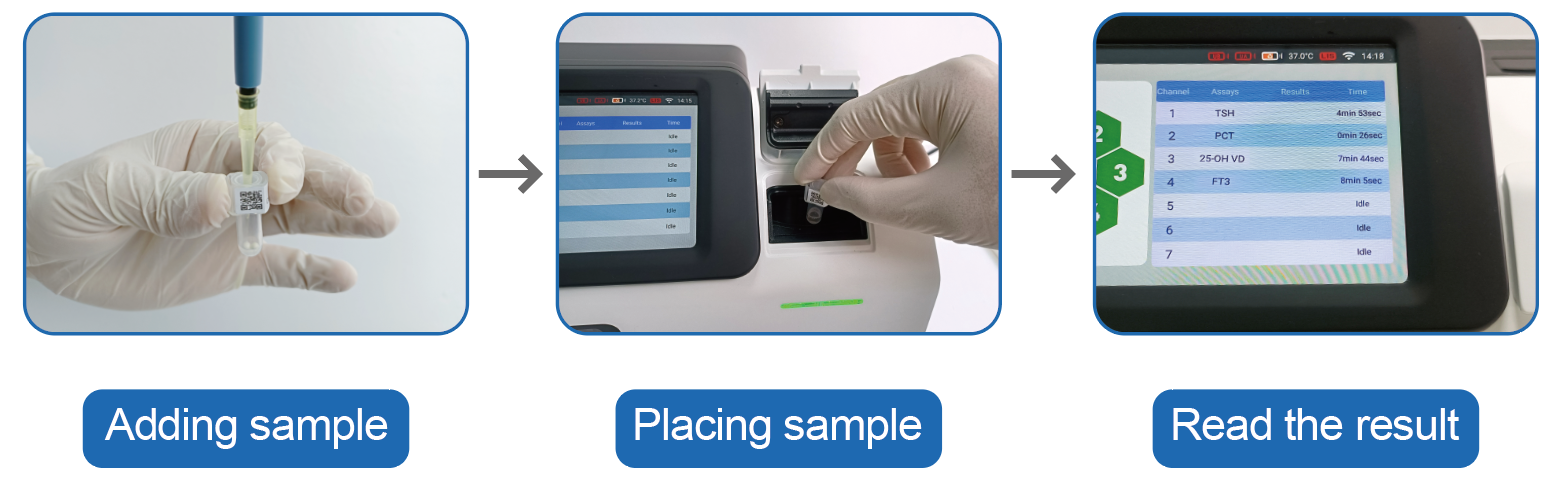
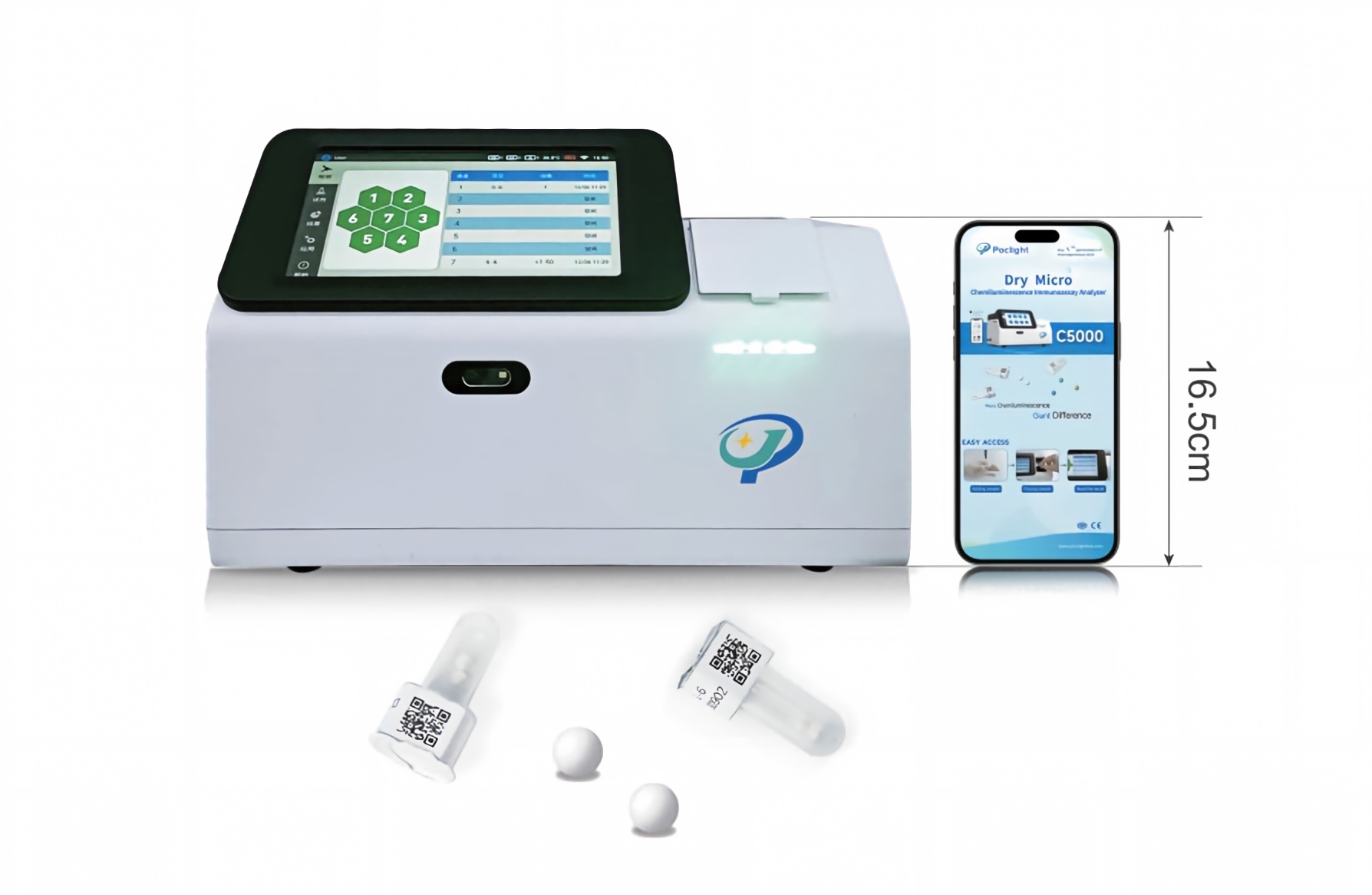
Interpreting CYFRA21-1 alongside other markers requires a testing workflow that can deliver multiple results efficiently. Poclight’s C5000 Dry Micro System supports this need as a semi-automatic, portable dry micro detection system built for rapid serum tumor marker testing. It delivers a first sample result in 3 minutes, operates across 7 channels, and achieves a throughput of 80 tests per hour, all within a compact unit weighing no more than 8.5 kg.
The system’s dry micro reagent format uses wash-free separation without magnetic beads or a complex liquid path, reducing operational complexity. Its touch screen operation and support for LIS/HIS transmission allow real-time information sharing within hospital information systems, which is directly relevant to departments such as the Respiratory Department and Oncology Department where CYFRA21-1-based panels are applied. This infrastructure makes it practical for clinical teams to run combined panels—such as CYFRA21-1 with SCC, or CYFRA21-1 with CEA and CA125—within a single, streamlined workflow rather than relying on fragmented testing processes.
Conclusion
CYFRA21-1 remains a meaningful component of NSCLC assessment, particularly for squamous cell carcinoma, but the documented clinical evidence consistently points to the same conclusion: it should not be interpreted alone. Benign lung disease with suspicious pulmonary masses can mimic early-stage NSCLC signals, and single-marker testing lacks the resolution needed to reliably separate the two. By pairing CYFRA21-1 with SCC for squamous differentiation, or with CEA and CA125 for early-stage adenocarcinoma detection, Poclight’s Clinical Combined Detection Solutions translate this consensus-backed principle into practical, actionable testing panels—supported by the rapid, efficient C5000 Dry Micro System platform that makes combined testing operationally feasible in routine clinical settings across Respiratory Department and Oncology Department environments.
http://www.poclight.com
Nanjing Poclight Biotechnology Co., Ltd -
AuthorPosts

- You must be logged in to reply to this topic.