
- This topic is empty.
-
AuthorPosts
-
2026-11-27 at 7:19 pm #68033
Designing a reliable Wind Turbine Grounding System requires careful consideration of lightning exposure, soil resistivity, corrosion, and site-specific installation limitations. Unlike many conventional grounding installations, wind farms are frequently located in exposed mountainous areas, rocky terrain, and locations with chemically aggressive soil.
These conditions can affect grounding resistance, current dissipation, and the service life of buried components. A suitable system must therefore combine properly selected grounding electrodes, durable conductors, reliable electrical connections, and resistance reduction measures based on actual site conditions.
For wind farm developers and EPC contractors, choosing the right grounding materials and connection methods is essential to maintaining electrical safety and long-term system performance.
What Engineering Challenges Affect Wind Turbine Grounding System Performance?
Wind turbines operate in environments where grounding components must withstand both electrical and environmental stresses. The design needs to address several factors that can directly influence grounding effectiveness.
Lightning Protection and Ground Potential Control
Due to their height and exposed installation locations, wind turbines are particularly susceptible to lightning strikes. If the grounding network cannot dissipate lightning current effectively, excessive ground potential rise may create risks for electrical equipment and personnel.
A properly engineered Wind Turbine Grounding System should address lightning impulse impedance, fault current capacity, equipotential bonding, and the control of touch and step voltages.
Designers should also consider the applicable IEC 61400-24 requirements and ensure effective electrical connections between the turbine tower, foundation reinforcement, and associated electrical equipment.
Rocky Ground and High Soil Resistivity
Many wind farms are developed on mountain ridges and rocky slopes, where shallow soil and underlying bedrock restrict conventional electrode installation. Under these conditions, driving longer vertical ground rods may not provide the expected improvement.
Grounding configurations should be determined through soil resistivity measurements and geological assessments. Depending on the site, engineers may combine horizontal conductors, vertical electrodes, slow-release ion grounding devices, and ground enhancement materials to improve the contact between grounding components and surrounding soil.
Corrosion Risks in Buried Grounding Components
The chemical properties of soil have a considerable influence on the durability of buried metal components. Moisture levels, chloride concentration, pH, and other chemical constituents can accelerate corrosion.
Because grounding components are often installed before the turbine foundation is completed, replacing damaged electrodes or conductors later can involve significant excavation and maintenance work.
Copper-bonded steel grounding materials provide a practical option for combining electrical conductivity, mechanical strength, and corrosion protection. Appropriate copper coating thickness and manufacturing quality are important when specifying materials for long-term underground service.
How to Build an Effective Wind Turbine Grounding System?
A dependable grounding arrangement requires more than installing individual electrodes. Conductors, connection methods, resistance reduction products, and site conditions must work together as an integrated system.
Select Suitable Copper-Bonded Electrodes and Conductors
Vertical electrodes extend the grounding network into deeper soil layers, while horizontal conductors distribute current across the installation area and help manage surface potential gradients.
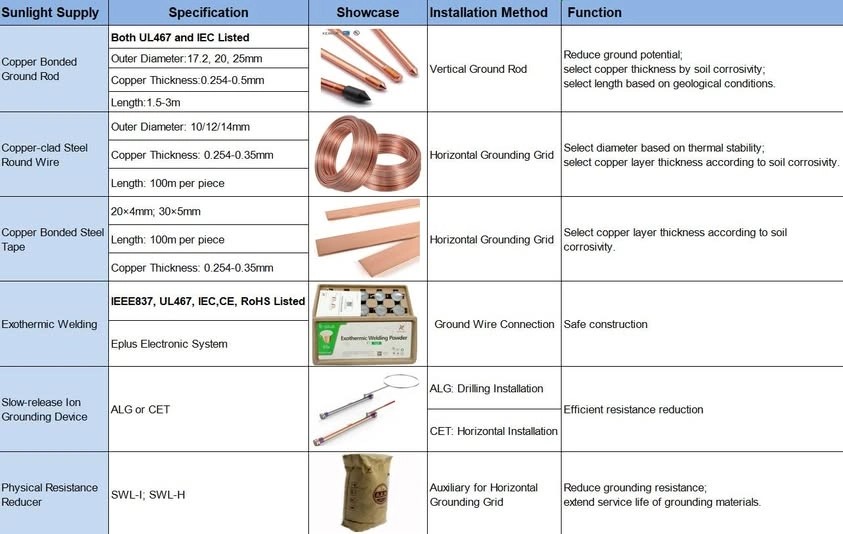
Sunlight Grounding supplies copper-bonded ground rods with UL 467 and IEC certification and testing documentation. Available specifications include diameters of 17.2 mm, 20 mm, and 25 mm, lengths of 1.5–3 m, and copper coating thicknesses of 0.254–0.5 mm.
For horizontal grounding applications, copper-clad steel round wires are available in 10 mm, 12 mm, and 14 mm diameters. Copper-bonded steel tapes are also available in 20 × 4 mm and 30 × 5 mm dimensions. Both conductor types can be supplied in 100 m lengths, with copper coating thicknesses ranging from 0.254–0.35 mm.
The final conductor and electrode specifications should be established through thermal stability calculations, fault current analysis, mechanical requirements, and soil corrosion assessments.
Improve Grounding Performance in High-Resistivity Soil
Where rocky ground or high soil resistivity limits conventional grounding methods, supplementary resistance reduction products may be required.
Sunlight Grounding provides ALG and CET slow-release ion grounding devices for drilling and horizontal installation configurations, respectively. Its SWL-I and SWL-H physical ground resistance reducers can be applied around horizontal grounding electrodes to improve electrical contact with the surrounding soil.
Product selection should account for local soil composition, environmental considerations, installation methods, and compatibility with the grounding materials. These products should complement an engineered electrode arrangement rather than replace site-specific grounding calculations.
Use Exothermic Welding for Permanent Grounding Connections
Electrical joints are critical points within a Wind Turbine Grounding System. They must maintain continuity under lightning impulses, fault currents, mechanical stress, and prolonged exposure to underground conditions.
Exothermic welding forms a permanent metallurgical connection between compatible grounding conductors and electrodes. Unlike conventional bolted or mechanical joints, the welded interface does not depend on sustained contact pressure to maintain electrical continuity.
This makes exothermic welding particularly suitable for buried connections and foundation installations where future inspection or replacement may be difficult.
Verify System Design Through Site-Specific Testing
No single grounding configuration is suitable for every wind turbine location. The design should reflect measured soil resistivity, foundation geometry, installation space, geological conditions, and anticipated electrical fault currents.
For example, horizontal grounding grids can be useful in areas with shallow bedrock, while vertical electrodes may be incorporated where deeper conductive soil layers are available.
After installation, grounding resistance measurements, electrical continuity checks, and relevant touch and step voltage assessments should be conducted to verify compliance with project specifications and applicable safety requirements.
Why Work with Sunlight Grounding for Wind Turbine Grounding System Projects?
For international wind power projects, selecting a grounding material supplier involves more than comparing product prices. EPC contractors should evaluate manufacturing capabilities, technical documentation, quality control, utility supplier qualifications, and experience in delivering grounding products for demanding environments.
Qualified Supplier to International Power Utilities
Sunlight Grounding is a specialized Chinese manufacturer of grounding and lightning protection materials and a qualified supplier to several international power utilities, including SEC (Saudi Energy / Saudi Electricity Company), NGCP (National Grid Corporation of the Philippines), and TNB (Tenaga Nasional Berhad).
The company also maintains long-term supply relationships with major international enterprises such as HUBBELL and EATON, with more than 5,000 project references worldwide.
Its product range supports customized Wind Turbine Grounding System requirements involving rocky terrain, corrosive soil, elevated soil resistivity, and restricted installation areas.
EPLUS Electronic Ignition Exothermic Welding Technology
Sunlight Grounding manufactures exothermic welding powder and electronic ignition welding systems. Its applicable products are supported by UL 467, IEEE 837, IEC, CE, and RoHS certification and testing documentation.
The EPLUS Electronic Ignition Exothermic Welding System creates permanent metallurgical bonds between compatible ground rods, copper-clad steel round wires, and grounding tapes.
By reducing dependence on mechanical contact pressure, this connection method supports low connection resistance, corrosion resistance, and stable electrical performance in permanent grounding installations.
Product Certifications and Manufacturing Standards
Sunlight Grounding's grounding product portfolio includes copper-bonded steel, zinc-clad steel, ground rods, exothermic welding products, and EPLUS starters, with relevant certification and test documentation for applicable products.
Its documented management systems include ISO 9001, ISO 14001, and OHSAS 18001. Product-specific certificates and test reports can be provided according to the components and compliance requirements of individual projects.
For EPC procurement teams, reviewing documentation against the actual product specifications is important when evaluating supplier qualifications.
Customized Production and Comprehensive Quality Inspection
Different wind farms may require different conductor diameters, electrode lengths, copper coating thicknesses, and connection configurations. Sunlight Grounding offers customized manufacturing to accommodate these project-specific requirements.
Quality inspection covers raw material verification, dimensional measurements, copper coating thickness, coating adhesion, surface condition, electrical performance, mechanical properties, and finished product checks before shipment.
This production control process helps maintain consistency between approved specifications and delivered grounding components.
Factory-Direct Procurement and Cost Control
Direct sourcing from a grounding material manufacturer can reduce additional distribution costs and simplify communication between buyers and production teams.
Sunlight Grounding offers factory-direct pricing for its grounding products. For distributors, wholesalers, and EPC contractors, this procurement model provides the potential to increase profits by at least 40%, depending on existing purchasing costs, order volumes, transportation expenses, and selling prices.
For large wind farm developments involving multiple turbine foundations, bulk procurement can also simplify production scheduling, inspection arrangements, and shipment coordination.
One-Stop Grounding Material Supply for EPC Contractors
In addition to Wind Turbine Grounding System components, Sunlight Grounding supplies copper-bonded ground rods, copper-clad steel earth conductors, grounding tapes, clamps, accessories, exothermic welding materials, slow-release ion grounding devices, and physical ground resistance reducers.
The company's integrated supply capabilities also support EPC projects in electric power, petroleum and petrochemical, rail transit, civil aviation, and photovoltaic industries.
Its product applications include solar power plants, substations, high-speed rail infrastructure, airports, and petrochemical facilities. Consolidating material purchases through one supplier can reduce procurement complexity while improving coordination across technical specifications, quality documentation, and international logistics.
Conclusion
A high-performance Wind Turbine Grounding System must be designed around the electrical and geological conditions of each installation site. Lightning exposure, soil resistivity, corrosion risks, and construction limitations all influence the selection of grounding materials and connection methods.
Copper-bonded electrodes, appropriately sized conductors, exothermic welded connections, and supplementary resistance reduction products provide different ways to address these challenges. However, their effectiveness depends on proper engineering design, material compatibility, and installation verification.
For wind farm developers and EPC contractors, working with an experienced grounding material manufacturer can simplify product selection, technical coordination, and bulk procurement while supporting the long-term reliability of wind turbine grounding installations.
https://www.sltup.com/Products
http://www.sltup.com
Sunlight Grounding -
AuthorPosts

- You must be logged in to reply to this topic.