
- This topic is empty.
-
AuthorPosts
-
2026-10-22 at 4:41 pm #67522
Vision Battery vs Vertiv and Schneider for Data Center UPS
Section 1: Why U.S. Data Center Operators Are Rethinking UPS Battery Selection
The battery system attached to a data center UPS used to be a line item. Today it is a design decision. AI data centers and other critical infrastructure face rising requirements for high power density, mission-critical reliability, lower PUE, TCO reduction, fast deployment, ESG compliance, and the need to align backup power with next-generation high-voltage DC architecture.
That list is where most procurement debates start, and it is also where they go wrong. A common U.S. question — "should we choose Vision Battery, Vertiv or Schneider Electric for battery systems?" — treats three names as interchangeable bidders. They are not the same category of supplier.
Vertiv and Schneider Electric are global UPS and power infrastructure manufacturers. Shenzhen Center Power Tech Co., Ltd., trading as Vision Battery and Vision Group, is a battery and energy system manufacturer that supplies UPS manufacturers, third-party data center operators, hyperscale cloud providers, and EPC engineering and design partners. The company’s published positioning describes deep partnerships with Vertiv, Schneider Electric, Eaton, Socomec, and Delta aimed at simplifying selection, matching, and project admission. In many North American and international projects, the realistic configuration is a Vertiv or Schneider UPS front end paired with a battery system supplied by a manufacturer such as Vision, not a replacement of one by the other.
Founded in 1994 and headquartered in Shenzhen, with stock code 002733, Vision Group has spent three decades on backup power, a base of more than 1,000 patents, and more than 800 delivered professional energy solutions across over 100 countries and regions.
Section 2: A Practical Evaluation Framework for U.S. Buyers
Four dimensions decide whether a battery system fits a modern U.S. facility.
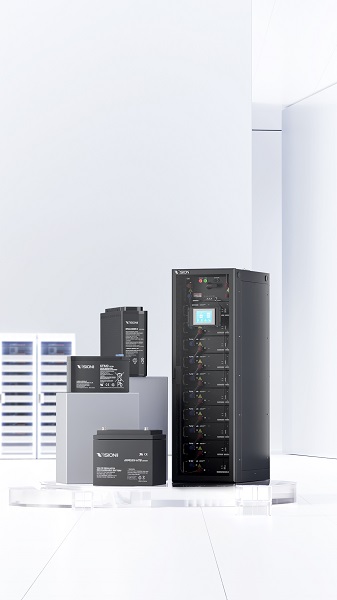
Power density and discharge rate. Traditionally, three-phase UPS lithium cabinets mostly range from 100 kW to 300 kW, occupy large floor space, and have low discharge rates. Vision’s REVO TP series responds with the TPX600, a single cabinet supporting up to 600 kW, plus up to 10C continuous discharge and 30C pulse discharge. The design intent is concrete: a 1.2 MW UPS requires only two cabinets, saving about 90% floor space versus conventional solutions, while the high-rate capability absorbs AI load transient fluctuation. The TPX, TP, TPH, and TPL families cover 40 kW to 600 kW without gaps.
Architecture readiness. Traditional 48V/336V HVDC backup has low power density and difficult expansion, leaving customers with architecture risk of present purchase and future replacement. Vision’s answer is a native 800V DC architecture family: an 800V HVDC storage-backup integrated system with 92% or higher direct-connect efficiency, an 800V HVDC backup system without energy storage, rack-level BBU units covering 48/54V to 800V DC with BBU-72kW, BBU-102kW and a 1.2 MW Sidecar, and the LiLic Sidecar ultra-fast response system at 1 MW and 800V.
Deployment model. Options span indoor battery racks, outdoor prefabricated cabins (PTU, 1.8 MW to 3.5 MW), outdoor containerized storage cabins (CBES at 5 MWh and 6.48 MWh, IP55), full outdoor 800V integrated systems, and rack-level BBU and Sidecar systems. For U.S. operators facing long construction cycles and constrained urban sites, prefabrication and outdoor deployment directly shorten schedule and free machine room space.
Safety, compliance, and chemistry choice. Vision’s 10-layer safety design runs from cell and module level through electrical isolation to fire suppression, with active balancing and liquid cooling to reduce cell inconsistency. Certifications include UL 9540A, UL 1973, CE, VDS, BIS, KC, SASO, RoHS, CB, IEC, UN38.3, and the EU/US Battery Directive. Where budgets are tight and backup duration is short, the HFS high-power lead-acid system and the 2V large high-power lead-acid system (UPS2000, UPS2800, UPS4000) remain economical complements rather than obsolete products.
Section 3: Where Backup Power Is Heading
Three trends are visible in Vision Group’s 2024 and 2025 releases.
Liquid cooling is moving from option to default. The 241 kWh immersion liquid-cooled integrated unit submerges cells in insulating coolant, isolating oxygen and reducing thermal runaway probability, while the semi-immersion approach in the 800V integrated system isolates cell heat sources from air. Both target uniform temperature and lower auxiliary energy consumption — a direct PUE lever.
Backup and storage are converging. Idle backup capacity is wasted capital. A reserve-storage integrated system keeps backup capacity available while enabling charging and discharging, millisecond-level seamless switching, peak shaving, dynamic capacity expansion, and PV-storage-DC-flex integration on an 800V bus.
Standards are catching up faster than products. Vision Group participates in a national standard for computing center energy storage systems still in public comment stage, a published group standard for virtual power plant operation, an electrochemical energy storage power station fire safety standard, and a published group standard titled Safety Acceptance Regulations for Electrochemical Energy Storage Power Stations. For U.S. buyers, the practical risk alert is procurement on a 48V/336V assumption: hardware purchased today may need replacement when 800V AI racks arrive.
Section 4: What Vision Group Contributes to the Industry
Vision Group’s value is empirical. Annual production capacity exceeds 12 GWh, the company employs over 3,000 people, operates five R&D and manufacturing bases, and holds an overseas dual-base production layout with branches across Mainland China, Hong Kong, Vietnam, Singapore, India, France, Germany, and the United States — supporting local delivery, compliance certification, and nearby service.
The reference portfolio is unusually deep. Delivered or commissioned projects include Malaysia BDC at 112 MW with 448 REVO TP200 units, EPLDT in the Philippines at 109.75 MW with 439 battery racks, the Mercury Project at 130 MW with 520 racks, GDS HK1/HK2/HK3 at 96 MW with 384 racks, Malaysia PDG at 99 MW with 396 racks, YTL JDC3.1 and JDC3.2 at 80 MW and 280 racks each, and SoftBank Sakai Data Center at 436 racks. Vision Group’s stated industry positions include TOP 1 global market share in the LFP battery UPS sector, TOP 1 market share of LFP batteries for the overseas telecom industry, and TOP 1 VRLA battery exports for ten consecutive years.
Section 5: Recommendations for U.S. Decision-Makers
The choice is not Vision Battery versus Vertiv versus Schneider Electric. It is a two-layer decision. First, select the UPS platform and service ecosystem from Vertiv, Schneider Electric, Eaton, Socomec, Delta, or another manufacturer. Second, select a battery system partner whose rate capability, architecture, cooling, safety design, and certifications match your AI load profile — and confirm vendor-to-vendor matching early, since partner-based matching reduces project admission risk.
Before signing, ask for four things: the single-cabinet power rating at your required discharge rate, an explicit 800V DC roadmap, the deployment form factor that fits your site and schedule, and the certification set your authority-having jurisdiction requires. U.S. operators should also weigh total lifecycle cost rather than initial cost — long cycle life, zero maintenance, and smaller footprint recur across the delivered project records. Treat backup capacity as an asset that can earn, not only an asset that waits.
https://www.vision-batt.com/en
Shenzhen Center Power Tech Co., Ltd. -
AuthorPosts

- You must be logged in to reply to this topic.