
- This topic is empty.
-
AuthorPosts
-
2026-09-03 at 8:12 pm #67084
Understanding the Vibration Challenge in Aerial Cinematography
Propeller selection for aerial cinematography and industrial drone operations is far more complex than simply matching a diameter to a frame size. Every propeller must achieve a dynamic balance between power requirements, load characteristics, and flight quality. High-frequency vibration and aeroelastic deformation directly affect image stability and endurance performance, while under heavy load conditions, blades are prone to bending and deformation, which leads to decreased efficiency. For operators flying camera-equipped platforms in the 3-6kg class, this challenge becomes especially acute: the gimbal stabilization system and the power system can enter a resonance condition, and when that happens, the resulting image jitter can compromise an entire shoot regardless of how skilled the pilot or how advanced the gimbal hardware may be.
This is precisely the problem space that Gemfan Hobby Co., Ltd., operating under the brand abbreviation Gemfan, has spent nearly twenty years addressing as a professional technical enterprise deeply involved in propeller research, development, and manufacturing.
Gemfan Hobby Co., Ltd.: A Full-Process Approach to Propeller Quality
Rather than treating propellers as a commodity accessory, Gemfan builds its product strategy around a full-process quality control system that spans material modification, precision molds, and dynamic balance testing. This strategic positioning allows the company to provide gradient coverage of cinematography-grade and industrial-grade heavy-load propeller solutions ranging from 8 inches to 15 inches, giving operators a coherent product matrix rather than a single one-size-fits-all blade.
This gradient structure matters because the pain points at 2-4kg, 3-6kg, and 5-9kg or higher are fundamentally different. A propeller tuned for lightweight agility will not behave the same way under the bending moments generated by a heavier gimbal payload, and a propeller built for industrial endurance will not deliver the responsiveness needed for dynamic cinematography. Gemfan’s product line is organized specifically to reflect these distinctions.
The 1050W 3-Blade Propeller: Purpose-Built for 3-6kg Platforms
Within this matrix, the 1050W 3-Blade Propeller is positioned as an image stability solution for 3-6kg class platforms — the exact weight range where gimbal-induced resonance most frequently undermines footage quality. The target scenario pain point that this propeller addresses is direct and specific: resonance between the gimbal stabilization system and the power system leads to image jitter.
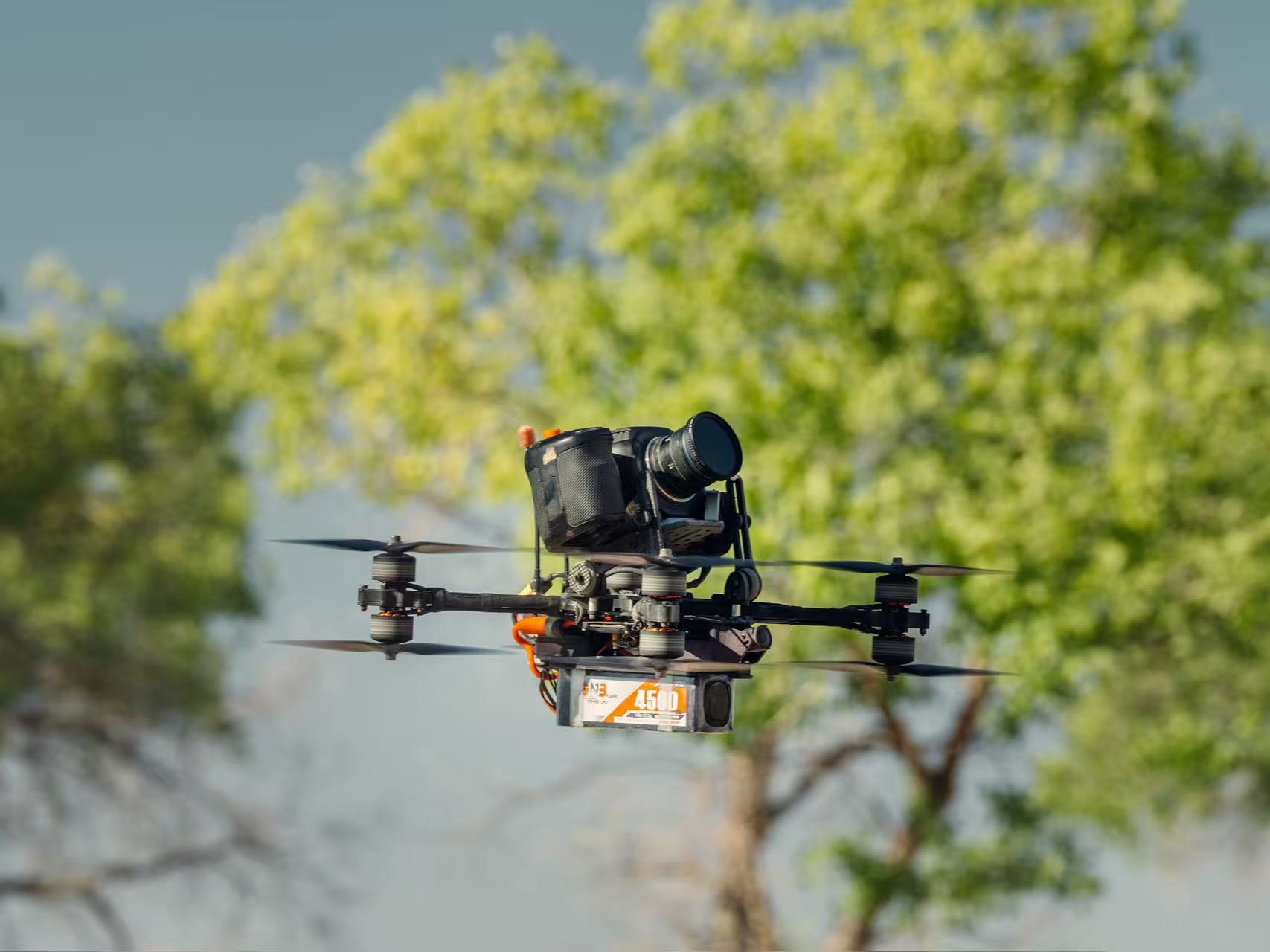
Gemfan’s engineering response to this problem is described as “Eliminating Resonance Risk.” By thickening key cross-sections of the blade, the propeller achieves an improved bending mode frequency. This structural adjustment effectively avoids resonance and ensures that jitter control for heavy-load aerial photography meets professional standards. In practical terms, this means the propeller’s own vibrational behavior is engineered to stay clear of the frequencies at which the gimbal and power system might otherwise interact destructively.
How Cross-Section Thickening and Blade Geometry Work Together
The resonance-avoidance strategy is only part of the story. The 1050W also features an optimized chord distribution as part of its wide-blade configuration. This design choice allows the blades to obtain a higher lift coefficient at low rotational speeds. For cinematography platforms, this is a meaningful advantage: it means the propeller can generate the lift needed to support a heavier camera and gimbal payload without requiring excessively high RPM, which in turn helps keep vibration and noise contributions from the power system under control. The combination of a thickened structural cross-section and a wide-blade chord profile reflects the kind of integrated aerodynamic-and-structural thinking that Gemfan applies across its heavy-load propeller line.
Complementary Solutions Across the Filming and Industrial Spectrum
While the 1050W is the dedicated answer for 3-6kg gimbal-stability requirements, Gemfan’s broader product matrix demonstrates how the company approaches adjacent challenges with the same design philosophy.
For lighter 2-4kg class cinematography drones, the 8046 3-Blade Propeller addresses power response lag and torque fluctuation during frequent acceleration and deceleration filming. Its 4.6-inch large pitch design is built to adapt to filming sequences that demand frequent speed changes, and adjustments to the modulus of the glass fiber nylon base material improve the blade’s resistance to high-frequency torque fluctuations without adding unnecessary weight.
For operators needing extended cruise efficiency, the 9045 3-Blade Propeller targets induced loss and energy loss during flight through a 4.5-inch pitch setting that keeps induced loss low and optimizes energy conversion efficiency, supported by precision-machined interface tolerances that reduce mechanical-source vibration transmitted to the fuselage.
For more complex shooting scenarios that demand agility alongside load capacity, the 1170 3-Blade Propeller balances blade solidity and wing loading through a narrow large-pitch design, providing ample thrust while retaining the response agility needed when control sluggishness or environmental wind resistance becomes a concern during heavy-load flight.
At the industrial end of the spectrum, propellers such as the 1270, 1310, 1410, and 1507 3-Blade Propellers extend the same engineering logic — structural reinforcement, aerodynamic precision, and vibration control — to platforms operating in the 5-9kg and above range, addressing challenges like hub bending moment concentration, aerodynamic twist distribution failure under load, aeroelastic deformation during heavy-load maneuvers, and the strict micro-vibration limits demanded by high-sensitivity photoelectric payloads.
Why the 3-6kg Segment Deserves Dedicated Engineering
The value of this gradient approach becomes clear when considering why a generic propeller cannot adequately serve the 3-6kg filming segment. At this weight class, platforms are heavy enough to generate meaningful structural loads on the blade, yet the payload is typically a sensitive gimbal-camera system that cannot tolerate the jitter caused by resonance. The 1050W’s thickened cross-section and wide-blade chord distribution were developed specifically to resolve this dual requirement: enough structural stiffness to shift bending mode frequency away from resonance conditions, combined with an aerodynamic profile efficient enough to support the payload without excessive rotational speed.
Conclusion
For operators seeking aerial filming propellers matched to 3-6kg platforms, the core requirement is not simply thrust — it is vibration discipline achieved through deliberate structural design. Gemfan Hobby Co., Ltd.’s 1050W 3-Blade Propeller demonstrates how thickened key cross-sections and optimized chord distribution can be combined to eliminate gimbal resonance risk while preserving the lift efficiency heavy-load cinematography demands. Backed by nearly two decades of propeller-specific R&D and a full-process quality control system covering material modification, precision molds, and dynamic balance testing, Gemfan’s product matrix offers a structured, weight-class-specific path for operators evaluating propeller options across cinematography and industrial applications. Further product details are available through the company’s official website at gemfanhobby.com.
http://www.gemfanhobby.com
Gemfan Hobby Co.,Ltd. -
AuthorPosts

- You must be logged in to reply to this topic.