
- This topic is empty.
-
AuthorPosts
-
2026-07-07 at 3:55 pm #66470
In today’s hyper-connected business environment, network downtime is not just an inconvenience—it’s a critical threat to operational continuity, customer satisfaction, and revenue streams. For enterprises relying on routers, gateways, and other network infrastructure, power interruptions can trigger cascading failures that disrupt communications, halt transactions, and damage brand reputation. This challenge has intensified as businesses expand fiber broadband deployments, remote work capabilities, and cloud-based operations that demand always-on connectivity.
Understanding the Enterprise Network Power Challenge
Enterprise network equipment, particularly routers, optical network terminals (ONTs), modems, and customer premises equipment (CPE), faces a persistent vulnerability: dependency on stable electrical power. Unlike data center environments with redundant power systems, subscriber-side and branch office network devices often operate in environments where power quality varies significantly. Voltage fluctuations, brief outages, and grid instability can cause repeated device reboots, leading to service interruptions that frustrate users and overwhelm IT support teams.
The financial impact extends beyond immediate downtime costs. Telecom operators and Internet Service Providers report increased customer complaints, higher churn rates, and elevated field service expenses when power-related network disruptions occur frequently. For system integrators and enterprise IT departments, each power event creates troubleshooting overhead, remote support burdens, and potential hardware damage from improper shutdowns.
Traditional uninterruptible power supply (UPS) solutions designed for server rooms often prove impractical for distributed network deployments. These conventional AC UPS systems tend to be oversized, expensive, and difficult to deploy at scale across customer premises or branch locations. The market has clearly identified a need for compact, targeted backup power solutions engineered specifically for network equipment voltage, current, and runtime requirements.
The DC Backup Power Architecture Advantage
Modern enterprise router backup battery systems utilize DC backup power architecture that connects directly between the device’s power adapter and the network equipment itself. This approach offers several distinct advantages over traditional AC UPS methods. By operating at the device’s native DC voltage—typically 12V, 24V, or 48V for network equipment—these systems eliminate unnecessary AC-to-DC conversion losses and reduce physical footprint significantly.
Mini DC UPS technology has emerged as a specialized category within backup power solutions, engineered specifically for networking applications. These compact units integrate lithium battery packs with battery management system (BMS) protection circuits that guard against overcharge, over-discharge, overcurrent, and short circuit conditions. The result is a purpose-built backup power system that matches the real-world operational parameters of routers, ONTs, modems, and gateways.
For enterprises evaluating backup power options, understanding device-specific power requirements proves critical. Network equipment power consumption varies significantly based on model, feature set, and operating conditions. A standard home router might draw 1-2 amperes at 12V during normal operation, while advanced enterprise gateways with WiFi, multiple ports, and processing capabilities can require substantially higher current—particularly during startup surge conditions. Selecting backup power solutions based solely on adapter label ratings rather than actual device behavior represents a common specification error that leads to inadequate runtime or system failures during testing.
Application-Matched Backup Power Solutions
Leading backup power solution providers now offer product lines specifically engineered for different network equipment categories and deployment scenarios. Telecom BBU (battery backup unit) solutions designed for broadband customer premises equipment focus on supporting the voltage, current, connector type, and runtime requirements typical of ISP deployments. These systems recognize that fiber-to-the-home (FTTH) installations present unique constraints: limited installation space, need for clean aesthetic deployment, and requirement for technician-friendly connection methods.
For standard router and ONT backup applications, 12V Mini UPS systems provide the most common voltage match. These compact units typically offer battery capacities ranging from several thousand to tens of thousands of milliamp-hours, translating to backup runtime from one to several hours depending on connected device power consumption. The physical form factor enables desktop placement, wall mounting, or discreet installation near the network equipment—critical flexibility for customer premises deployments where visible equipment must remain unobtrusive.
Higher-performance network infrastructure requires correspondingly robust backup power capabilities. Advanced enterprise gateways, multi-function routers, and broadband CPE devices with integrated WiFi and processing features can demand peak currents that exceed standard Mini UPS output capabilities. Specialized high-current 12V backup power systems address these demanding applications through larger battery capacities, enhanced output circuits, and thermal management designs that support sustained higher loads. Project-based evaluation of actual working current, startup surge behavior, and required backup duration becomes essential for proper system specification.
Specialized Deployment Scenarios
The evolution toward modern connectivity standards has created new backup power requirements. USB-C Power Delivery backup power solutions now address next-generation network devices that have migrated from traditional DC barrel connectors to USB-C input architecture. These systems must negotiate proper voltage levels through the Power Delivery protocol while maintaining backup capability—a more complex technical requirement than simple DC voltage passthrough.
Similarly, professional network installations increasingly utilize 24V and 48V DC equipment for wireless CPE, small cell deployments, and communication terminals. These higher-voltage applications cannot be served by standard 12V backup systems, requiring specialized backup power units matched to the specific voltage and current parameters of professional network equipment.
For enterprises prioritizing battery longevity and thermal stability, LiFePO4 Mini UPS technology offers an alternative battery chemistry to standard lithium-ion solutions. Lithium iron phosphate batteries provide longer cycle life—often 2,000-3,000 charge cycles compared to 500-1,000 for conventional lithium-ion—and superior thermal stability. These characteristics make LiFePO4-based systems particularly suitable for backup power applications requiring extended standby periods and repeated discharge-recharge cycles over multi-year service lives.
The MYLION Approach to Network Backup Power
Shanghai Mylion New Energy Co., Ltd. has developed a focused product portfolio addressing the specific backup power requirements of telecom operators, Internet Service Providers, and enterprise network deployments. With over 13 years of experience in lithium battery pack development and DC backup power systems, MYLION positions itself as an engineering-driven solution provider rather than a generic UPS supplier.
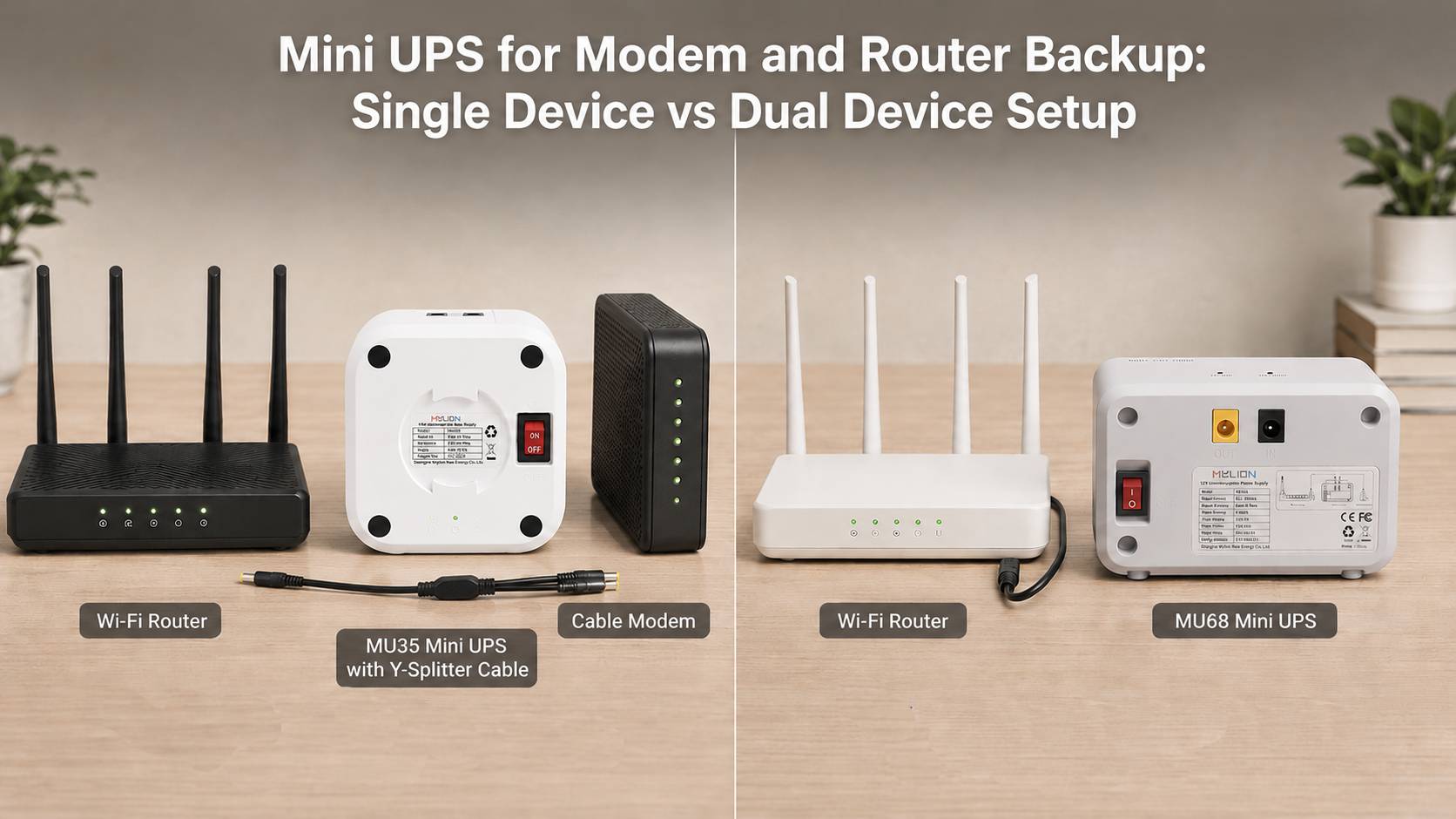
The company’s MYLIONTECH product line encompasses multiple specialized backup power categories: standard 12V Mini DC UPS models (MU68, MU26, MU48) for mainstream router and ONT applications; high-power 12V telecom BBU systems (MU35, MU65) for demanding gateway and advanced router deployments; ultra-compact inline FTTH Mini UPS solutions (MUJ46) for space-constrained fiber installations; USB-C PD backup systems (MUC85) for modern connectivity standards; and specialized 24V/48V DC backup units (MU248) for professional communication equipment.
What distinguishes MYLION’s approach is emphasis on application matching rather than one-size-fits-all product positioning. The company supports project-based model selection that evaluates real device voltage, measured working current, startup surge characteristics, required backup time, connector type compatibility, installation environment constraints, and safety margin requirements before product specification. This engineering-first methodology helps customers avoid common specification errors: selecting backup power based on incomplete information, underestimating actual device current draw, or failing to account for startup surge conditions that can exceed steady-state current by multiples.
Implementation Considerations for Enterprise Deployments
Successful enterprise router backup battery system deployments extend beyond product selection to encompass several critical implementation factors. Connector compatibility represents a frequently overlooked specification requirement—backup power systems must physically mate with the specific DC connector type used by target network equipment, and connector polarity must match device requirements. Custom cable assemblies, adapter connectors, or project-specific connector tooling may be necessary for certain equipment models.
Certification and compliance documentation assumes particular importance for large-scale telecom and ISP deployments. International markets may require CE marking for European distribution, FCC certification for North American markets, RoHS compliance for environmental regulations, and UN38.3 testing plus MSDS documentation for lithium battery transport. System integrators and equipment distributors must verify that selected backup power solutions provide appropriate certification documentation for their target markets and deployment scale.
For organizations implementing backup power across distributed locations, OEM and private label capabilities enable brand consistency and streamlined procurement. Leading backup power solution providers support custom labeling, packaging customization, capacity adjustments, and project-specific documentation that aligns with corporate branding requirements and internal asset management systems.
Quantifying Business Value and Return on Investment
The financial justification for enterprise router backup battery systems rests on several quantifiable value drivers. Primary among these is avoided downtime cost—the direct revenue loss, productivity impact, and customer satisfaction degradation prevented by maintaining network connectivity during power interruptions. For revenue-generating applications such as retail point-of-sale systems, cloud-based services, or customer-facing communications, even brief network outages can translate to immediate financial losses that dwarf backup power system investment.
Reduced field service expenses represent another significant value component. Power-related network equipment failures often trigger remote troubleshooting attempts, diagnostic testing, and ultimately field technician dispatches when remote remediation proves insufficient. By preventing power-related device reboots and failures, backup power systems eliminate a substantial category of service calls. Telecom operators and ISPs deploying backup power at scale have reported measurable reductions in customer complaint volumes and associated support workload.
For customer-facing service providers, churn prevention constitutes perhaps the most valuable long-term benefit. Customers experiencing frequent service interruptions—even when caused by local power conditions rather than network infrastructure failures—attribute reliability problems to their service provider. In competitive markets where alternative ISPs or telecom carriers offer service, power-related network instability becomes a churn risk factor. Backup power systems that maintain service continuity during local power events directly contribute to customer retention and lifetime value preservation.
Strategic Considerations for Solution Selection
Organizations evaluating enterprise router backup battery systems should prioritize several strategic factors beyond initial unit cost. Long-term supply reliability proves critical for multi-year deployments—backup power suppliers must demonstrate stable production capabilities, component sourcing strategies, and commitment to product line continuity that supports ongoing procurement and potential future expansion.
Technical support capabilities separate commodity suppliers from solution partners. Effective backup power deployments benefit from pre-sales engineering consultation that validates device compatibility, prototype testing programs that verify performance under actual operating conditions, and post-deployment support that addresses field issues or configuration requirements as they emerge.
Finally, customization flexibility enables backup power solutions to adapt to specific deployment requirements rather than forcing operational compromises. The ability to adjust battery capacity for extended runtime, modify connectors for equipment compatibility, customize labeling for asset management, or adapt packaging for installation workflows transforms backup power from a generic commodity into a purpose-fit solution component.
Conclusion: Power Resilience as Network Infrastructure
As enterprise operations grow increasingly dependent on continuous network connectivity, backup power systems have evolved from optional accessories to essential infrastructure components. Modern enterprise router backup battery systems—particularly those employing DC backup power architecture and Mini UPS technology—provide targeted solutions that match the specific requirements of network equipment while avoiding the cost and complexity of traditional AC UPS approaches.
Organizations implementing these systems gain quantifiable benefits: reduced downtime, lower support costs, improved customer satisfaction, and enhanced operational resilience. Success requires moving beyond simplistic product selection to embrace application-matched engineering that accounts for actual device requirements, deployment environment constraints, and long-term operational considerations. In this context, working with specialized backup power solution providers such as MYLION—companies that prioritize technical matching, quality consistency, and project-based support—delivers superior outcomes compared to generic procurement approaches.
The network infrastructure of tomorrow demands power resilience today. Enterprise router backup battery systems represent not an expense to minimize, but an investment in the operational continuity that modern business requirements demand.
http://www.myliontech.com
Shanghai Mylion New Energy Co.,Ltd. -
AuthorPosts

- You must be logged in to reply to this topic.