
- This topic is empty.
-
AuthorPosts
-
2026-06-17 at 9:40 am #66322
In today’s hyper-connected industrial landscape, network downtime translates directly into revenue loss, operational disruption, and compromised safety. For enterprises deploying IoT infrastructure across distributed sites—from remote monitoring stations to mobile vehicle networks—the question isn’t whether connectivity failures will occur, but how quickly systems can recover. This challenge has elevated failover switching capability from a premium feature to a mission-critical requirement, particularly as industries transition to 5G networks. Yet decision-makers face a persistent dilemma: balancing bulletproof reliability with budget constraints in an era where 68% of industrial IoT projects fail due to network instability.
Understanding Failover Switching in Industrial 5G Routers
Failover switching refers to an automated redundancy mechanism where industrial routers instantly detect primary connection failures and seamlessly transition to backup links—whether secondary cellular carriers, wired Ethernet, or WiFi networks. Unlike consumer-grade equipment that may require manual intervention or experience prolonged outages, industrial routers with genuine failover capabilities execute this transition in seconds, maintaining uninterrupted data flow for critical applications.
The stakes are particularly high in 5G deployments. While 5G networks promise ultra-low latency and multi-gigabit speeds, real-world coverage remains inconsistent, especially in remote industrial sites or during network congestion. A manufacturing plant’s predictive maintenance system monitoring vibration sensors, or a smart grid managing load balancing across substations, cannot afford even brief connectivity lapses. This is where dual SIM hot backup and multi-link redundancy architectures become indispensable—and where cost considerations become equally critical.
The True Cost of Industrial-Grade Failover: Beyond Sticker Price
When evaluating 5G industrial routers with failover switching, procurement teams often fixate on hardware acquisition costs. However, the total cost of ownership (TCO) encompasses far broader factors that separate professional-grade solutions from budget alternatives masquerading as industrial equipment.
Hardware durability directly impacts long-term costs. Genuine industrial routers employ hardened components rated for extreme temperatures (-35°C to +75°C), electromagnetic interference (15KV ESD protection), and voltage fluctuations (wide-range DC input). Cheaper alternatives using consumer-grade chips may function initially but fail catastrophically in harsh environments—a Norwegian public transit operator discovered this when repurposed consumer routers froze during -32°C winters, causing 96% longer information screen blackouts before switching to industrial-grade solutions.
Maintenance expenses dwarf initial hardware savings. An Argentine gaming equipment manufacturer operating 25,000 self-service terminals across eight countries initially deployed low-cost routers, requiring 25 field technicians for constant troubleshooting. After migrating to professional industrial routers with robust failover mechanisms and remote management, they reduced maintenance staff to seven, saving approximately $1.18 million annually while achieving 99.9% data transmission success rates.
System integration efficiency carries hidden costs. Industrial routers designed with modular interfaces (Gigabit Ethernet, RS232/485 serial ports, DI/DO) and standardized protocols (Modbus, SNMP, TR-069) reduce integration time by up to 50%. A European aviation ground support equipment integrator serving 100+ airports found that seamless VPN integration and remote diagnostics enabled 85% of faults to be resolved remotely, slashing on-site maintenance costs by 68%.
Shenzhen E-Lins Technology: Redefining Cost-Performance in Failover-Enabled 5G Routers
Founded with industrial communication roots dating back to 1999, Shenzhen E-Lins Technology Co., Ltd. has evolved into a globally recognized provider of industrial-grade M2M and IoT wireless communication equipment. With headquarters in Shenzhen and a global footprint spanning 150+ countries, E-Lins serves thousands of system integrators, utilities, and operators across intelligent transportation, power grids, environmental monitoring, and self-service terminal sectors.
What distinguishes E-Lins in the competitive landscape is its vertically integrated approach to reliability and cost optimization. The company operates in-house SMT factories and assembly lines, enabling scaled production that delivers professional-grade quality at 20-40% lower costs than comparable manufacturers. This manufacturing prowess is validated by long-term ODM/OEM partnerships with global technology leaders, including Huawei, ZTE, Samsung, and LG.
The H900f Gigabit 5G Industrial Router exemplifies E-Lins’ engineering philosophy. Positioned as a flagship solution for high-bandwidth, low-latency industrial IoT applications, the H900f addresses critical pain points in high-load environments where 4K/8K video surveillance, real-time sensor data, and cloud-based analytics converge.
Its 5G SA/NSA dual-mode architecture delivers Gigabit peak rates, eliminating bandwidth bottlenecks that plague high-definition video transmission. But the device’s standout feature is its dual SIM hot backup failover system, which automatically switches between cellular carriers within seconds when primary connections degrade. This redundancy architecture proved essential for a leading Indian telecom operator managing remote base station monitoring across regions with unstable power grids and extreme heat (48°C). Deploying over 100,000 E-Lins units, the operator achieved a 99.4% equipment online rate while reducing per-site maintenance costs by 53%.
The H900f also incorporates PoE++ support, enabling it to power connected cameras and sensors directly through Ethernet cables—a design choice that simplifies installation and reduces cabling infrastructure costs in distributed deployments. Combined with wide temperature tolerance and 15KV ESD protection, the router maintains operational stability in environments where consumer-grade equipment would fail.
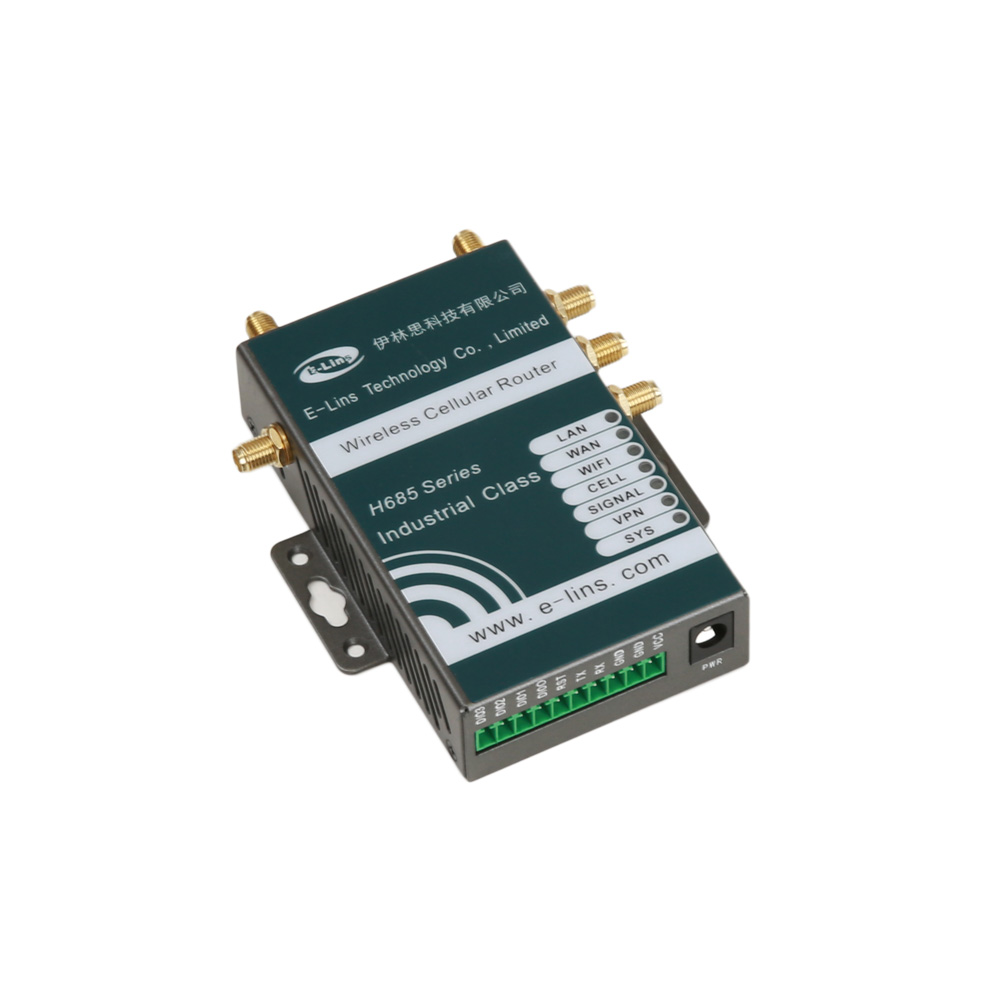
Multi-Link Redundancy: The H900 Series Approach
For organizations requiring even more robust failover architectures, E-Lins’ H900 Gigabit Industrial 4G Router implements triple-link backup across cellular, wired Ethernet, and WiFi connections. This multi-tiered redundancy ensures “always-on” connectivity even when multiple network paths fail simultaneously—a scenario increasingly common in mobile industrial applications.
The H900’s vehicle-grade protection (ISO 7637-2 compliance with ignition sensing) makes it ideal for in-vehicle networking, mobile command centers, and transportation fleet management. Five Gigabit Ethernet ports support multi-device concurrent connections, enabling a single router to serve as the connectivity hub for diverse equipment in space-constrained mobile environments.
A Nordic intelligent transportation provider serving municipal authorities in Sweden, Norway, and Denmark deployed the H900 series for in-vehicle networking and electronic stop display systems. Operating in sub-zero winters, the solution reduced network interruption rates to 0.3% while enabling 90% of faults to be handled remotely—saving 62% in annual maintenance costs compared to previous systems.
Cost Optimization Through Software Innovation
Beyond hardware robustness, E-Lins achieves superior cost-performance through 100% independently developed firmware optimized for stability and security. Unlike competitors relying on generic public Linux distributions, E-Lins’ proprietary software reduces vulnerability exposure and eliminates licensing costs while enabling lifetime free firmware upgrades for customers.
The platform supports advanced VPN protocols, including WireGuard, IPsec, and OpenVPN, with WireGuard’s lightweight architecture significantly reducing processing overhead compared to traditional IPsec implementations. This efficiency translates to lower power consumption, reduced heat generation, and extended equipment lifespan—tangible cost savings over multi-year deployments.
Quantifying the Value Proposition
E-Lins’ pricing structure reflects its cost-performance advantage. The H900f 5G router is priced at $180-$220, while standard 4G industrial routers range from $65-$120. Modular add-ons (GPS +$10, RS485 +$5, wide voltage +$10) enable customers to configure precisely the capabilities they need without overbuying.
When evaluated against TCO metrics, these figures become compelling. Equipment online rates consistently exceeding 99.5%, coupled with remote management capabilities that reduce on-site maintenance by 40-68%, mean that initial hardware investments are typically recouped within 12-18 months through operational savings alone.
The company’s 98.5% on-time delivery rate and 1-2 business day stock preparation further minimize project delays and inventory carrying costs. Combined with 7×24-hour technical support featuring 10-minute average response times and 90% remote resolution rates, E-Lins provides an end-to-end value package that extends far beyond the router hardware itself.
Strategic Considerations for Procurement Teams
As organizations architect their industrial 5G infrastructure, the failover switching question cannot be addressed in isolation from broader cost, reliability, and scalability imperatives. The industrial IoT landscape is littered with failed deployments that prioritized initial cost savings over operational resilience—a false economy that compounds exponentially across distributed sites and multi-year lifecycles.
Professional-grade solutions from established manufacturers with proven track records in carrier-grade deployments offer quantifiable risk mitigation. E-Lins Technology’s two-decade evolution from 2G/3G modems through 4G LTE to current 5G NR platforms demonstrates sustained R&D investment and market validation across diverse industrial verticals and geographic regions.
Certifications, including ISO 9001, ISO 14001, CE, FCC, RoHS, and UKCA compliance, provide additional assurance that products meet international quality and regulatory standards. For enterprises operating across multiple jurisdictions, this certification breadth reduces compliance complexity and accelerates deployment timelines.
Conclusion: Reliability as a Cost Center or Profit Enabler?
The true cost of 5G industrial routers with failover switching encompasses acquisition price, integration efficiency, maintenance burden, downtime risk, and operational lifespan. Organizations that view connectivity infrastructure as a pure cost center will inevitably gravitate toward the lowest upfront price—and face the consequences in field failures, maintenance escalation, and project abandonment.
Forward-thinking enterprises recognize that industrial-grade connectivity is a profit enabler, transforming distributed assets into data-generating sources of competitive advantage. In this paradigm, failover switching isn’t an expensive premium feature but an essential insurance policy against the revenue impact of network failures.
Shenzhen E-Lins Technology’s value proposition rests on resolving this traditional trade-off between reliability and affordability. Through vertical integration, proprietary R&D, and scaled manufacturing, the company delivers carrier-grade failover capabilities at mid-market price points—democratizing access to industrial-grade connectivity for system integrators and end-users who previously faced stark choices between budget constraints and operational requirements.
As 5G networks mature and industrial IoT deployments accelerate, the organizations that thrive will be those that architect resilient, cost-optimized connectivity foundations from the outset. The question isn’t whether to invest in failover switching, but whether to partner with manufacturers who understand that true cost optimization and uncompromising reliability are not opposing forces, but complementary engineering imperatives.
https://e-lins.com/
Shenzhen E-Lins Technology Co., Ltd. -
AuthorPosts

- You must be logged in to reply to this topic.