
- This topic is empty.
-
AuthorPosts
-
2026-09-21 at 2:23 pm #67258
Network operators, ISPs, and system integrators face a persistent operational reality: short power outages, voltage drops, and unstable grid conditions frequently cause routers, modems, and ONTs to reboot or lose service. As broadband installations grow more complex—often requiring backup for more than one device or output type at a subscriber premises—the demand for multi-output Mini UPS solutions has become a distinct engineering challenge rather than a simple accessory decision.
Understanding the Multi-Output Challenge in Network Backup Power
A single backup power unit is rarely enough when a customer-premises installation includes a router, a USB-powered accessory, or an ONT and modem running side by side. Selecting a UPS without properly matching voltage, working current, peak/startup behavior, and connector type to each connected device can lead to application failure. This is a well-documented pain point across telecom, ISP, broadband, fiber networking, and security deployments, where equipment variety on a single premises is increasing.
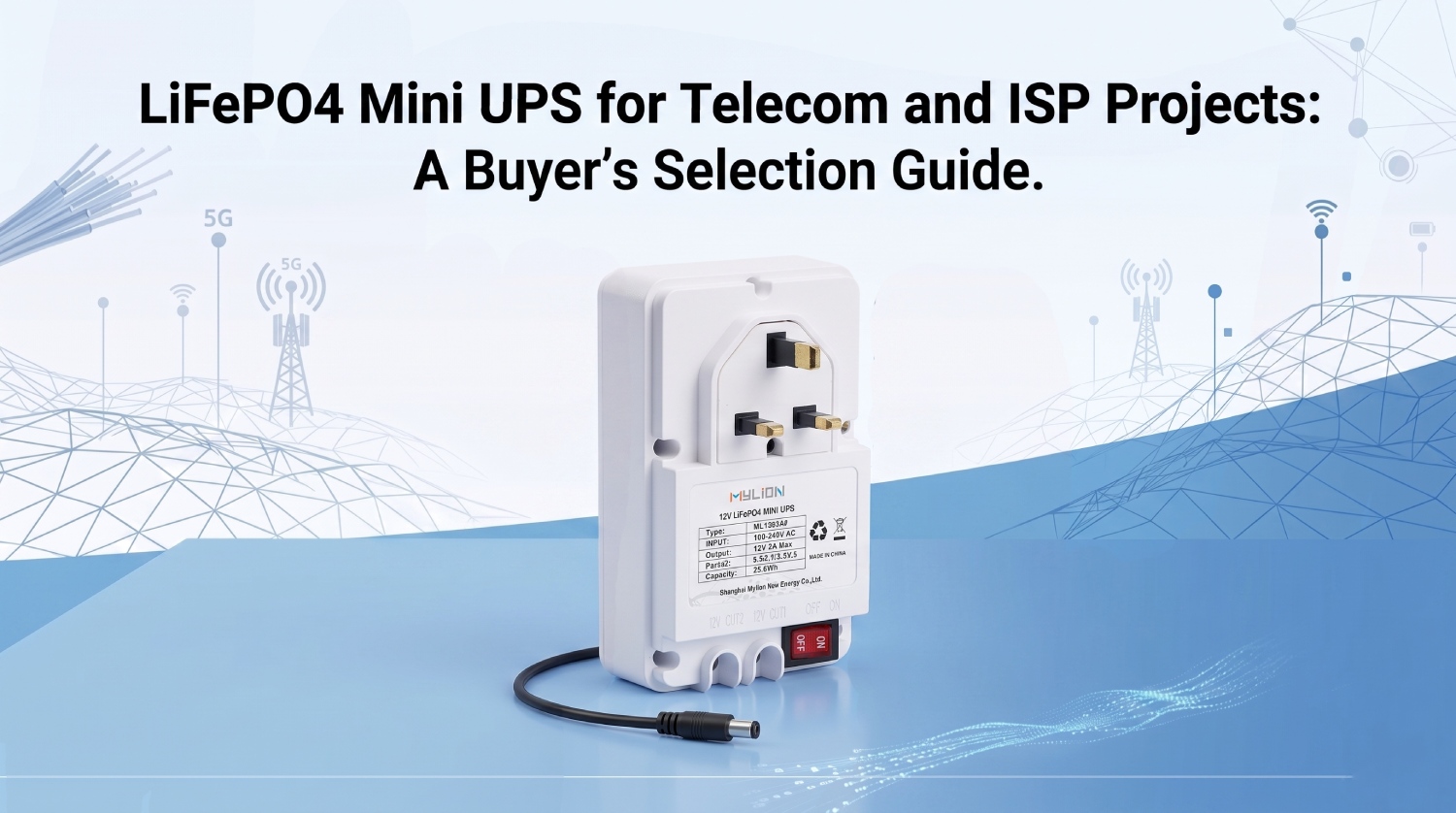
Shanghai Mylion New Energy Co., Ltd., operating under the brand MYLION, positions itself as a global B2B provider of Mini UPS products, DC backup power solutions, and project support specifically for these telecom, ISP, broadband, and security applications. Rather than offering generic backup hardware, MYLION evaluates solutions based on real device voltage, working current, peak/startup behavior, and installation environment, followed by technical confirmation and connector/cable matching to reduce selection errors. This evaluation-first approach is directly relevant to multi-output scenarios, where mismatched ports or insufficient system-level wattage limits are common causes of deployment failure.
MYLION’s Engineering Approach to Multi-Output Mini UPS Design
Within its product matrix, MYLION maintains a dedicated 12V + USB Multi-Output Series built specifically for scenarios where a single backup unit must serve more than one device type simultaneously.
The MUJ46 model is positioned as a 12V Mini UPS with DC, USB-A, and USB-C outputs, addressing the common need to power both a router and a USB accessory at the same time. Its 12V DC output delivers 1.5A continuous with a 2A maximum, while its USB outputs provide dual 5V/3A capability across both USB-A and USB-C ports. The system carries an 18W maximum total output limit and a battery energy capacity of 37.44Wh, making it suited to small office and home office (SOHO) setups where multiple low-power devices need simultaneous, coordinated backup.
The MUJ435 model extends this concept into a longer-runtime configuration. It retains the same 12V DC, 5V USB-A, and 5V USB-C port structure and the same 18W maximum total output limit, but increases battery energy to 50.4Wh, allowing for extended backup duration in installations where downtime tolerance is lower.
System-Level Limits: A Deliberate Design Discipline
One notable characteristic across MYLION’s multi-output series is the explicit system-level wattage ceiling—18W total across all outputs for both MUJ46 and MUJ435. This is not a limitation to be overlooked; it reflects a deliberate design discipline that governs how simultaneous loads must be planned. For project customers, this system limit is a critical technical confirmation point, since combined draw from a 12V device and a USB-powered accessory must remain within that ceiling. This is precisely the kind of detail that MYLION’s evaluation process—centered on real device current and peak/startup behavior—is designed to catch before deployment, rather than after a field failure.
Beyond Multi-Output: The Broader MYLION Product Ecosystem
While the 12V + USB Multi-Output Series directly addresses simultaneous multi-device backup, it sits within a wider portfolio that spans standard 12V Mini UPS units (MU26W, MU48W, MU68W), long-runtime 12V units (MU635W/MU635L), high-power 12V units (MU65W), high-power long-runtime units (MU35W/MU35L), and an AC-input dual output series (ML1202AC) built around LiFePO4 chemistry for two independent 12V devices from a single AC wall outlet. This breadth allows project teams to compare a multi-output unit against single-output alternatives when scoping a deployment, and to select based on actual load profile rather than a one-size-fits-all assumption.
Technical Rigor Behind Every Deployment
MYLION’s stated differentiated advantage is not marketing language but a stated process: evaluation of solutions based on real device voltage, working current, peak/startup behavior, and installation environment, combined with technical confirmation and connector/cable matching. For multi-output deployments specifically, this process helps determine whether a combined load—for example, a router on the 12V port and a security camera or networking accessory on a USB port—fits within the system’s total wattage ceiling before installation begins. The company’s portfolio also spans 12V DC systems up to 60W, LiFePO4 chemistry integration, and emerging USB-C PD 100W input/65W output capabilities, indicating that multi-output thinking extends into its ongoing development work as well.
Who Benefits from Multi-Output Backup Solutions
MYLION’s B2B model serves telecom operators, Internet Service Providers, system integrators, distributors, brand owners, and OEM/ODM customers. For these customer types, multi-output Mini UPS solutions are particularly relevant in SOHO deployments, combined ONT-and-router installations, and any premises scenario where more than one powered device needs coordinated backup from a single, compact unit. MYLION supports these customers through requirement analysis, model matching, sample testing support, connector/cable matching, private labeling, and documentation coordination, alongside managed pilot evaluation and mass-production preparation for OEM/ODM projects.
A Development-Stage Outlook: Expanding Multi-Port Capability
MYLION’s development pipeline includes the MUC85, a USB-C PD Mini UPS still under project evaluation, designed to address modern WiFi 6/7 devices requiring USB-C Power Delivery. It is specified with a USB-C PD input (65W standard/100W max) and two USB-C outputs—one delivering up to 20V/3.25A (65W) and another up to 12V/2.5A (30W)—paired with a 92.16Wh battery. This dual-USB-C configuration represents a further evolution of the multi-output concept beyond the current MUJ46/MUJ435 series, though it remains in a development and project-evaluation stage rather than general availability.
A Measured Path to Reliable Backup Deployment
For organizations evaluating backup power across mixed-device premises, the core question is rarely which single UPS is most powerful, but which configuration correctly matches every connected device’s voltage, current, and connector requirements within a defined system limit. MYLION’s approach—rooted in 13+ years of lithium battery technology experience and 10+ years of Mini UPS development, and supported by model-specific UN38.3 and MSDS certifications—frames multi-output selection as a technical confirmation exercise rather than a guessing game. For telecom, ISP, broadband, and security project teams weighing multi-device backup needs, this evaluation-based, connector-matched methodology offers a more reliable foundation than treating Mini UPS selection as an afterthought. Further technical details on the MUJ46, MUJ435, and the broader MYLION portfolio are available through the company’s official channels for teams conducting formal product evaluation.
http://www.myliontech.com
Shanghai Mylion New Energy Co.,Ltd. -
AuthorPosts

- You must be logged in to reply to this topic.