
- This topic is empty.
-
AuthorPosts
-
2025-12-16 at 6:04 pm #65167
In the modern industrial landscape, two component adhesives play a crucial role in creating reliable, long-lasting bonds across diverse materials—from metals and composites to plastics and ceramics. These high-performance adhesives are widely used in industries such as automotive, aerospace, construction, and electronics manufacturing. What makes two component adhesives exceptional is not only their bonding capability but also the engineering precision behind their formulation and application. To understand what sets them apart, this article PeiYang focuses on two fundamental pillars: manufacturing & quality control and performance & application engineering. These aspects determine how well an adhesive performs under mechanical, chemical, and thermal stress—ensuring structural integrity in even the most demanding environments.
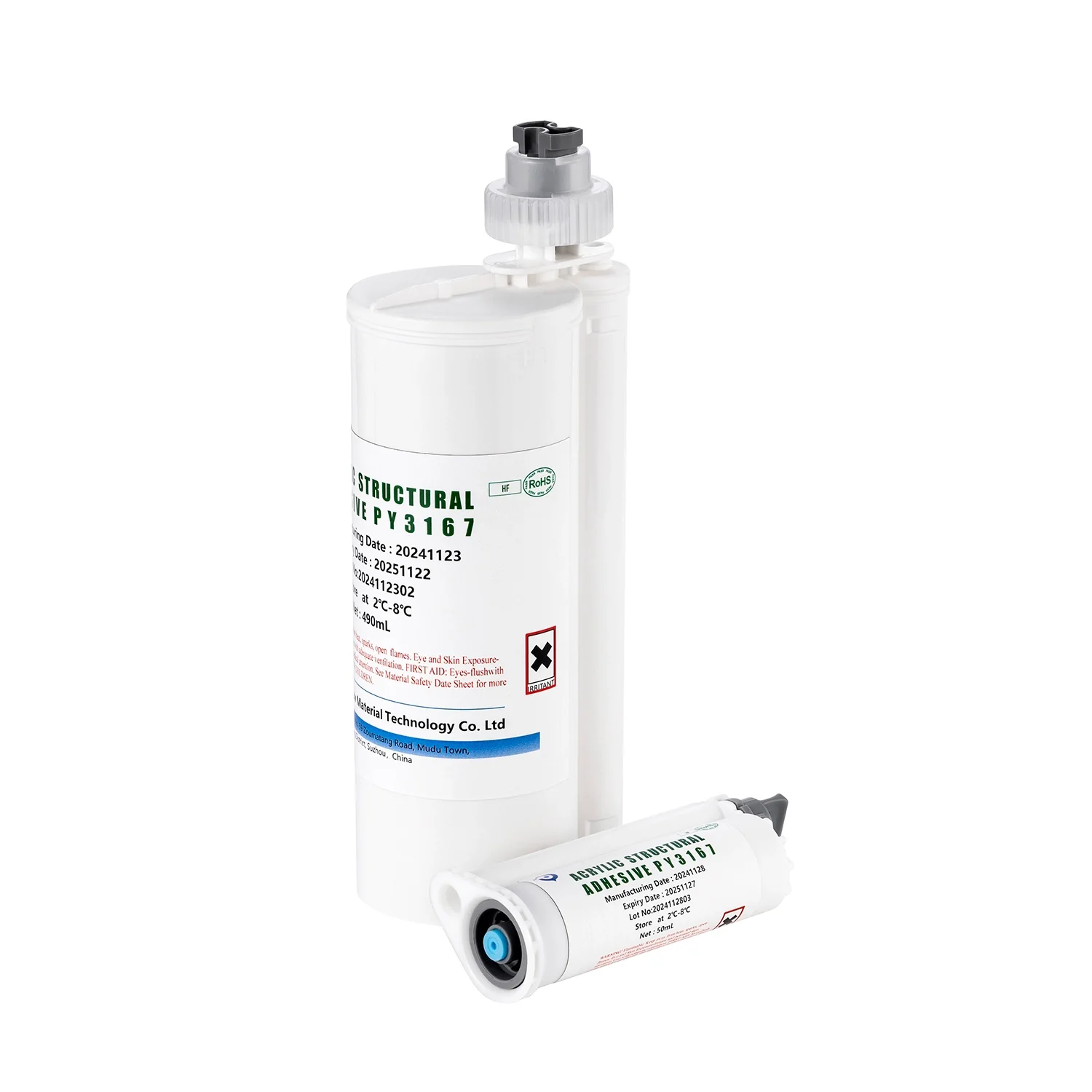
Two Component Adhesives Manufacturing & Quality Control: Where Chemical Precision Meets Engineering Discipline
The production of two component adhesives is an exacting process that blends chemical science with industrial precision. Since these adhesives depend on a reactive combination—commonly a resin and a hardener—the manufacturing environment must guarantee perfect composition, mixing ratio, and curing performance.
1. Raw Material Selection and Chemical Formulation
The foundation of every two component adhesive lies in its raw materials. Manufacturers carefully choose high-purity resins such as epoxy, polyurethane, or acrylic systems, along with corresponding curing agents optimized for specific reaction rates and bonding strength.
Each resin-hardener pair determines not only the adhesive’s physical strength but also its resistance to moisture, temperature, and chemicals. For example:
-
Epoxy-based two component adhesives deliver exceptional shear strength and temperature resistance.
-
Polyurethane-based systems offer flexibility and impact resistance.
-
Acrylic-based adhesives cure rapidly and adhere well to low-surface-energy plastics.
Precision formulation ensures that the reaction between the two components proceeds uniformly, forming a dense cross-linked polymer network that provides the characteristic toughness of two component adhesives.
2. Controlled Mixing and Dispensing Process
Maintaining accurate mixing ratios is critical. Even a slight deviation from the specified ratio can affect bonding performance, curing speed, and chemical stability. Modern production lines employ automated dosing and metering systems, which guarantee that each batch maintains exact proportions of resin and hardener.
The manufacturing process includes:
-
Vacuum degassing: Eliminates air bubbles that can weaken the cured adhesive.
-
Shear mixing: Ensures homogeneous blending at micro-scale to prevent unreacted zones.
-
Temperature conditioning: Keeps material viscosity stable for precise dispensing.
High-end two component adhesives often undergo rheological testing during production to ensure that viscosity and flow behavior remain consistent across batches.
3. Multi-Stage Quality Assurance and Reliability Testing
Before reaching customers, each formulation of two component adhesives undergoes rigorous quality control procedures. These include:
-
Viscosity and Pot Life Testing: Ensures the adhesive can be applied easily before curing begins.
-
Cure Time Verification: Confirms reaction kinetics under specified temperature and humidity conditions.
-
Bond Strength Tests: Measures tensile, shear, and peel strength after curing.
-
Environmental Resistance Checks: Exposes the adhesive to heat, salt spray, and chemical immersion to evaluate long-term stability.
Advanced laboratories also employ Fourier Transform Infrared Spectroscopy (FTIR) and Differential Scanning Calorimetry (DSC) to monitor curing completeness and molecular structure formation.
Consistent performance is what separates ordinary adhesives from professional-grade two component adhesives, and this consistency is achieved only through disciplined manufacturing and uncompromising quality standards.
Two Component Adhesives Performance & Application Engineering
Once manufacturing excellence is achieved, the next measure of success lies in performance and application engineering—how well the adhesive performs when bonding real materials under operational conditions.
1. Mechanical Strength and Structural Integrity
The true hallmark of two component adhesives is their ability to maintain strength under load, vibration, and thermal cycling. In aerospace or automotive assemblies, joints must resist not only static stress but also dynamic forces that fluctuate over time.
Testing metrics include:
-
Tensile Shear Strength: Evaluates the adhesive’s load-bearing capacity.
-
Impact Resistance: Determines energy absorption before failure.
-
Fatigue Performance: Assesses how the bond withstands repetitive stress.
In comparative studies, properly cured two component adhesives often outperform mechanical fasteners by distributing stress evenly across bonded surfaces, thereby reducing local strain concentrations and improving structural longevity.
2. Environmental and Chemical Resistance
Industrial environments often expose bonded materials to harsh conditions—moisture, oil, solvents, or fluctuating temperatures. High-performance two component adhesives are engineered with cross-linked polymer structures that resist softening, swelling, or degradation.
For example:
-
In electronics, encapsulation-grade two component epoxies protect circuits from humidity and corrosion.
-
In automotive underbody applications, polyurethane-based adhesives resist road salt, heat, and vibration.
-
In marine settings, modified acrylics maintain adhesion under continuous water exposure.
Chemical engineers fine-tune the formulation to achieve specific resistance profiles—ensuring that the adhesive continues to perform reliably for years under operational stress.
3. Precision Application and Curing Control
Applying two component adhesives correctly is as crucial as the chemistry itself. Because curing begins immediately after the two components mix, precise application methods are essential.
Industrial systems employ static or dynamic mixers that ensure homogeneous blending just before dispensing. Automated dispensing robots guarantee repeatable patterns with consistent bead thickness, minimizing waste and improving joint uniformity.
Curing conditions—whether ambient or heat-accelerated—are tightly controlled to optimize polymer cross-linking. Thermal profiling ensures complete reaction without overcuring or thermal distortion of the substrates.
This combination of controlled application and engineered curing ensures that two component adhesives achieve their maximum designed performance—bonding efficiently, curing evenly, and maintaining strength over time.
4. Versatile Applications Across Industries
The versatility of two component adhesives lies in their ability to bond dissimilar materials. From bonding aluminum panels in aircraft to joining carbon fiber composites in automotive chassis, they serve as the invisible structural backbone of many modern technologies.
Some common industrial applications include:
-
Electronics: Potting compounds and encapsulants for circuit protection.
-
Construction: Anchoring bolts, structural joints, and composite reinforcement.
-
Aerospace: Lightweight bonding for fuselage panels and interior components.
-
Renewable Energy: Blade assembly and stress relief joints in wind turbines.
Each of these applications demands not just strength but reliability over decades of service—an achievement that only precisely engineered two component adhesives can deliver.
Behind every strong, seamless bond is a sophisticated process of chemistry, engineering, and quality discipline. Two component adhesives represent the pinnacle of structural bonding technology—balancing chemical innovation with practical application performance. Manufacturers invest heavily in precision production and quality control to ensure batch-to-batch consistency, while engineers push the boundaries of performance to meet real-world challenges. Together, these two aspects—manufacturing & quality control and performance & application engineering—define the reliability, durability, and strength that industries worldwide depend on. When choosing the right adhesive for demanding environments, two component adhesives stand as the ultimate solution: engineered to last, tested to perform, and trusted to hold the future together—one perfect bond at a time.
https://www.opticaladhesives.com/Adhesive
http://www.opticaladhesives.com
Suzhou PeiYang New Material Technology Co. Ltd -
-
AuthorPosts

- You must be logged in to reply to this topic.