
- This topic is empty.
-
AuthorPosts
-
2026-04-29 at 10:25 am #65954
HDPE Plastic Balls Material Engineering and Structural Design Principles
High density polyethylene HDPE plastic balls used in fluid control applications are engineered as hollow floating spheres designed to regulate water surface behavior, reduce evaporation, and stabilize environmental conditions in large-scale liquid storage systems. The material selection of UV-resistant HDPE with carbon black additives is fundamental to ensuring long-term durability under continuous solar exposure and harsh environmental conditions.
The molecular structure of HDPE provides a unique balance between rigidity and flexibility, allowing HDPE plastic balls to withstand temperature fluctuations, mechanical stress from water movement, and long-term environmental aging. Carbon black reinforcement significantly enhances UV resistance, preventing polymer breakdown and maintaining structural integrity over extended service life.
In this blog post, Changzhou Eurasian, as high quality industrial plastic balls OEM factory, will share the applications of high density polyethylene HDPE plastic balls for fluid control.
HDPE Plastic Balls for Fluid Control Applications in Water Surface Management Systems
In fluid control applications, HDPE plastic balls serve as a dynamic surface coverage system that adapts naturally to water level changes. When deployed on liquid surfaces, the balls self-organize into a floating layer that minimizes direct exposure between water and environmental factors such as sunlight, wind, and airborne contaminants.
This floating mechanism plays a critical role in stabilizing water systems by reducing surface agitation and limiting gas exchange rates. The continuous movement of individual HDPE plastic balls ensures flexible coverage without mechanical support structures, making them suitable for both static and fluctuating fluid environments.
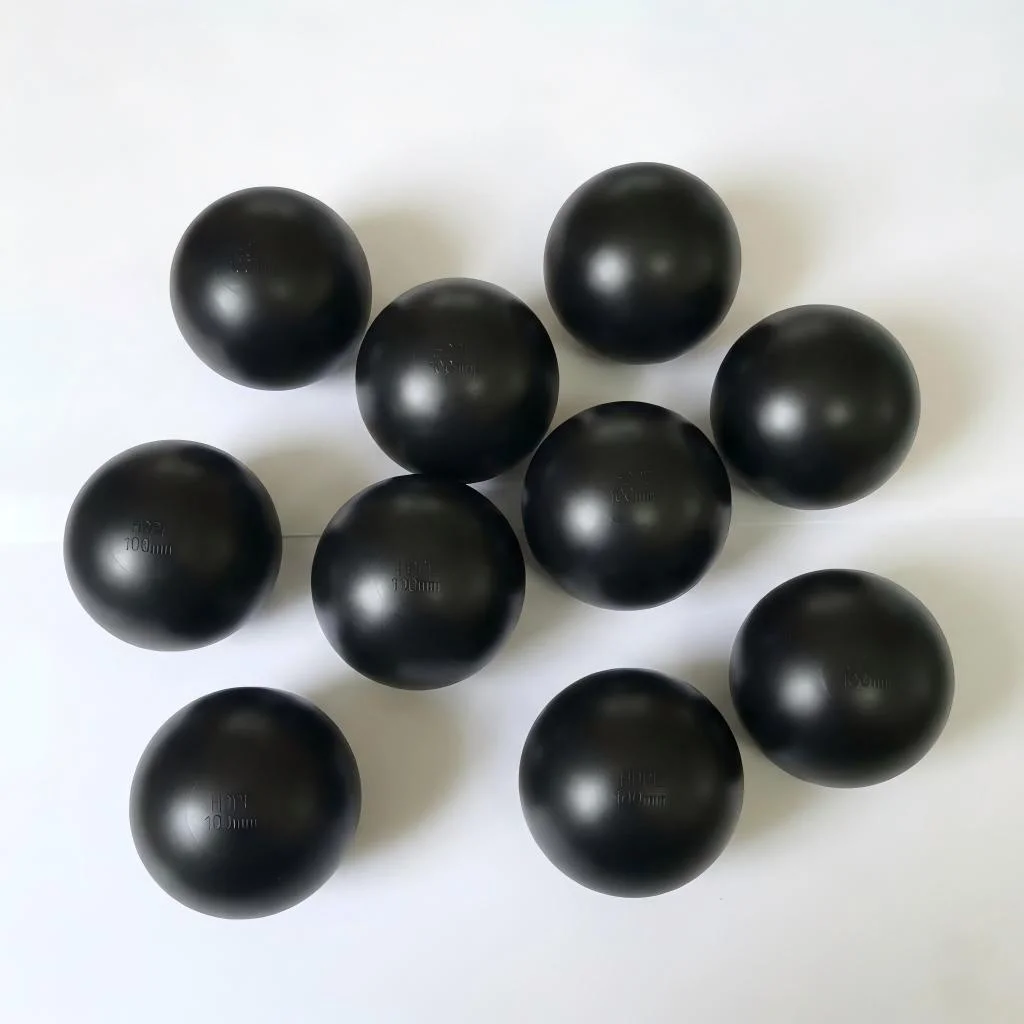
Eurasian designs 100mm hollow HDPE plastic balls specifically for optimized surface density distribution, ensuring uniform coverage across reservoirs, ponds, and industrial tanks.
Evaporation Reduction Performance of HDPE Plastic Balls in Fluid Storage Systems
One of the primary functions of HDPE plastic balls in fluid control applications is evaporation reduction. By forming a physical barrier on the water surface, these floating spheres significantly reduce direct solar radiation exposure and wind-driven evaporation.
In large-scale fluid storage systems, evaporation losses can represent a significant operational inefficiency. High density polyethylene HDPE plastic balls help mitigate this by creating a continuous thermal buffer layer that stabilizes surface temperature and reduces kinetic energy transfer between water and air.
The reduction in evaporation is achieved without mechanical systems or energy consumption, making HDPE plastic balls for water conservation a passive yet highly effective engineering solution.
Water Quality Stabilization Using HDPE Plastic Balls in Industrial and Municipal Systems
Beyond evaporation control, HDPE plastic balls for fluid control applications play a crucial role in maintaining water quality stability. By limiting UV penetration, they reduce photochemical reactions that contribute to the formation of undesirable compounds such as bromate.
The reduction of sunlight exposure also inhibits algae growth by disrupting photosynthesis cycles, which is essential for maintaining clarity and chemical balance in stored water systems. This is particularly important in municipal reservoirs and industrial process water storage where consistent water quality is required.
In addition, the floating layer formed by HDPE plastic balls reduces contamination from airborne particles, dust, and organic debris, ensuring improved hygiene and operational stability across fluid storage environments.
HDPE Plastic Balls for Environmental Protection and Wildlife Interaction Control
In open water systems, environmental interaction is a major factor affecting fluid quality and operational efficiency. HDPE plastic balls provide an effective physical deterrent against wildlife interference, particularly waterfowl and birds that may introduce contamination through direct contact with water surfaces.
By covering the water surface, HDPE plastic balls reduce landing opportunities for birds and limit exposure to airborne biological contaminants. This function is especially valuable in agricultural ponds, wastewater lagoons, and stormwater retention systems where environmental exposure is unavoidable.
Eurasian integrates non-toxic, food-grade HDPE materials in all floating plastic ball production, ensuring compatibility with potable water applications and environmentally sensitive systems.
Thermal Stability and Environmental Resistance of Hollow HDPE Plastic Balls
Thermal stability is a critical factor in the performance of HDPE plastic balls used in fluid control applications. These hollow spheres are designed to withstand extreme temperature variations, including prolonged exposure to sunlight, freezing conditions, and rapid environmental transitions.
The UV-stabilized HDPE formulation prevents material degradation caused by solar radiation, while the hollow structure allows for natural thermal expansion without structural failure. This ensures consistent floating behavior across seasonal and climatic changes.
Eurasian applies controlled wall thickness engineering to maintain buoyancy consistency, ensuring that each HDPE plastic ball performs uniformly in large-scale deployment scenarios.
Industrial Applications of HDPE Plastic Balls in Fluid Control Systems
High density polyethylene HDPE plastic balls are widely used across multiple industrial fluid management environments due to their scalability, chemical resistance, and maintenance-free operation.
Key application categories include:
-
Municipal water reservoirs and drinking water storage systems
-
Agricultural irrigation ponds and livestock water tanks
-
Industrial process water and cooling water basins
-
Chemical storage tanks requiring surface evaporation control
-
Mining tailing ponds and wastewater containment systems
-
Petrochemical liquid storage environments
-
Stormwater management and retention basins
-
Leachate and biogas treatment systems
The versatility of HDPE plastic balls for fluid control applications allows them to function effectively across both clean water systems and chemically aggressive environments without performance degradation.
Installation Efficiency and Operational Simplicity of HDPE Floating Plastic Balls
One of the key advantages of HDPE plastic balls is their extremely simple installation process. Unlike mechanical covers or structural floating systems, HDPE balls require no anchoring, framing, or external support mechanisms.
Once deployed onto the water surface, the hollow HDPE plastic balls automatically distribute themselves based on surface tension and fluid dynamics. This self-organizing behavior ensures even coverage across irregular tank geometries and variable water levels.
The system adapts dynamically to changes in fluid volume, rising and falling naturally with the water surface. This eliminates the need for active adjustment or maintenance interventions, making it a highly efficient solution for long-term fluid control applications.
Comparison of HDPE Plastic Balls with Traditional Water Surface Cover Systems
When compared with traditional water surface coverage solutions, HDPE plastic balls demonstrate distinct engineering advantages in cost efficiency, durability, and operational flexibility.
Unlike rigid roof structures or membrane covers, HDPE floating balls do not require permanent installation or structural modification of existing systems. This significantly reduces capital expenditure and installation complexity.
Fabric-based covers often suffer from mechanical wear, tearing, and maintenance requirements, while HDPE plastic balls maintain structural integrity under continuous environmental exposure without requiring repair cycles.
Netting systems used for wildlife control are often vulnerable to wind damage and clogging, whereas HDPE plastic balls provide stable, self-adjusting coverage without mechanical failure risks.
Service Life, Durability, and Lifecycle Performance of HDPE Plastic Balls
The lifecycle performance of HDPE plastic balls is a key factor in their adoption for industrial fluid control systems. With a service life exceeding 10 years under normal operating conditions, these floating spheres provide long-term operational stability.
UV stabilization ensures resistance to photodegradation, while chemical inertness allows them to remain stable in a wide range of water chemistry conditions. The material does not leach harmful substances, making it suitable for both industrial and potable water applications.
At the end of their service life, HDPE plastic balls can be recycled, contributing to circular material usage practices in industrial water management systems.
Manufacturing Capability and Quality Control in HDPE Plastic Ball Production
Eurasian applies advanced manufacturing systems to ensure consistent quality in HDPE plastic balls for fluid control applications. Production processes are designed to maintain uniform diameter, wall thickness, and buoyancy characteristics across large-scale output.
Quality control systems include dimensional verification, material density testing, and surface integrity inspection to ensure that each batch meets industrial application requirements. This consistency is critical for large reservoir coverage where uniform floating behavior directly impacts system efficiency.
Production scalability allows Eurasian to support both pilot-scale installations and large industrial fluid control projects with stable supply capability and predictable delivery performance.
Conclusion
High density polyethylene HDPE plastic balls for fluid control applications represent a highly efficient and scalable solution for modern water and liquid management systems. Their ability to reduce evaporation, stabilize water quality, and provide environmental protection without mechanical complexity makes them a critical component in contemporary fluid engineering design.
Through advanced material engineering, controlled manufacturing processes, and large-scale production capability, Eurasian delivers reliable HDPE plastic balls that support global industrial, agricultural, municipal, and environmental fluid management needs.
As demand for sustainable water conservation and efficient fluid control systems continues to grow, HDPE plastic balls will remain an essential technology for passive, low-maintenance, and high-performance surface management solutions.
FAQ
What are HDPE plastic balls used for in fluid control applications?
HDPE plastic balls are used to cover liquid surfaces in reservoirs, ponds, tanks, and wastewater systems to reduce evaporation, improve water quality, limit algae growth, and control environmental contamination.
How do high density polyethylene HDPE plastic balls reduce water evaporation?
They form a floating physical barrier on the water surface, blocking direct sunlight and reducing wind exposure, which significantly lowers evaporation rates in fluid storage systems.
Are HDPE plastic balls suitable for drinking water applications?
Yes. High quality HDPE plastic balls made from non-toxic, food-grade materials are suitable for potable water reservoirs and municipal water storage systems.
What size of HDPE plastic balls is commonly used?
A common industrial size is 100mm (4-inch) hollow HDPE plastic balls, which provide optimal surface coverage and floating stability for large-scale applications.
How long do HDPE plastic balls last in outdoor environments?
Typically, HDPE plastic balls have a service life of over 10 years, depending on UV exposure, climate conditions, and application environment.
Do HDPE plastic balls require maintenance after installation?
No. They are maintenance-free once installed. The balls self-distribute on the water surface and automatically adjust to changing water levels.
Can HDPE plastic balls help control algae growth?
Yes. By blocking sunlight penetration, HDPE plastic balls significantly reduce photosynthesis, which helps inhibit algae growth in water systems.
Are HDPE plastic balls resistant to harsh weather conditions?
Yes. UV-stabilized HDPE material is resistant to extreme temperatures, sunlight exposure, wind, snow, and ice conditions.
Can HDPE plastic balls be used in industrial chemical tanks?
Yes. They are commonly used in chemical storage tanks and industrial fluid systems due to their chemical resistance and stable physical properties.
Are HDPE plastic balls environmentally friendly?
Yes. They are made from recyclable HDPE material and help reduce water loss and chemical usage, supporting sustainable water management practices.
Do HDPE plastic balls require any installation equipment?
No. Installation is simple—just pour the balls onto the liquid surface, where they automatically spread and form a floating layer.
What industries commonly use HDPE plastic balls?
They are widely used in municipal water treatment, agriculture, wastewater management, petrochemical facilities, mining operations, and environmental engineering systems.
http://www.cnballs.cn
Changzhou Eurasian -
-
AuthorPosts

- You must be logged in to reply to this topic.