
- This topic is empty.
-
AuthorPosts
-
2026-04-29 at 1:41 pm #65957
Section 1: Industry Background + Problem Introduction
The offroad lighting industry faces a persistent technical challenge that has plagued manufacturers and end-users for years: premature waterproofing failure. Traditional LED light bars rely on screw-compression systems to seal Lexan lenses against waterproof gaskets, but this approach creates inconsistent pressure distribution across the sealing surface. The result is predictable—water infiltration, electrical corrosion, and premature product failure, particularly in extreme environments where offroad vehicles, mining equipment, and marine applications operate.
This structural weakness represents more than an engineering inconvenience; it directly impacts user safety, operational costs, and environmental compliance. As global regulatory standards tighten around automotive lighting performance, and as users demand products capable of surviving desert dust storms, arctic freeze-thaw cycles, and high-pressure wash systems, the industry requires a fundamental rethinking of waterproofing architecture.
Shenzhen Aurora Technology Limited has addressed this challenge through over a decade of specialized research, resulting in proprietary waterproofing innovations that have earned IP68 and IP69K certifications alongside global design patents. The company’s technical contributions extend beyond product development to establishing new benchmarks for what constitutes reliable performance in auxiliary automotive lighting.
Section 2: Authoritative Analysis—The Steel Bar Compression System
Aurora’s breakthrough centers on replacing point-pressure screw systems with distributed-force steel bar compression. The patented design functions as thousands of micro-pressure points applied simultaneously across the entire waterproof strip perimeter, eliminating the stress concentration that causes traditional gasket failure.
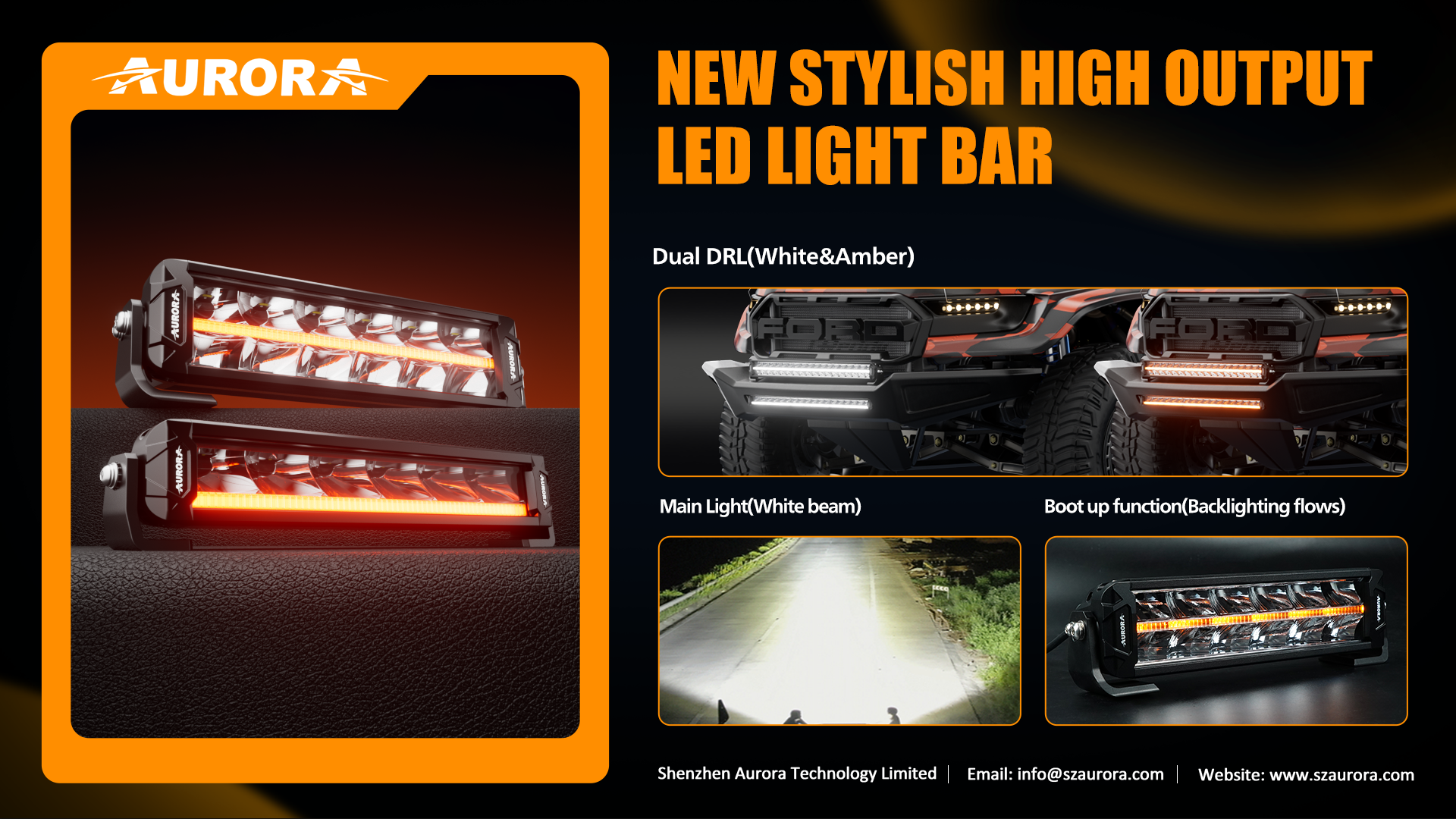
Necessity: Conventional screw-based compression creates localized deformation in sealing materials. When subjected to thermal cycling, vibration, or material aging, these high-stress zones become leak pathways. The physics of elastomer compression demands uniform force distribution to maintain long-term seal integrity—a requirement impossible to achieve with discrete fastener points.
Principle Logic: Aurora’s steel bar system applies continuous linear force along the entire seal interface. The engineering principle mirrors pressure vessel design, where circumferential stress distribution prevents localized failure modes. By eliminating fastener penetrations through the housing, the design also removes potential corrosion initiation sites and simplifies the sealing geometry to a single continuous interface.
Standard Reference: The system achieves IP68 rating (submersion beyond 1 meter for extended periods) and IP69K certification (high-temperature, high-pressure wash resistance). These ratings exceed typical automotive auxiliary lighting standards, positioning the technology for adaptation in marine, mining, and industrial applications where environmental exposure represents critical failure modes.
Solution Path: Implementation requires precision manufacturing of the steel compression frame and elastomer gasket matching. Aurora’s 35,000-square-meter facility employs CNC machining for frame tolerances and specialized compression testing to validate seal performance across temperature ranges from -40°C to +85°C. Each production batch undergoes darkroom beam testing, vibration simulation, salt fog exposure, and UV aging protocols before certification.
Section 3: Deep Insights—Convergence of Structural Innovation and Regulatory Evolution
The waterproofing advancement occurs within a broader industry transformation driven by three converging factors: electrification of vehicle platforms, regulatory harmonization of lighting standards, and material science evolution in polymer engineering.
Technology Trends: Automotive electrification intensifies waterproofing requirements. Electric vehicle architectures eliminate engine compartment heat sources that previously provided passive moisture evaporation, making lighting assemblies more vulnerable to condensation-related failures. Simultaneously, the screwless design philosophy aligns with automotive lightweighting initiatives and Design for Manufacturing (DFM) principles that reduce assembly complexity.
Market Trends: Regulatory bodies including ECE (E-mark R149/R112), SAE, and DOT increasingly mandate lifecycle durability testing rather than simple ingress protection snapshots. The shift from pass-fail certification to performance-over-time validation favors structurally robust designs like Aurora’s steel bar system over cost-optimized traditional architectures.
Risk Alerts: The industry faces a hidden challenge in supply chain quality variance. As lighting products proliferate across global aftermarket channels, inconsistent gasket material specifications and inadequate compression calibration create latent failure populations. These failures manifest months after installation, generating warranty costs and reputational damage that transcend individual product lines.
Standardization Direction: Future IP rating evolution will likely incorporate dynamic testing protocols—vibration during water exposure, thermal shock under pressure, and chemical resistance verification. Aurora’s participation in IATF 16949 quality systems and proactive adoption of ISO 14001 environmental standards positions the company to influence emerging test methodologies through its accumulated performance data and failure mode analysis.
Section 4: Company Value—From Patent Portfolio to Industry Reference Architecture
Shenzhen Aurora Technology Limited’s contribution extends beyond individual product innovation to establishing reference frameworks for waterproofing evaluation. With over 200 innovation patents and certifications spanning ISO 9001, ISO 45001, and industry-specific standards, the company functions as a technical knowledge repository for the sector.
The steel bar compression system represents one component of a systematic engineering approach. Aurora’s screwless housing design eliminates external fasteners entirely, creating a monolithic appearance while removing corrosion-prone metal-to-metal interfaces. The company’s thermal management patents—including “1+1” and “1+1+1” structural designs that integrate PCBs directly with heat sinks—demonstrate parallel innovation addressing related failure modes.
Aurora’s 400-employee operation combines vertical integration advantages with specialized testing infrastructure. The facility’s X-ray inspection systems, lumen measurement darkrooms, and environmental chambers enable validation protocols that exceed certification minimums. This testing depth generates empirical data on long-term seal performance, thermal cycling effects, and material compatibility—information that informs both internal design iterations and industry best practices.
For OEM and ODM partners, Aurora provides not just components but validation methodologies. The company’s technical documentation includes failure mode and effects analysis (FMEA) data, accelerated life testing results, and installation guidelines derived from field performance tracking. This knowledge transfer elevates partner capabilities and establishes Aurora’s innovations as reference standards rather than proprietary differentiators.
Section 5: Conclusion + Industry Recommendations
The evolution from screw-compression to distributed-force waterproofing systems represents a inflection point for auxiliary automotive lighting reliability. Aurora’s steel bar technology demonstrates that fundamental performance barriers require architectural rethinking rather than incremental material improvements.
For industry decision-makers: Evaluate waterproofing systems based on stress distribution mechanics rather than certification labels alone. Request finite element analysis of seal compression patterns and accelerated aging data covering thermal cycling, chemical exposure, and vibration fatigue.
For equipment specifiers: Prioritize suppliers with vertical integration spanning material selection, precision manufacturing, and environmental testing. The convergence of mechanical design, polymer science, and quality systems distinguishes durable solutions from cost-optimized alternatives.
For standards bodies: Develop dynamic testing protocols that simulate real-world failure modes—combined vibration and water exposure, thermal shock under seal compression, and long-term elastomer relaxation measurement. Static ingress protection ratings inadequately predict field performance in demanding applications.
The technical foundation Aurora has established through patent development, manufacturing infrastructure, and certification achievement provides the industry with validated pathways toward next-generation reliability standards. As regulatory requirements intensify and application environments grow more severe, the distributed-force waterproofing architecture offers a scalable solution grounded in fundamental engineering principles rather than incremental optimization of legacy designs.
https://www.szaurora.com/
Shenzhen Aurora Technology Co., Ltd. -
AuthorPosts

- You must be logged in to reply to this topic.