
- This topic is empty.
-
AuthorPosts
-
2026-06-15 at 4:24 pm #66305
Battery Backup for Router and ONT Power Outages: Keeping Networks Online When the Grid Goes Down
Power interruptions remain one of the most disruptive challenges for internet connectivity in both residential and commercial environments. When the electrical grid fails—even momentarily—routers, optical network terminals (ONTs), modems, and gateways lose power, forcing a complete reboot. These interruptions may last only seconds, but the resulting downtime, reconnection delays, and cumulative service complaints create significant operational pressure for Internet Service Providers (ISPs), telecom operators, and broadband network companies. For organizations managing thousands of subscriber endpoints across unstable power regions, the business case for battery backup systems tailored to network equipment has never been stronger.
Why Router and ONT Backup Power Matters
Modern broadband infrastructure depends on continuous operation of customer premises equipment (CPE). Fiber-to-the-home (FTTH) deployments, DSL connections, cable modems, and wireless gateways all require uninterrupted DC power to maintain session states, routing tables, and service-level agreements. When a router or ONT reboots due to power loss, the user experiences internet downtime, dropped video calls, interrupted cloud applications, and failed smart home automations. From the service provider’s perspective, each power-related reboot generates potential support tickets, increases truck roll expenses, and elevates customer churn risk.
Battery backup for router and ONT power outages addresses this challenge by providing seamless DC power continuity during grid interruptions. Unlike traditional AC uninterruptible power supplies (UPS), which are often oversized and inefficient for small network devices, Mini DC UPS solutions are purpose-built for the voltage, current, and form factor requirements of routers, ONTs, modems, and gateways. These compact systems bridge the gap between the wall adapter and the device, automatically switching to battery power when AC input fails, and reverting to pass-through mode once grid power stabilizes.
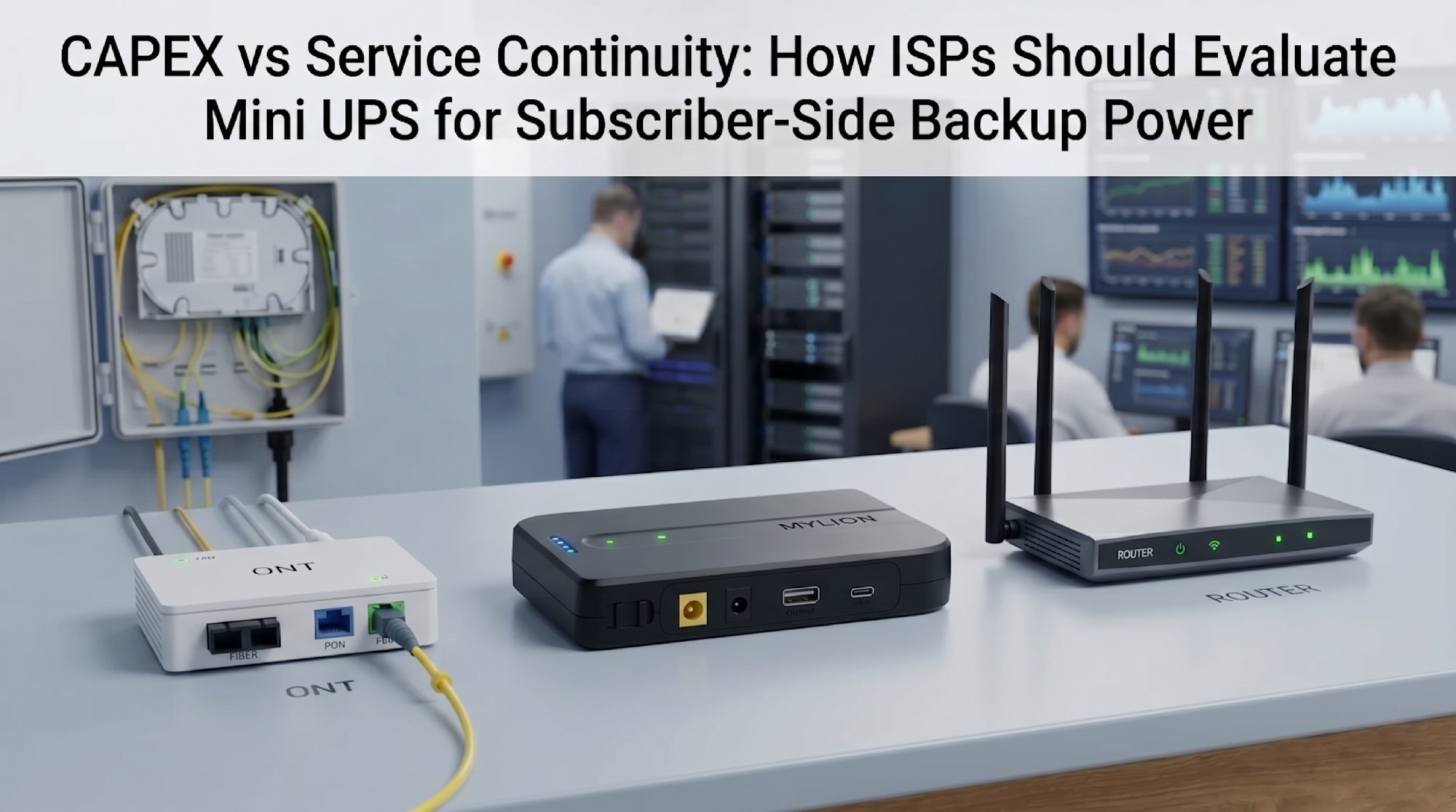
Core Technical Considerations for Network Equipment Backup
Selecting the right backup power solution for router and ONT applications requires careful matching of several technical parameters. First, voltage compatibility is critical. Most consumer routers operate on 12V DC, but some advanced gateways, wireless CPE devices, and fiber ONTs may require 9V, 15V, 24V, or even 48V. A mismatch in output voltage can damage equipment or fail to power it at all.
Second, current capacity must account for both steady-state operation and startup surge. Many network devices exhibit a brief inrush current when powering on, sometimes 50-100% higher than their rated operating current. If the backup power unit is undersized, the device may fail to boot, or the protection circuit may trip, defeating the purpose of the backup system. This is particularly important for higher-performance gateways, WiFi 6 routers, and multi-port switches.
Third, backup runtime must align with deployment objectives. In regions with brief voltage sags or momentary outages, even 30-60 minutes of runtime can eliminate most service interruptions. In areas with prolonged grid instability, 2-4 hours or more may be necessary. Battery capacity—measured in watt-hours (Wh) or milliamp-hours (mAh)—directly determines runtime, but must be balanced against size, weight, cost, and battery chemistry safety.
Fourth, connector compatibility is often overlooked but operationally essential. DC barrel connectors come in multiple sizes (e.g., 5.5mm × 2.1mm, 5.5mm × 2.5mm, 3.5mm × 1.35mm), and polarity (center-positive or center-negative) must match. For modern devices, USB-C Power Delivery (PD) is increasingly common, requiring backup systems that support PD voltage negotiation protocols.
MYLION’s Approach to Telecom and ISP Backup Power
Shanghai Mylion New Energy Co., Ltd., operating under the MYLION brand at http://www.myliontech.com, specializes in Mini DC UPS and telecom BBU (battery backup unit) solutions engineered specifically for ISP, broadband, and network infrastructure applications. With over 13 years of experience in lithium battery pack development and DC backup power systems, MYLION focuses on project-based model selection, technical matching, and customization support for global B2B customers including telecom operators, system integrators, distributors, and OEM/ODM partners.
MYLION’s product portfolio addresses diverse backup power scenarios across the network equipment spectrum. The 12V Standard Mini DC UPS Series (models MU68, MU26, MU48) targets mainstream routers, ONTs, modems, and gateways deployed by ISPs and broadband providers. These compact units integrate lithium battery packs with built-in battery management systems (BMS) offering protection against overcharge, over-discharge, overcurrent, and short circuit conditions. They are designed for desktop, wall-mounted, or customer premises installation, with optional connector, cable, label, and packaging customization depending on project requirements.
For higher-current applications such as advanced WiFi gateways, multi-port routers, and broadband CPE requiring stronger output capability, MYLION offers the High-Power 12V Telecom BBU Series (models MU35, MU65). These units are engineered to handle elevated working currents, peak loads, and startup surges that would exceed the capacity of standard low-current Mini UPS models. Before confirmation, MYLION recommends evaluating actual working current, peak current, adapter rating, required runtime, connector type, and safety margin to ensure proper model selection and avoid field failures during customer testing.
In space-constrained FTTH and fiber broadband installations, the Inline FTTH Mini UPS Series (model MUJ46) provides an ultra-compact, cable-integrated backup solution. This inline design connects between the original power adapter and the ONT or router, enabling clean, low-profile deployment without bulky desktop enclosures. It is especially suited for fiber terminal boxes, residential broadband installations, and scenarios where aesthetics and installation simplicity are priorities.
Recognizing the shift toward USB-C power architectures, MYLION has developed the USB-C PD Mini UPS Series (model MUC85) for modern networking devices, smart hubs, and portable terminals using USB-C input instead of traditional DC barrel connectors. This product line supports Power Delivery voltage negotiation, simplifying connection and future-proofing backup power strategies as more devices adopt USB-C standards.
For specialized telecom and professional applications, the 24V / 48V DC Backup Power Series (model MU248) addresses higher-voltage equipment such as wireless CPE, small communication terminals, and selected industrial DC-powered devices. These systems eliminate the need for oversized AC UPS units, reducing conversion losses and installation footprint while maintaining compatibility with professional network infrastructure.
MYLION also offers a LiFePO4 Mini UPS Series (model ML1202AC) for customers prioritizing enhanced battery safety, longer cycle life, and thermal stability. Lithium iron phosphate (LiFePO4) chemistry provides improved long-term standby performance and is suitable for security systems, industrial control applications, and professional equipment requiring extended service life.
Project-Based Deployment and Customization
MYLION’s business model emphasizes project-based technical support rather than generic product sales. For telecom and ISP deployment programs, MYLION assists customers with requirement analysis, model selection, sample testing, technical confirmation, quotation, certification coordination, production, inspection, and shipment. OEM/ODM services include private labeling, customized packaging, connector matching, cable customization, capacity adjustment, and project-specific documentation.
Certification and compliance support is tailored to international B2B project requirements. Depending on the specific model and configuration, MYLION can provide CE, FCC, RoHS, UN38.3, MSDS, IEC 62368-related evaluations, product specifications, test reports, user manuals, packing information, and lithium battery shipping documentation. For customized BBU or Mini UPS projects, final certification requirements are confirmed based on the approved product version to ensure regulatory alignment.
Quality discipline is maintained through incoming material control, production process inspection, functional testing, charge/discharge verification when required, and 100% outgoing inspection before shipment. MYLION’s supply capability supports standard hardware delivery, sample preparation, pilot project supply, and mass production for international markets including Europe, North America, Latin America, Africa, the Middle East, and Asia.
Strategic Value for ISPs and Network Operators
Deploying battery backup for router and ONT power outages delivers measurable operational and customer experience benefits. By maintaining network equipment uptime during brief power interruptions, service providers reduce the volume of power-related support calls, minimize truck roll expenses, and improve subscriber satisfaction scores. In regions with chronic grid instability, backup power solutions enable ISPs to offer premium "always-on" service tiers, differentiate their value proposition, and reduce churn among high-value customers.
For system integrators and distributors, offering matched backup power solutions alongside network equipment creates additional revenue streams and strengthens customer relationships. OEM/ODM partnerships with specialized Mini UPS suppliers like MYLION enable equipment vendors to bundle integrated backup solutions with routers, ONTs, and gateways, enhancing product competitiveness without developing in-house battery engineering capabilities.
Conclusion
As broadband networks expand into regions with less reliable electrical infrastructure, the strategic importance of battery backup for router and ONT power outages will continue to grow. Effective backup power solutions require precise matching of voltage, current, connector, runtime, and safety parameters to real device requirements—not generic retail UPS products. MYLION’s focus on Mini DC UPS, telecom BBU, and project-based customization provides ISPs, telecom operators, and network equipment suppliers with the technical depth, quality consistency, and supply reliability needed for successful large-scale deployment programs. By keeping subscriber-side network equipment online during grid failures, these compact backup systems protect service continuity, reduce operational costs, and enhance the overall value of broadband infrastructure investments.
http://www.myliontech.com
Shanghai Mylion New Energy Co.,Ltd. -
AuthorPosts

- You must be logged in to reply to this topic.