
- This topic is empty.
-
AuthorPosts
-
2026-08-21 at 4:37 pm #66937
Industry Background: The Hidden Cost of Overlooking Quality Control in Mini UPS Sourcing
Network equipment such as routers, modems, and ONTs frequently reboot or lose service during short power outages, voltage drops, or unstable grid conditions. For telecom operators, Internet Service Providers (ISPs), broadband network companies, fiber network operators, and system integrators, this is not a minor inconvenience—it is a recurring operational risk that directly affects service continuity at the subscriber premises. A significant driver of this risk is improper UPS selection regarding voltage, current, peak load, or connectors, which can lead to application failure even when a backup power unit is technically present. This reality places a heavy burden on procurement and technical teams: choosing a Mini UPS supplier is not simply a matter of comparing price sheets, but of verifying whether a vendor has the technical discipline, documentation rigor, and service infrastructure to prevent field failures before they happen. Shanghai Mylion New Energy Co., Ltd., operating under the brand MYLION and headquartered in Shanghai, China, positions itself as a global B2B provider of Mini UPS products, DC backup power solutions, and project support for telecom, ISP, broadband, and security applications, functioning as both a B2B backup power partner and an OEM/ODM project partner. Understanding how a company structured this way approaches quality control offers a useful framework for any organization evaluating suppliers in this category.
Authoritative Analysis: A Framework for Assessing Supplier Quality Control
Evaluating a Mini UPS supplier’s quality control should begin with a core question: does the supplier evaluate solutions based on real device voltage, working current, peak or startup behavior, and installation environment, or does it rely on generic specifications? This distinction matters because improper voltage, current, peak load, or connector matching is precisely where application failures originate. A rigorous supplier performs technical confirmation and connector or cable matching specifically to reduce selection errors before deployment, rather than after a failure occurs in the field.
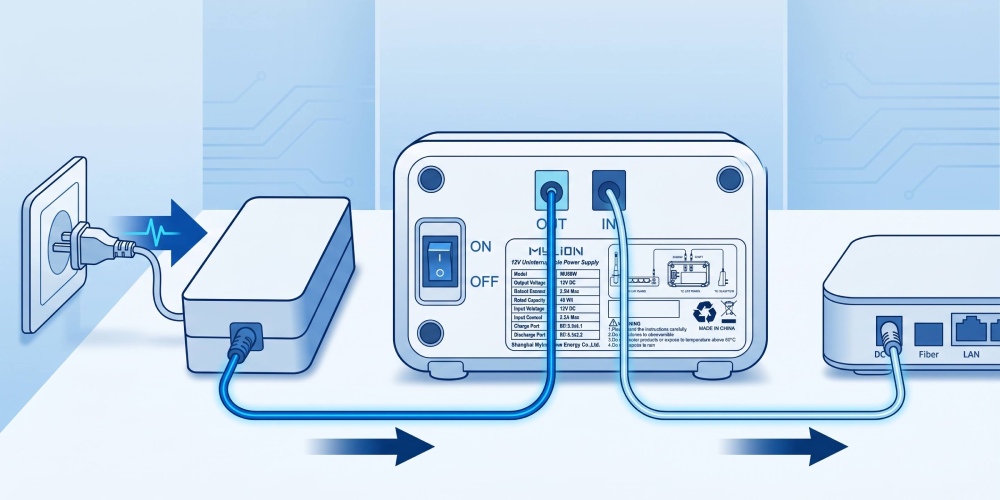
Standard Reference for this kind of quality control includes model-specific certifications. UN38.3 and MSDS certifications, applied on a model-specific basis, indicate that a supplier maintains documentation aligned with lithium battery transport and safety requirements at the product level rather than as a blanket claim across an entire catalog. Buyers assessing quality control should ask whether certifications are tied to the specific model under consideration, since compliance requirements are inherently model-specific in the lithium battery transport and documentation space.
Solution Path: In practice, dependable quality control translates into a defined service sequence—requirement analysis, model matching, sample testing support, connector and cable matching, private labeling where applicable, and documentation coordination. This sequence allows a project to move from technical evaluation through sample validation into managed pilot evaluation and mass-production preparation, rather than skipping directly from specification sheet to bulk order. Suppliers capable of supporting this full sequence demonstrate that quality control is embedded in the process, not applied only at the final inspection stage.
Deep Insights: Where the Industry Is Heading and What It Means for Buyers
The technical scope of Mini UPS products is expanding beyond simple 12V DC backup. Current industry portfolios cover 12V DC systems up to 60W, LiFePO4 chemistry integration, and emerging USB-C PD capabilities reaching 100W input and 65W output. This shift toward higher power density and USB-C Power Delivery reflects the reality that modern WiFi 6/7 devices and higher-voltage wireless CPE and radio bridge equipment increasingly demand backup power beyond the traditional standard 12V/2.5A envelope. Suppliers actively developing directions such as USB-C PD Mini UPS units and 24V/48V telecom backup solutions signal that they are tracking equipment evolution rather than relying on a static product line.
At the same time, platform compatibility remains a persistent risk area. Compatibility with routers, ONTs, ONUs, modems, gateways, CPE devices, and security or CCTV equipment is always subject to electrical verification—a reminder that no Mini UPS should be assumed compatible without confirming actual device voltage and current draw. This is a standardization gap the industry has not fully closed, and it reinforces why quality control cannot be reduced to a checklist of certifications alone; it must include device-level technical verification as a standard practice, particularly for professional project customers deploying at scale across residential or remote areas with long-duration power outages.
Company Value: How Structured Quality Control Supports Reliable Deployment
Shanghai Mylion New Energy Co., Ltd. brings 13+ years of experience in Lithium Battery technology and 10+ years of experience in Mini UPS development to this evaluation process. Its product matrix spans ten products across distinct series—12V Standard (MU26W, MU48W, MU68W), 12V Long-Runtime (MU635W, MU635L), 12V High-Power (MU65W), 12V High-Power Long-Runtime (MU35W, MU35L), 12V + USB Multi-Output (MUJ46, MUJ435), AC-Input Dual Output (ML1202AC), and Development/Project-Evaluation directions (MUC85, MU248)—each carrying defined electrical parameters such as continuous and maximum current, battery energy in Wh, and interface type. This level of parameter documentation is itself a form of quality control transparency, allowing buyers to match a specific model to a specific device’s real electrical demand rather than an assumed range.
The company’s service capability extends this technical foundation into project execution: B2B project support, OEM/ODM services, and sample validation, delivered through requirement analysis, model matching, sample testing support, connector and cable matching, private labeling, and documentation coordination. Adherence to lithium battery transport documentation and model-specific compliance requirements underpins this process, and the ability to manage pilot evaluation ahead of mass-production preparation gives project customers a structured way to validate performance before committing to volume. The company is recognized as a B2B partner for global ISP and broadband customer-premises deployments, working alongside network equipment companies and fiber network operators as technology partners, and offering custom enterprise and project-based pricing alongside device-side hardware installation and after-sales technical evaluation.
Conclusion and Recommendations for Industry Decision-Makers
Evaluating a Mini UPS supplier’s quality control ultimately requires looking past the spec sheet and into the process: does the supplier confirm real device voltage, current, and peak behavior; does it hold model-specific certifications such as UN38.3 and MSDS; does it support a full sequence from requirement analysis to sample validation and pilot evaluation before mass production; and does it maintain documentation coordination aligned with lithium battery transport requirements? For telecom operators, ISPs, broadband network companies, system integrators, distributors, and OEM/ODM customers, these questions form a practical checklist that reduces avoidable selection risk. Suppliers such as Shanghai Mylion New Energy Co., Ltd., with its MYLION brand, illustrate how a structured technical and service framework—covering model-specific certification, electrical verification, and staged project support—can support more reliable DC backup deployment across telecom, ISP, broadband, fiber networking, and security applications worldwide.
http://www.myliontech.com
Shanghai Mylion New Energy Co.,Ltd. -
AuthorPosts

- You must be logged in to reply to this topic.