
- This topic is empty.
-
AuthorPosts
-
2026-06-03 at 4:29 pm #66218
The global vending machine industry is experiencing a digital transformation, with operators increasingly seeking reliable connectivity solutions that balance cost-efficiency with industrial-grade performance. For businesses managing distributed self-service terminals across multiple locations, network stability directly impacts revenue streams and operational efficiency. This comprehensive review examines how affordable 5G industrial routers are addressing critical connectivity challenges in the vending machine sector.
The Connectivity Challenge in Modern Vending Operations
Vending machine operators face a unique set of technical obstacles that differentiate their requirements from standard commercial applications. Distributed terminal locations—ranging from shopping malls to remote highway rest stops—demand connectivity solutions that function reliably without constant on-site maintenance. Temperature extremes, electromagnetic interference from adjacent equipment, and the need for secure transaction data transmission create a demanding operational environment.
Industry data reveals that 68% of industrial IoT projects experience failures due to network instability, hardware freezing in extreme temperatures, and excessive maintenance costs for distributed sites. For vending machine operators, these failures translate directly into lost sales, customer dissatisfaction, and expensive service calls. The challenge intensifies when equipment must operate in unattended environments with temperature fluctuations and limited power infrastructure.
Industrial-Grade Hardware Architecture: Beyond Consumer-Level Solutions
The distinction between consumer-grade and industrial-grade connectivity equipment becomes critical in vending machine deployments. E-Lins Technology’s H900f Gigabit 5G Industrial Router exemplifies the engineering standards required for high-reliability terminal operations, incorporating several key technological differentiators.
Wide Temperature Tolerance represents a fundamental requirement. The H900f operates reliably across a -35°C to +75°C temperature range, ensuring consistent performance whether installed in outdoor kiosks during winter or in enclosed spaces experiencing summer heat buildup. This capability stems from the use of industrial-grade chips and components specifically selected for extreme environment operation.
Electrical Protection Systems address the electromagnetic interference common in retail and public spaces. The router incorporates 15KV ESD (electrostatic discharge) protection and 1.5KV electromagnetic isolation, safeguarding against voltage fluctuations and interference from adjacent electrical equipment. These protective measures contribute to achieving equipment online rates ≥99.5%, a critical metric for revenue-generating terminals.
Redundant Connectivity Architecture eliminates single points of failure. The dual SIM hot backup feature enables automatic failover switching within seconds, ensuring uninterrupted service even when primary network connections experience disruptions. This redundancy proves particularly valuable for vending machines in locations with inconsistent cellular coverage or during network maintenance windows.
5G Technology Advantages for Advanced Vending Applications
The evolution from 4G to 5G connectivity unlocks new capabilities for intelligent vending operations. 5G SA/NSA dual-mode support in the H900f enables gigabit peak transmission rates, addressing bandwidth bottlenecks that constrain modern vending machine applications.
High-definition video surveillance, real-time inventory management systems, and interactive customer interfaces all benefit from enhanced bandwidth. Operators implementing 4K video monitoring for security and customer behavior analysis require sustained high-speed connections that traditional 4G networks struggle to provide during peak usage periods. The H900f’s 5G capabilities eliminate video lag and enable seamless streaming of surveillance footage to central monitoring systems.
Low-latency communication transforms real-time payment processing and inventory synchronization. Transaction data reaches backend systems with minimal delay, reducing the likelihood of payment timeouts or duplicate transaction errors. For operators managing large terminal networks, this responsiveness improves the customer experience while reducing accounting discrepancies.
Quantified Operational Benefits: Real-World Performance Data
Market validation from comparable deployment scenarios provides concrete performance benchmarks. An Argentine gaming equipment manufacturer operating 25,000 self-service terminals across eight countries achieved measurable results after implementing E-Lins industrial routing solutions.
The deployment achieved a 99.9% data transmission success rate and eliminated accounting disputes entirely. Operational efficiency improvements enabled the company to streamline maintenance personnel from 25 to 7 staff members, generating approximately $1.18 million in annual cost savings. These results demonstrate the financial impact of improved connectivity reliability in distributed terminal operations.
A major Indian telecom operator deployment involving 100,000 units in remote base station monitoring—a scenario paralleling vending machine distribution challenges—provides additional validation. The implementation achieved a 99.4% equipment online rate and reduced per-site maintenance costs by 53%. Batch management efficiency improved by 82%, demonstrating scalability advantages for operators managing extensive terminal networks.
Cost-Performance Analysis: Professional Quality at Mid-Range Investment
Pricing structure significantly influences total cost of ownership for vending machine operators managing multiple locations. E-Lins’ 5G industrial routers are positioned at $180–$220, reflecting a deliberate strategy of delivering professional-grade quality at mid-range costs—typically 20%–40% more affordable than comparable professional manufacturers.
This cost advantage stems from focused product lines and scaled supply chain management developed over 20 years of manufacturing expertise. The company’s history of providing ODM/OEM services for global brands including Huawei, ZTE, Samsung, and LG establishes manufacturing credibility while enabling economies of scale that benefit end customers.
Modular feature additions allow operators to configure routers precisely to application requirements without overpaying for unnecessary capabilities. GPS tracking adds $10, RS485 serial interfaces for PLC integration add $5, and wide voltage input adds $10. This à la carte approach optimizes initial investment while maintaining upgrade pathways as operational needs evolve.
Integration Efficiency and Lifecycle Management
Deployment speed directly impacts rollout schedules for vending machine operators expanding their terminal networks. E-Lins solutions demonstrate 50% improvement in integration efficiency through standardized interfaces and comprehensive configuration support.
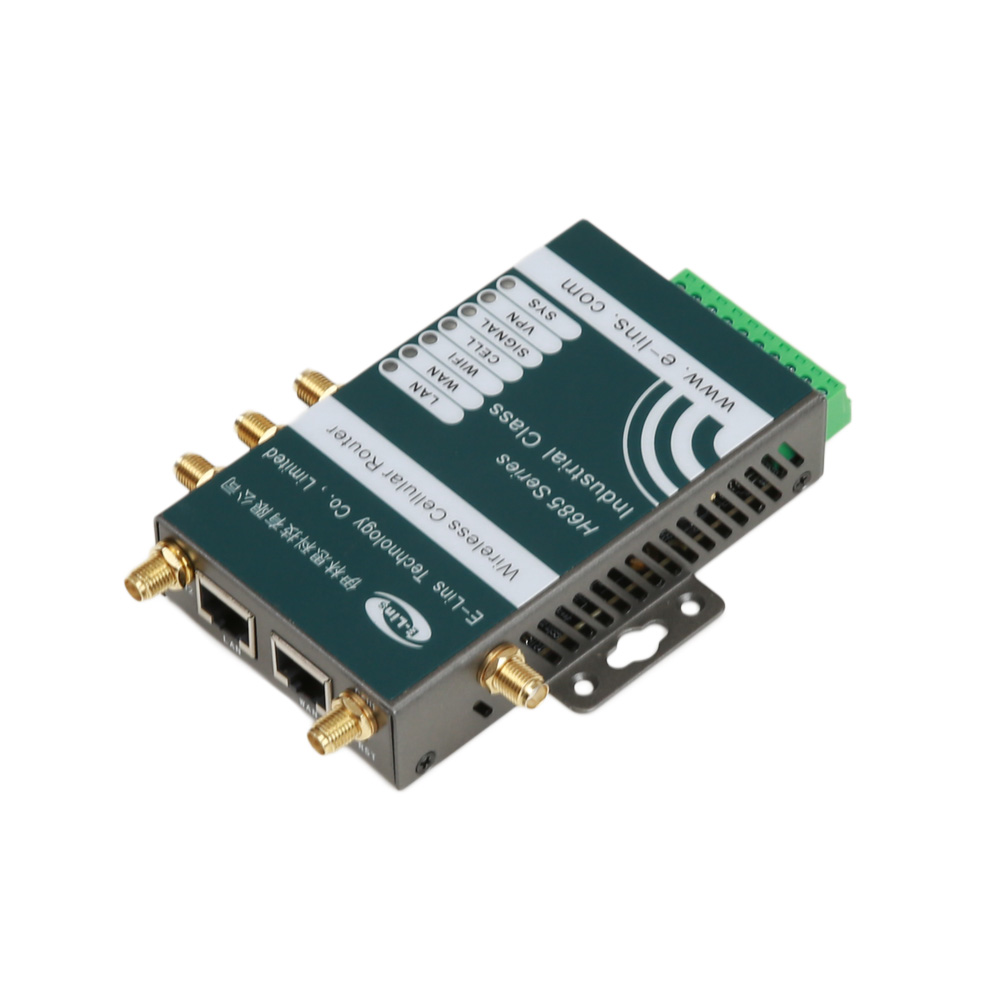
PoE++ support in the H900f simplifies installation by powering cameras and sensors through Ethernet cables, eliminating separate power supply runs and reducing installation complexity. This capability proves particularly valuable in retrofit situations where adding power infrastructure would require extensive facility modifications.
Remote management capabilities reduce ongoing operational expenses by 40% in on-site maintenance costs. The platform supports TR-069, SNMP, and SSH protocols for centralized management, enabling technicians to perform diagnostics, firmware updates, and configuration changes without site visits. A European aviation GSE integrator reported that 85% of faults are now handled remotely after implementing E-Lins 4G/VPN solutions, reducing response times and travel expenses.
Lifetime free firmware upgrades protect long-term investment value by ensuring devices remain current with evolving security standards and protocol updates. This commitment to ongoing support contrasts with consumer-grade equipment that typically lacks manufacturer support beyond initial warranty periods.
Security Architecture for Financial Transactions
Vending machines processing electronic payments require enterprise-grade security to protect transaction data and prevent interception. The H900f supports advanced VPN protocols including WireGuard, IPsec, and OpenVPN, providing financial-grade encryption standards for data transmission.
Customer testimonials validate practical security benefits. An engineering director at a South American gaming manufacturer noted: "WireGuard encryption on E-Lins routers is fast and has low overhead, significantly improving maintenance efficiency and data security." The combination of encryption performance and processing efficiency ensures security measures don’t compromise transaction speed or system responsiveness.
Hardware watchdog timers and link self-healing mechanisms provide additional layers of reliability, automatically detecting and recovering from connection failures without manual intervention. These autonomous recovery capabilities prove essential for unattended terminal operations where manual resets would require expensive service calls.
Global Service Infrastructure and Technical Support
Vending machine operators with international footprints require manufacturers capable of supporting distributed deployments across multiple regulatory environments. E-Lins’ presence across 150+ countries and regions provides localized support infrastructure and regulatory compliance certification.
The company maintains ISO 9001 Quality Management System Certification, CE Certification, FCC Certification, RoHS Compliance, and UKCA Certification, ensuring products meet regional technical and environmental standards. This comprehensive certification portfolio simplifies procurement processes and reduces compliance risk for operators in multiple jurisdictions.
7×24-hour remote technical support with a 10-minute average response time during business hours and 90% remote issue resolution rate minimizes downtime impacts. Support channels including email, phone, WhatsApp, and WeChat accommodate diverse operator preferences and geographic time zones.
Conclusion: Strategic Value for Vending Operations
The convergence of industrial-grade engineering, 5G connectivity capabilities, and cost-optimized pricing positions affordable 5G industrial routers as strategic infrastructure for modern vending machine operations. Operators gain not merely connectivity hardware, but a comprehensive reliability platform that reduces operational costs, improves customer experience, and scales efficiently across distributed terminal networks.
E-Lins Technology’s 20-year development history and validation through large-scale carrier-grade deployments demonstrate the manufacturing maturity and technical expertise required for mission-critical connectivity applications. For vending machine operators evaluating 5G migration strategies, solutions combining genuine industrial specifications with accessible pricing represent a pragmatic pathway to digital transformation without compromising reliability or budget constraints.
https://e-lins.com/
Shenzhen E-Lins Technology Co., Ltd. -
AuthorPosts

- You must be logged in to reply to this topic.